How Long Do Fiber Supplements Take to Work?
The short answer, by goal: for regularity, expect something within 12 to 72 hours of your first proper dose, and expect it to take one to two weeks to settle into a predictable pattern. For bloating and gas to calm down after starting, give it one to two weeks of a steady dose. For cholesterol, the relevant trials run weeks to months, so judge it on a lipid panel rather than on how you feel. And for blood sugar, the effect is per-meal and immediate — fiber taken with food slows the rise from that meal rather than building up over time. A fiber supplement is not a laxative, which is the single most useful thing to understand about the timeline. Bulk-forming fiber such as psyllium works by absorbing water and forming a gel, which makes stool bulkier, softer and easier to move; that is a gradual mechanical change rather than a chemical trigger, so the first dose is rarely the dose you notice. The classic failure pattern is to take one serving, see nothing by the next morning, double up, and end up gassy and bloated and convinced fiber does not agree with you. The fix is the opposite of intuition: start low — half a teaspoon of psyllium a day — hold it for several days, drink a full glass of water with every dose, and only increase once the current dose feels unremarkable. Our pick for most people is Metamucil Psyllium Husk powder, precisely because the powder lets you dose in small increments, which is what makes the first two weeks survivable. If psyllium has already defeated you, Sunfiber is the gentler, flavorless, low-FODMAP alternative.
Affiliate disclosure: Trusted Health Gear is an Amazon Associate. If you buy through links on this page, we may earn a commission at no extra cost to you. Commission does not influence our rankings. Full policy.
The realistic timeline, goal by goal
Regularity is the fastest and the most variable. Psyllium absorbs water in the gut and forms a gel, and because normal transit time from stomach to toilet runs roughly a day or two, the earliest you would reasonably see an effect is around 12 hours and the common range is 12 to 72 hours after a proper dose. But a single bowel movement is not the outcome you are after; what you want is a predictable pattern, and that typically takes one to two weeks of consistent daily dosing to establish. Gas and bloating after starting follow their own curve: fermentable fibers feed gut bacteria, the bacteria produce gas, and the microbiome adapts over one to two weeks, which is why the discomfort usually peaks early and then fades. Cholesterol works on a completely different timescale. The trials behind the FDA's authorised claim linking soluble fiber from psyllium husk to reduced coronary heart disease risk run for weeks, so the honest advice is to take a consistent dose for at least six to twelve weeks and then measure a lipid panel. Blood sugar is the outlier: a soluble fiber taken with a meal slows gastric emptying and carbohydrate absorption from that meal, so the effect is immediate and does not accumulate.
Why starting low is faster than starting high
This sounds backwards, so here is the mechanism. The uncomfortable part of starting fiber is fermentation — gut bacteria metabolising the fiber and producing gas — and the amount of gas depends on both the dose and how well adapted your bacterial population is to that dose. Start at a full serving and you create a large fermentation load on an unadapted gut, which produces bloating, cramping and often enough discomfort that you stop. Start at a half-teaspoon and the same adaptation happens with far less to show for it, and after a few days you can step up. The people who get to a useful dose fastest are almost always the ones who started slowest, because they never had the week off that a bad first experience causes. A reasonable ramp for psyllium looks like this: a half to one teaspoon daily for the first three to five days, then increase by about half a teaspoon every three to five days until you reach the dose that does the job. There is no prize for arriving in two days, and the entire failure mode of this category is impatience in week one.
What we'd start with
Every pick below is already reviewed and scored in our roundups — same products, same specs, with live Amazon prices.
| Attribute | Metamucil Metamucil Psyllium Husk Fiber (Powder)Our pick | Tomorrow's Nutrition Sunfiber (Tomorrow's Nutrition) — Partially Hydrolyzed Guar | NOW NOW Psyllium Husk Caps (500 mg) |
|---|---|---|---|
| Best for | Best overall — the most-studied psyllium, in a scalable powder | Best gentle, low-FODMAP option for sensitive guts | Best psyllium capsule — grit-free, from a trusted maker |
| Who it's for | For most people starting out, because the timeline depends on being able to dose in small increments. A powder lets you begin at half a teaspoon and step up every few days, which is the single biggest predictor of whether you are still taking it in week three. | For anyone whose first two weeks on psyllium were miserable, and for people managing IBS. Partially hydrolyzed guar gum is gentler, flavorless and dissolves clear, so there is no gel, no grit and far less fermentation discomfort to ride out. | For the person who will never stir a drink and so would otherwise take nothing. Capsules make consistency easy, which matters more than format purity — just take them with a genuinely full glass of water, not a mouthful. |
| Key specs | Psyllium husk soluble fiber powder · scalable dosing by the teaspoon · flavored and sugar-free options · the psyllium brand behind much of the clinical research · mixes into water | Partially hydrolyzed guar gum (PHGG) soluble fiber · flavorless, dissolves clear · marketed as low-FODMAP and gentle · prebiotic · mixes into any drink or food | Psyllium husk in capsules · 500 mg each · Non-GMO Project Verified · no grit or mixing · GMP-manufactured · take with a full glass of water |
| Our score | 8.6/10 | 7.9/10 | 8.3/10 |
| Where to buy |
Prices pulled from Amazon as of October 18, 2026 and are subject to change. The price shown on Amazon at checkout applies.
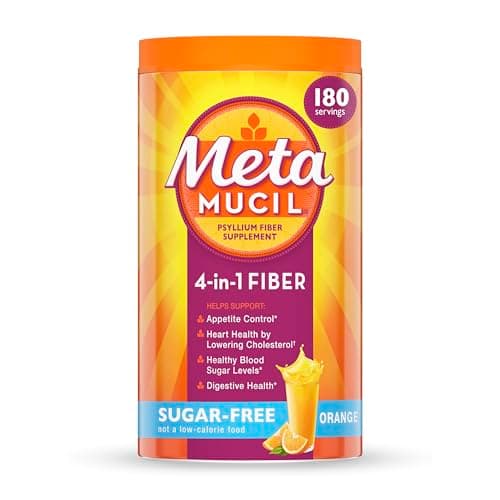
Metamucil — Metamucil Psyllium Husk Fiber (Powder)
For most people starting out, because the timeline depends on being able to dose in small increments. A powder lets you begin at half a teaspoon and step up every few days, which is the single biggest predictor of whether you are still taking it in week three.
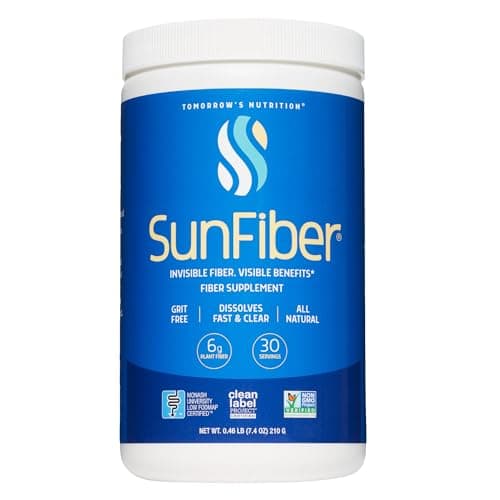
Tomorrow's Nutrition — Sunfiber (Tomorrow's Nutrition) — Partially Hydrolyzed Guar
For anyone whose first two weeks on psyllium were miserable, and for people managing IBS. Partially hydrolyzed guar gum is gentler, flavorless and dissolves clear, so there is no gel, no grit and far less fermentation discomfort to ride out.
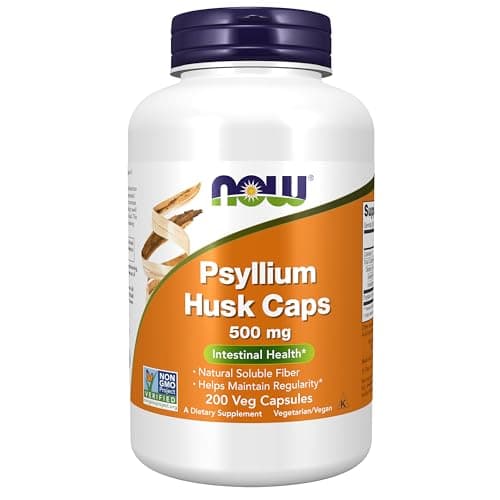
NOW — NOW Psyllium Husk Caps (500 mg)
For the person who will never stir a drink and so would otherwise take nothing. Capsules make consistency easy, which matters more than format purity — just take them with a genuinely full glass of water, not a mouthful.
The water is not optional, and it changes the timeline
Psyllium works by forming a gel, and the gel needs water. Taking psyllium with too little fluid produces the exact opposite of what you wanted — a denser, harder mass that is more difficult to pass, not less — which is the most common reason someone reports that fiber made their constipation worse. It is also the mechanism behind the rare but real choking and obstruction warnings on psyllium labels, which exist because dry psyllium swells quickly. So: a full glass of water per dose, not a sip, and keep general fluid intake up through the day rather than relying on the one glass. This applies with equal force to psyllium capsules, where the volume of water people take is usually much smaller — swallowing six capsules with a mouthful of water is the worst version of this. If you have increased your fiber and things have got harder rather than easier, the first thing to change is almost never the product; it is the water.
When it is not working, and what to change
Give any dose a genuine week before judging it, then work through this order. First, water — covered above, and the most common fix. Second, dose: many people are taking a token amount. The Institute of Medicine's adequate intake is 25 g of total fiber a day for adult women and 38 g for men, most US adults eat around 15 g, and a supplement serving providing 3-5 g is closing part of that gap rather than all of it. If one serving has done nothing after two weeks, two servings is the reasonable next step. Third, timing: taken with meals, soluble fiber does more for blood sugar and satiety; taken away from meals it is purely about bulk. Fourth, the fiber itself: if psyllium causes persistent bloating beyond the first fortnight, switch to a gentler soluble fiber such as partially hydrolyzed guar gum rather than abandoning fiber. Fifth, the obvious one that no supplement replaces: food. Beans, oats, berries and vegetables deliver fiber with potassium, magnesium and polyphenols attached, and a powder is a patch for the last few grams, not a substitute for the diet.
What should make you stop and see a clinician instead
A fiber supplement is an appropriate thing to try for ordinary sluggish regularity. It is not the right response to several specific signals, and this is where the right move is a clinician rather than a bigger scoop. Blood in the stool, unexplained weight loss, a persistent change in bowel habit that is new rather than long-standing, severe or worsening abdominal pain, vomiting, or constipation that does not respond to a sensible fiber-and-fluid trial over a few weeks all warrant medical assessment rather than a second tub. If you have a history of bowel obstruction, strictures, or swallowing difficulty, psyllium specifically is a product to clear with your clinician first, because of the swelling mechanism. Two practical interaction notes that affect timing rather than safety: separate your fiber dose from prescription medications by one to two hours, because psyllium's gel can slow absorption of some drugs; and separate it from an iron supplement by the same margin, since fiber and the phytates travelling with it blunt non-heme iron absorption. If you are pregnant, bulk-forming fiber is commonly the first option clinicians suggest for constipation — but start that conversation with yours rather than with an article.
Frequently asked questions
For regularity, usually 12 to 72 hours after a proper dose, with one to two weeks needed before the pattern becomes predictable. For the bloating and gas that often accompany starting, expect one to two weeks for your gut bacteria to adapt. For cholesterol, think in terms of six to twelve weeks and judge it on a lipid panel rather than on symptoms, since that is the timescale the trials behind the FDA's psyllium heart health claim used. For blood sugar, the effect is per-meal and immediate rather than cumulative. Bulk-forming fiber is not a laxative, so the first dose is rarely the dose you notice — which is why doubling up on day two is the classic mistake.
Related reading
Sources
- Dietary Reference Intakes for Energy, Carbohydrate, Fiber, Fat, Fatty Acids, Cholesterol, Protein, and Amino Acids — adequate intake for total fiber (25 g/day adult women, 38 g/day adult men) — Institute of Medicine / National Academies
- Health claims: soluble fiber from certain foods and risk of coronary heart disease (21 CFR 101.81) — the FDA-authorized psyllium husk claim and the trial basis for it — US Food and Drug Administration / eCFR
- Constipation — definition, management and when to seek medical assessment (bulk-forming fiber as first-line; warning signs) — National Institute of Diabetes and Digestive and Kidney Diseases
- Iron — Health Professional Fact Sheet (non-heme iron absorption and the inhibiting effect of phytate and fiber) — NIH Office of Dietary Supplements
- Product titles, fiber types, serving sizes, dosing instructions, live prices and availability for the supplements referenced — retrieved via the Amazon product data layer — Amazon product listing data, 2026
Metamucil — Metamucil Psyllium Husk Fiber (Powder)
$34.97 · on Amazon