Daily Protein Requirements: How Much Do You Actually Need?
The RDA for adults is 0.8 grams of protein per kilogram of body weight — a minimum to prevent deficiency, not an optimum for active adults. Current sports-nutrition literature supports 1.2-2.0 g/kg for active adults and up to 2.0-2.2 g/kg for strength-training athletes. Older adults appear to need more per kg (1.2-1.6 g/kg) due to anabolic resistance. The practical takeaway: most adults targeting fitness or muscle goals need meaningfully more than the RDA.
Affiliate disclosure: Trusted Health Gear is an Amazon Associate. If you buy through links on this page, we may earn a commission at no extra cost to you. Commission does not influence our rankings. Full policy.
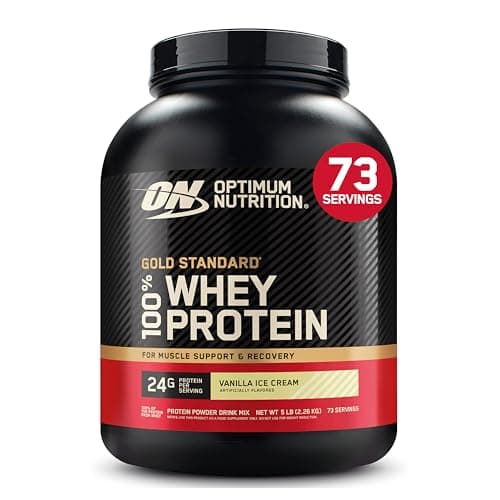
Optimum Nutrition — Gold Standard 100% Whey
Best for hitting the higher protein target aging actually demands
The RDA is a floor, not a target
The US RDA for protein is 0.8 g/kg/day. This was set to prevent nitrogen-balance deficiency in the general population, not to optimize muscle protein synthesis, recovery, or satiety. If you're sedentary and not trying to build or preserve muscle, the RDA is sufficient. If you're active, older, training for strength, or losing weight and trying to preserve lean mass, the research supports higher intakes.
What sports nutrition research supports
The 2017 International Society of Sports Nutrition position stand on protein concluded 1.4-2.0 g/kg/day is safe and effective for resistance-trained adults seeking to build or maintain lean mass. A 2022 meta-analysis in the British Journal of Sports Medicine found benefits plateau around 1.6 g/kg/day for most resistance-training outcomes, with some evidence for continued small benefits up to 2.2 g/kg/day in active training contexts.
Older adults need more per kg
Protein needs rise with age due to anabolic resistance — older muscle is less responsive to the same dose of protein. A 2013 PROT-AGE consensus recommended 1.2-1.6 g/kg/day for older adults, with 30-40g per meal to overcome the blunted response. Practically, someone 70 years old should not target the 0.8 g/kg RDA.
Calculation examples
A 70kg (154lb) sedentary adult: 70 × 0.8 = 56g/day (RDA). A 70kg recreationally-active adult: 70 × 1.4-1.6 = 98-112g/day. A 70kg strength-training athlete: 70 × 1.6-2.2 = 112-154g/day. A 70kg older adult: 70 × 1.2-1.6 = 84-112g/day. Weight-loss dieters need more (target the higher end) to preserve lean mass under calorie deficit.
Distribution matters — 3-5 meals of 25-40g
Muscle protein synthesis responds to discrete protein 'doses,' not just daily totals. Most research supports 3-5 meals per day of 25-40g protein each, each meal containing enough leucine (roughly 2.5-3g) to cross the synthesis-stimulating threshold. Three meals of 40g is more effective than one 120g meal for muscle protein synthesis.
Food vs powder
There's nothing special about protein powder other than convenience and cost. Whole-food protein (chicken, beef, fish, Greek yogurt, eggs, cottage cheese, tofu, tempeh) delivers the same amino acids with the benefit of micronutrients and satiety. Powder is a useful supplement for people struggling to hit targets from food, for post-workout convenience, or for budget reasons — not a requirement.
Optimum Nutrition — Gold Standard 100% Whey
Frequently asked questions
Track what you eat for a few days using a food log or app. If you're consistently under your target (0.8 g/kg for general health, 1.2-2.0 g/kg for training goals), increase your per-meal protein. Feeling less satiated than you'd like is also a common sign.
Related reading
Sources
- International Society of Sports Nutrition Position Stand: Protein and Exercise — JISSN, 2017
- A systematic review, meta-analysis and meta-regression of the effect of protein supplementation on resistance training-induced gains in muscle mass and strength — British Journal of Sports Medicine, 2022
- Evidence-based recommendations for optimal dietary protein intake in older people: a position paper from the PROT-AGE study group — JAMDA, 2013
Optimum Nutrition — Gold Standard 100% Whey
$90.90 · on Amazon