Ashwagandha Dosage: What the Research Actually Uses
Ashwagandha doses in research vary by extract: KSM-66 trials typically use 300-600 mg per day of a 5%-withanolide extract, taken once or twice daily. Sensoril trials typically use 125-250 mg per day of a 10%-withanolide root+leaf extract. Generic 'ashwagandha root powder' at 1-2 grams does not map cleanly to these extract doses — if you want to match the research, buy the specific extract the research used. Neither extract is objectively better — they have different clinical profiles.
Affiliate disclosure: Trusted Health Gear is an Amazon Associate. If you buy through links on this page, we may earn a commission at no extra cost to you. Commission does not influence our rankings. Full policy.
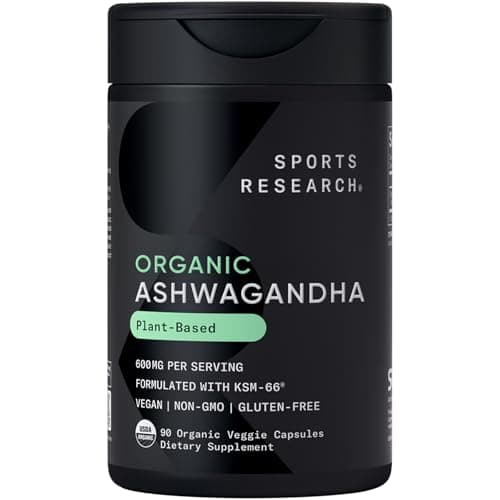
Sports Research — Sports Research Organic Ashwagandha (KSM-66)
Best certified KSM-66 from a reputable brand (Non-GMO, vegan, gluten-free)
Why extract identity matters more than milligrams
Ashwagandha is sold in many forms — bulk root powder, 'full-spectrum' tinctures, KSM-66, Sensoril, generic 5%-withanolide extracts, and others. They are not interchangeable at the milligram level. The published trials that support ashwagandha's anxiety, sleep, and strength benefits used specific standardized extracts at specific doses. A '500mg ashwagandha' capsule from an unspecified extract cannot be assumed to match the research.
KSM-66 — the most-used extract in recent trials
KSM-66 is a full-spectrum root extract standardized to 5% withanolides. The typical clinical dose is 300-600 mg per day. Trials in stress (Chandrasekhar et al. 2012, Salve et al. 2019) used 300mg twice daily. Trials in strength and recovery used 600mg/day. Some cognitive trials used 600mg once daily. If you want to mirror the research, this is where to start.
Sensoril — root + leaf, higher withanolide concentration
Sensoril is a root + leaf extract standardized to 10% withanolides — about twice the concentration of KSM-66. Typical clinical doses are 125-250 mg per day, reflecting the higher concentration. Trials using Sensoril have tested stress and cognitive endpoints. The smaller dose is not a lesser effect — it's a different extract used at a proportional dose.
Timing
Research protocols vary — some use single daily dose, some split morning and evening. Ashwagandha is mildly calming for most users, which is why evening dosing is common in sleep-focused use. For stress-during-the-day trials, morning dosing was used. There's no strong 'right answer' on timing. Consistency matters more than time of day.
How long before effects?
Most published trials measure primary endpoints at 8-12 weeks of daily use. Some subjective effects — calmer feeling, better sleep — are reported earlier (2-4 weeks). If you haven't noticed anything after 8 weeks of consistent daily dosing at a researched extract and dose, it's unlikely to work for you at higher doses.
When to use lower doses
Start at the lower end (300mg KSM-66 or 125mg Sensoril) for the first 1-2 weeks to assess tolerance. A minority of users experience digestive discomfort or an unusual 'flat' feeling initially; lower doses give you a gentler on-ramp. Titrate up if tolerated and needed.
Who shouldn't take ashwagandha
Not recommended during pregnancy or breastfeeding — research data is insufficient and traditional-use contraindications exist. People with autoimmune conditions (lupus, MS, RA) should discuss with a doctor because ashwagandha can modulate immune activity. People on thyroid medication should also check first — ashwagandha has modest thyroid-stimulating effects that can interact. This is a doctor conversation, not a guess.
Sports Research — Sports Research Organic Ashwagandha (KSM-66)
Frequently asked questions
Depends on the extract. KSM-66: 300-600mg/day of the standardized 5%-withanolide extract. Sensoril: 125-250mg/day of the 10%-withanolide root+leaf extract. Generic root powder doesn't have a clean research equivalent — expect 1-2g/day at minimum for any meaningful effect, if it works at all.
Sources
- Efficacy and Safety of Ashwagandha Root Extract on Anxiety in Adults — Indian Journal of Psychological Medicine, 2012
- An Investigation into the Stress-Relieving and Pharmacological Actions of an Ashwagandha Extract — Medicine (Baltimore), 2019
- Adaptogenic and Anxiolytic Effects of Ashwagandha Extract: A Randomized, Double-Blind, Placebo-Controlled Clinical Study — Cureus, 2019
Sports Research — Sports Research Organic Ashwagandha (KSM-66)
on Amazon