Best Hair Growth Supplements, Scored on a Public Rubric
This is the aisle where the gap between marketing and evidence is widest, so we are going to start with the finding that reorganizes the whole category: the single most effective thing you can buy over the counter for hair regrowth is not a supplement. It is topical minoxidil, and it is a drug the FDA reviewed and approved for exactly this purpose. Everything else on this page is a dietary supplement, which in the United States means it was never approved for anything — it just has to avoid claiming to treat a disease. That regulatory difference is not a technicality. It is the reason a foam that costs about $11 a month has decades of controlled trials behind it while a $40-a-month capsule can be sold on a single study the ingredient's own manufacturer paid for. The second thing worth knowing is what dermatologists actually say about the vitamins. The American Academy of Dermatology's guidance on hair loss is unusually blunt: 'You should only take biotin, iron, or zinc when your blood test shows that you have a deficiency,' and it notes that rather than reaching for targeted single nutrients, 'many dermatologists recommend taking a multivitamin instead.' That is the opposite of how the hair aisle is merchandised, where a 10,000 mcg biotin megadose is sold to people who have never had their levels checked. Correcting a real deficiency helps hair. Topping up a level that was already normal has very little evidence behind it, and the biotin literature is clear that the popular hair-and-nail claims rest on a handful of case reports rather than trials in healthy people. So does anything in a capsule work? Honestly, maybe — a little, for some people. A 2023 systematic review in JAMA Dermatology looked at 30 studies of nutritional interventions in people with hair loss but no known deficiency, and concluded that the highest-quality evidence pointed to potential benefit for a specific short list of branded products including Viviscal, Nourkrin, and Nutrafol, plus a few isolated ingredients like zinc, tocotrienol, and pumpkin seed oil. That is a real, citable finding and we are not going to pretend otherwise. But the same review called for adequately powered randomized trials, which is academic language for 'the existing studies are small.' When you actually open those studies the pattern is consistent: modest sample sizes, and funding that traces back to the company selling the product. The best-studied supplement in this roundup rests on a 180-day trial with fifteen participants, ten of whom took the product, paid for by the manufacturer. That does not make it worthless. It does mean you should price it as a maybe, not as a treatment. So this page scores products on the two things that actually separate them: how good the evidence is, and how independent that evidence is. A product with a real drug approval scores at the top. A product with a small manufacturer-funded trial scores in the middle. A hair-skin-and-nails blend with no trial of the finished formula at all, sold on the strength of a biotin number, scores at the bottom no matter how cheap it is. And before you buy anything: thinning hair has many causes — genetics, thyroid problems, low iron, stress, medications, postpartum shifts — and only some of them are fixable from a bottle. Getting the cause identified is worth more than any product on this list.
Top pick
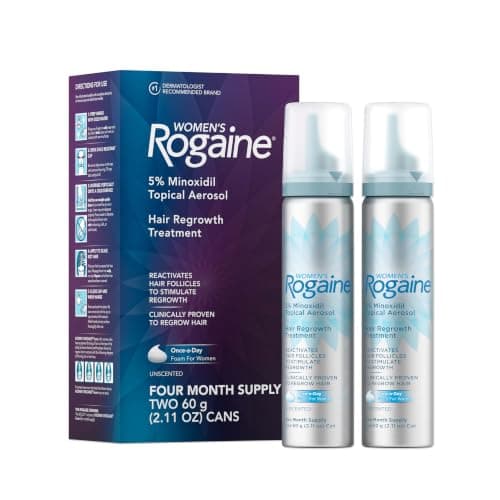
Rogaine — Women's Rogaine 5% Minoxidil Topical Foam (4-month supply, 2 x 2.11 oz)
5% minoxidil topical foam, applied once daily to the scalp, 2 x 2.11 oz cans (about a 4-month supply), OTC drug with an FDA Drug Facts label
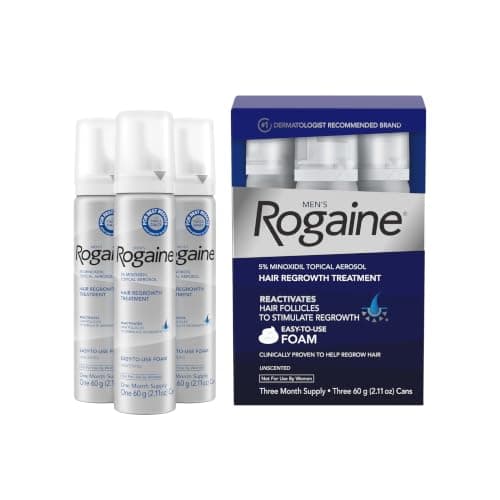
Rogaine — Men's Rogaine 5% Minoxidil Topical Foam, Unscented (3-month supply, 3 x 2.11 oz)
At a glance
Tap a row to check price · tap a header to sort| # | Best for | Price | ||
|---|---|---|---|---|
| 1 | 1. Rogaine — Women's Rogaine 5% Minoxidil Topical Foam (4-month supply, 2 x 2.11 oz)Best overall for women | Best overall for women | 8.9/10 | |
| 2 | 2. Rogaine — Men's Rogaine 5% Minoxidil Topical Foam, Unscented (3-month supply, 3 x 2.11 oz)Best overall for men | Best overall for men | 8.7/10 | |
| 3 | 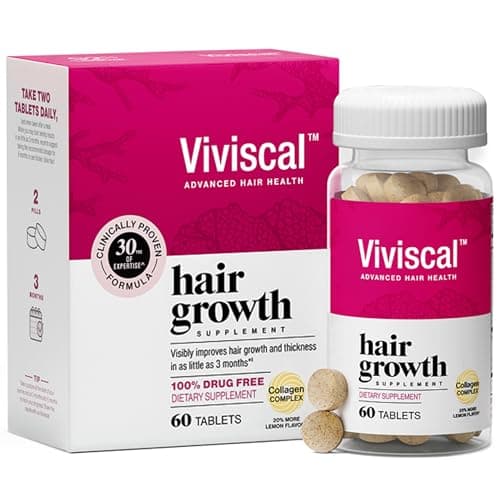 3. Viviscal — Viviscal Hair Growth Supplements for Women (60 tablets, 1 month)Best-studied actual supplement | Best-studied actual supplement | 6.8/10 | $37.50$39.996% offCheck Price for Viviscal Viviscal Hair Growth Supplements for Women (60 tablets, 1 month) on AmazonIn Stock |
| 4 | 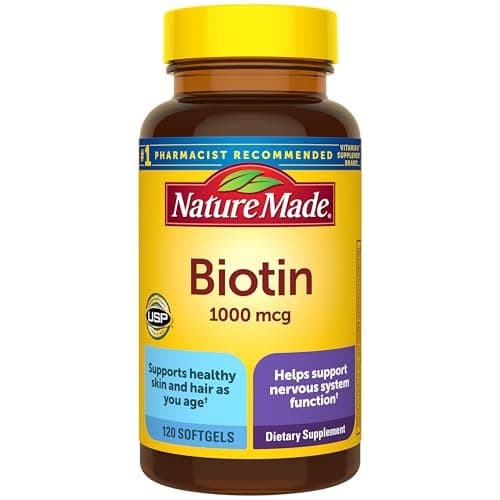 4. Nature Made — Biotin 1000 mcg (120 softgels)Best biotin | Best biotin | 6.5/10 | |
| 5 | 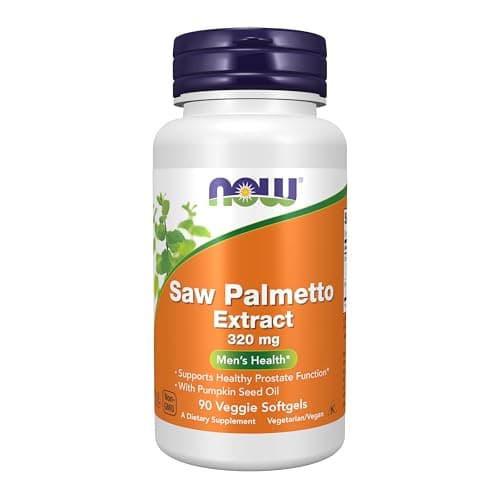 5. NOW Foods — Saw Palmetto Extract 320 mg with Pumpkin Seed Oil (90 veg softgels)Best clean-label option for the DHT angle | Best clean-label option for the DHT angle | 6.4/10 | $19.99$39.9950% offCheck Price for NOW Foods Saw Palmetto Extract 320 mg with Pumpkin Seed Oil (90 veg softgels) on AmazonIn Stock |
| 6 | 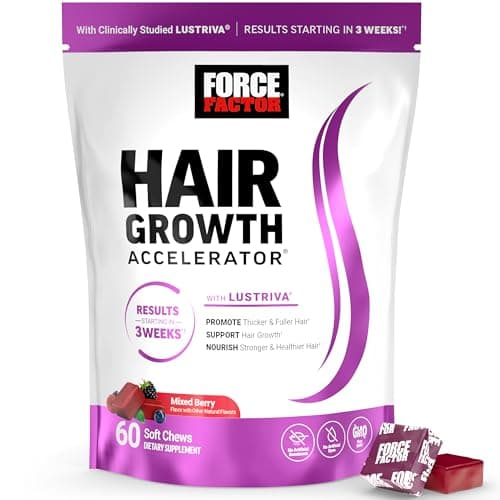 6. Force Factor — Hair Growth Accelerator Soft Chews with LustrivaThe branded-ingredient option | The branded-ingredient option | 5.6/10 | |
| 7 | 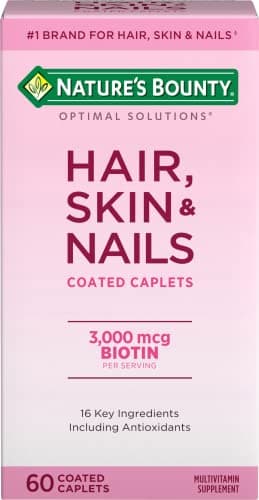 7. Nature's Bounty — Optimal Solutions Hair, Skin & Nails Formula with 3,000 mcg Biotin (20 servings)The category archetype | The category archetype | 4.8/10 |
Prices pulled from Amazon as of October 18, 2026 and are subject to change. The price shown on Amazon at checkout applies.
How we scored
Every product below is scored on six metrics, 0-10 each, with the weighting described on how we review. The criteria specific to this category:
- Evidence it regrows hair — the top of this scale is a drug the FDA reviewed and approved for hair regrowth, with a Drug Facts label that states plainly what it does and does not do. The middle is a supplement with at least one randomized, placebo-controlled trial. The bottom is a product sold entirely on an ingredient's reputation, with no trial of the finished formula at all.
- Independence of that evidence — that a study exists is not the same as a study you can trust. We score down every trial funded by the company selling the product or the company selling the branded ingredient, and we score down small samples hard. A fifteen-person manufacturer-funded study is real evidence, but it is weak evidence, and the label never tells you that.
- Label honesty — this scores what the packaging admits. A Drug Facts panel that says results take months, that the product only works on the crown, and that stopping means losing the regrowth is being honest with you. A proprietary blend that hides how much of each ingredient you are getting is not. Per this site's minimal-label bias, we want doses you can actually check.
- Third-party testing — supplements are not pre-approved for potency or purity, so an independent NSF or USP mark, or a published third-party potency test, is the only real check on whether the bottle contains what the panel claims. An OTC drug clears a higher manufacturing bar by default, which is part of why it scores well here.
- Cost per month at the real dose — not the sticker price. A bottle of 60 caplets sounds like two months until you read that a serving is three caplets, which makes it 20 days. We normalize everything to what a month of honest use actually costs, and hair products are a multi-month commitment, so that number compounds.
- Realistic to stick with — hair treatments only work while you use them, and the regrowth reverses when you stop. A once-daily foam is easier to sustain than a twice-daily one; two tablets a day is easier than three caplets. A product you abandon in month two was never going to work regardless of what is in it.
What to know before buying
- Find the cause before you buy the fix. Thinning hair is a symptom, not a diagnosis. Genetics, thyroid disease, low iron, major stress, crash dieting, postpartum hormone shifts, and a long list of medications all cause hair loss, and they do not all respond to the same thing. The AAD's position on nutrients is that you should take biotin, iron, or zinc only when a blood test shows a deficiency — which means the useful first step is getting tested, not guessing. A supplement bought to treat an undiagnosed thyroid problem is money and months lost.
- Minoxidil is the only over-the-counter hair regrowth ingredient the FDA has approved, and its label is refreshingly honest. The men's 5% foam Drug Facts panel states it is 'to regrow hair on the top of the scalp (vertex only)' and explicitly not for frontal baldness or a receding hairline. It says results may occur at 2 months with twice-daily use, and that some men need at least four months. The women's 5% foam is applied once a day and its label says results may be seen as early as 3 months. Both say the same thing about quitting: continued use is necessary, or the loss resumes.
- Read the serving size before you compare prices. This is where the cheap hair-skin-and-nails products get you. A bottle of 60 caplets at a serving size of three caplets is 20 servings — under three weeks. Suddenly the $8 bottle is not meaningfully cheaper per month than a mid-priced product, and you are taking three pills a day to get there. Always divide the count by the serving size before you decide anything is a bargain.
- A megadose of biotin is not doing what the bottle implies, and it can distort your bloodwork. The adult Adequate Intake for biotin is 30 mcg per day and deficiency is genuinely rare in people eating a normal diet, so the 10,000 mcg on the front of a hair supplement is a marketing number, not a dose-response finding. More importantly, the FDA has repeatedly warned that high-dose biotin interferes with common lab assays and can produce falsely high or falsely low results for troponin, thyroid hormones, and vitamin D. Tell your doctor and the lab that you take it, especially before any cardiac or thyroid testing.
- 'Clinically studied' usually means the ingredient's manufacturer ran the study. This phrase is doing enormous work on hair supplement packaging, and it is almost never a lie — it is just far less than it sounds. The branded silicon-and-biotin complex used in some hair products was studied in 90 women over 12 weeks by the ingredient supplier. The best-studied marine complex was tested in a 180-day trial with 15 total participants, funded by the company that sells it. Both count as clinical studies. Neither is the kind of independent, adequately powered evidence that would let you predict your own result.
- Proprietary blends are the tell. If the panel lists a named 'complex' with a single milligram total rather than an amount for each ingredient, you cannot check the dose against any study, you cannot compare it to a competitor, and you cannot tell whether the impressive-sounding ingredient is present in a meaningful amount or a pinch. This site's bias is consistent across every category: buy ingredients you can count. It is the single easiest filter to apply while standing in the aisle.
- Whatever you choose, it is a multi-month commitment or it is nothing. Hair grows slowly, and every product here — drug and supplement alike — is evaluated on 3-to-6-month timelines because that is how long it takes for a change to show. Both the AAD and the minoxidil label put meaningful results at roughly 4 to 12 months, and the AAD notes that if you stop applying minoxidil you lose its benefits. Buy a three-month supply of one thing and use it properly rather than a month each of three different things.
Our picks
Rogaine — Women's Rogaine 5% Minoxidil Topical Foam (4-month supply, 2 x 2.11 oz)
Key specs: 5% minoxidil topical foam, applied once daily to the scalp, 2 x 2.11 oz cans (about a 4-month supply), OTC drug with an FDA Drug Facts label
Pros
- This is a regulated OTC drug, not a supplement — the FDA reviewed minoxidil for hair regrowth, which puts it in a completely different evidence class from everything else on this page
- Once-daily application, which is genuinely easier to sustain for the months it takes to work than the twice-daily men's protocol
- The Drug Facts label is honest in a way supplement panels never are: it states results may be seen as early as 3 months, that not everyone responds, and that the response cannot be predicted
Cons
- It is a permanent commitment — the label is explicit that continued use is necessary, and the regrowth reverses when you stop
- It treats pattern hair loss on the top of the scalp; it does nothing for hair loss caused by thyroid disease, iron deficiency, or medication, which is why getting a cause identified first still matters
Rogaine — Women's Rogaine 5% Minoxidil Topical Foam (4-month supply, 2 x 2.11 oz)
- Evidence it regrows hair10/10
- Independence of evidence8/10
- Label honesty10/10
- Third-party testing9/10
- Cost per month8/10
- Realistic to stick with7/10
Rogaine — Men's Rogaine 5% Minoxidil Topical Foam, Unscented (3-month supply, 3 x 2.11 oz)
Key specs: 5% minoxidil topical foam (50 mg per gram), applied twice daily, 3 x 2.11 oz cans (about a 3-month supply), OTC drug with an FDA Drug Facts label
Pros
- The same FDA-approved active ingredient as the women's version, with decades of controlled trials behind it rather than a single manufacturer-funded study
- The label sets expectations properly: results may occur at 2 months with twice-daily use, and some men need at least four months before anything is visible
- Foam is easier to apply to the scalp without running than the older liquid solutions, which matters when you are doing this twice a day indefinitely
Cons
- The Drug Facts label restricts it to the vertex — it is 'to regrow hair on the top of the scalp (vertex only)' and explicitly not for frontal baldness or a receding hairline, which is exactly where many men want it to work
- Twice-daily application indefinitely is a real adherence problem, and continued use is necessary or the hair loss begins again
Rogaine — Men's Rogaine 5% Minoxidil Topical Foam, Unscented (3-month supply, 3 x 2.11 oz)
- Evidence it regrows hair10/10
- Independence of evidence8/10
- Label honesty10/10
- Third-party testing9/10
- Cost per month7/10
- Realistic to stick with6/10
Viviscal — Viviscal Hair Growth Supplements for Women (60 tablets, 1 month)
Key specs: AminoMar C marine complex (a proprietary blend of shark and mollusk powder), horsetail-derived silica, and vitamin C from acerola cherry; one tablet morning and evening, 60 tablets per month
Pros
- It is one of the few branded supplements the 2023 JAMA Dermatology systematic review singled out as having the highest-quality evidence, in a category where most products have none
- Real randomized, double-blind, placebo-controlled trials exist, and the reported terminal hair counts moved substantially while the placebo group did not budge
- Straightforward two-tablet daily routine and a widely available product, which makes the multi-month commitment realistic
Cons
- The headline 180-day trial enrolled 15 women total — 10 on the product, 5 on placebo — and funding was provided by Lifes2good, the manufacturer, with the lead author disclosing a research grant from them; that is a long way from adequately powered independent evidence
- AminoMar C is a proprietary blend, so you cannot see how much of anything you are getting, and at roughly $40 a month it is the most expensive per-month option here
Viviscal — Viviscal Hair Growth Supplements for Women (60 tablets, 1 month)
- Evidence it regrows hair6/10
- Independence of evidence3/10
- Label honesty5/10
- Third-party testing4/10
- Cost per month4/10
- Realistic to stick with7/10
Nature Made — Biotin 1000 mcg (120 softgels)
Key specs: 1000 mcg biotin per softgel, 120 softgels (about a 4-month supply), single-ingredient label, gluten-free, from a brand with USP-verified products in its range
Pros
- A single-ingredient label at a restrained dose — the least likely biotin product on the shelf to interfere with the blood tests the FDA warns about, and the easiest to reason about
- Nature Made carries USP verification across much of its lineup, which is meaningful third-party assurance in a category with very little of it
- At roughly $3 a month it is by far the cheapest thing here, so if a clinician told you your biotin is low, this is the sane way to fix it
Cons
- If you are not deficient, the evidence that biotin does anything for your hair is thin — the NIH notes the popular hair, skin, and nail claims are 'supported, at best, by only a few case reports and small studies'
- Even 1000 mcg is more than 30 times the 30 mcg adult Adequate Intake, so it is a modest dose rather than a minimal one, and it is still worth disclosing before bloodwork
Nature Made — Biotin 1000 mcg (120 softgels)
- Evidence it regrows hair3/10
- Independence of evidence5/10
- Label honesty8/10
- Third-party testing8/10
- Cost per month10/10
- Realistic to stick with9/10
NOW Foods — Saw Palmetto Extract 320 mg with Pumpkin Seed Oil (90 veg softgels)
Key specs: 320 mg saw palmetto extract with pumpkin seed oil per vegetarian softgel, 90 softgels (about a 3-month supply at one per day), non-GMO, GMP-tested in NOW's own labs
Pros
- Pumpkin seed oil is one of the isolated ingredients the JAMA Dermatology review listed among those with the highest-quality supporting evidence, which is more than most of this aisle can claim
- A short, countable label — a stated extract amount rather than a proprietary complex — so you can actually compare it against the doses used in studies
- NOW runs its own GMP-certified testing labs and publishes quality documentation, which is unusual transparency at this price, and about $8 a month is easy to sustain
Cons
- The DHT-blocking rationale is largely borrowed from prostate research; the direct evidence that oral saw palmetto regrows hair is weak, and this is not a substitute for minoxidil if pattern hair loss is what you have
- The product is marketed for men's health rather than hair specifically, and there is no independent NSF or USP consumer seal — you are trusting NOW's in-house program
NOW Foods — Saw Palmetto Extract 320 mg with Pumpkin Seed Oil (90 veg softgels)
- Evidence it regrows hair4/10
- Independence of evidence4/10
- Label honesty8/10
- Third-party testing7/10
- Cost per month8/10
- Realistic to stick with8/10
Force Factor — Hair Growth Accelerator Soft Chews with Lustriva
Key specs: Lustriva (inositol-stabilized arginine silicate plus magnesium biotinate, the ingredient supplier's high-solubility biotin form) in a soft chew format
Pros
- Lustriva is at least backed by a specific randomized, placebo-controlled study — three groups of 30 women over 12 weeks — which is more than the generic hair-skin-and-nails blends can point to
- Soft chews are the easiest format here to actually take every day, and adherence is the thing that quietly decides whether any of these work
- The magnesium biotinate form is a real formulation difference rather than pure marketing, since it is substantially more soluble than standard biotin
Cons
- The study was run by Nutrition21, the company that sells the Lustriva ingredient — the definition of a manufacturer-funded result, and it has not been replicated independently
- You are paying close to $40 a month for a branded complex rather than countable ingredients, and chews add sweeteners and flavoring that a capsule does not
Force Factor — Hair Growth Accelerator Soft Chews with Lustriva
- Evidence it regrows hair4/10
- Independence of evidence2/10
- Label honesty5/10
- Third-party testing4/10
- Cost per month4/10
- Realistic to stick with8/10
Nature's Bounty — Optimal Solutions Hair, Skin & Nails Formula with 3,000 mcg Biotin (20 servings)
Key specs: 3,000 mcg biotin per 3-caplet serving plus vitamins A, C, D, and E, B vitamins, and minerals including zinc; 60 coated caplets at a 3-caplet serving size, which is 20 servings per bottle
Pros
- It is genuinely inexpensive and available everywhere, and it does include zinc — one of the isolated nutrients the JAMA Dermatology review flagged as having supporting evidence
- If you were going to buy a multivitamin anyway, this is close to one, which lines up with the AAD's note that many dermatologists suggest a multivitamin over targeted single nutrients
- The panel lists individual amounts rather than hiding everything inside a proprietary blend
Cons
- There is no trial of this finished formula for hair growth — it is sold on the reputation of biotin, and the biotin case collapses if you were not deficient to begin with
- The serving math is the real catch: 60 caplets at 3 per serving is 20 days, not 60, so the cheap sticker price works out to roughly $12 a month for three pills a day
Nature's Bounty — Optimal Solutions Hair, Skin & Nails Formula with 3,000 mcg Biotin (20 servings)
- Evidence it regrows hair2/10
- Independence of evidence2/10
- Label honesty4/10
- Third-party testing5/10
- Cost per month7/10
- Realistic to stick with6/10
Frequently asked questions
If you want the honest answer: the most effective over-the-counter product for hair regrowth is not a supplement at all — it is topical minoxidil, an FDA-approved OTC drug sold as Rogaine and as store-brand foams. Among actual dietary supplements, the 2023 JAMA Dermatology systematic review found the highest-quality evidence for a short list of branded products including Viviscal, Nourkrin, and Nutrafol, plus isolated ingredients like zinc, tocotrienol, and pumpkin seed oil. But that review also called for adequately powered randomized trials, because the existing studies are small and usually funded by the companies selling the products. Treat a supplement as a maybe, and minoxidil as the thing with real evidence behind it.
Related reading
- → How to read a supplement label (serving-size math and proprietary blends — the two tricks this aisle relies on)
- → Does creatine cause hair loss? What the evidence actually shows
- → Greens powder vs multivitamin — relevant here, since the AAD suggests a multivitamin over targeted single nutrients
- → Best biotin supplements (the full breakdown, including the FDA lab-test interference warning)
- → Best collagen peptides (the other hair-and-skin supplement, bought at a studied dose)
- → Best iron supplements (one of the deficiencies genuinely worth testing for first)
- → Best multivitamins (what many dermatologists suggest instead of targeted single nutrients)
- → Best zinc supplements (one of the isolated nutrients the JAMA review flagged)
Sources
- Hair loss: Diagnosis and treatment ('You should only take biotin, iron, or zinc when your blood test shows that you have a deficiency'; many dermatologists recommend a multivitamin instead; minoxidil results usually take 6 to 12 months; 'If you stop applying minoxidil, you lose its benefits') — American Academy of Dermatology
- Thinning hair and hair loss: Could it be female pattern hair loss? (products containing either 2% or 5% minoxidil are approved to treat female pattern hair loss) — American Academy of Dermatology
- Evaluation of the Safety and Effectiveness of Nutritional Supplements for Treating Hair Loss: A Systematic Review (30 studies — 17 randomized controlled trials, 11 clinical studies, 2 case series — in people with hair loss and no known nutritional deficiency; the highest-quality evidence suggested potential effectiveness for Viviscal, Nourkrin, Nutrafol, Lamdapil, Pantogar, zinc, tocotrienol and pumpkin seed oil, with adequately powered randomized trials still warranted) — JAMA Dermatology (Drake et al.), 2023
- Nutritional Supplements and Hair Loss — Limitations to the Interpretation of Clinical Studies Before Implementation in Clinical Practice (published commentary on the limits of the supplement trial evidence base) — JAMA Dermatology, 2023
- A Double-blind, Placebo-controlled Study Evaluating the Efficacy of an Oral Supplement in Women with Self-perceived Thinning Hair (Viviscal Maximum Strength; 15 women total, 10 on product and 5 on placebo, 180 days; terminal hairs 271.0 at baseline to 571 at 90 days and 609.6 at 180 days, versus placebo 256.0 to 245.0 to 242.2; 'Funding for this study was provided by Lifes2good, Inc.') — Journal of Clinical and Aesthetic Dermatology (Ablon)
- Minoxidil Foam 5% (For Men) — Drug Facts ('to regrow hair on the top of the scalp (vertex only)'; not for frontal baldness or a receding hairline; apply half a capful twice daily; results may occur at 2 months and some men need at least 4 months; continued use is necessary or hair loss begins again) — DailyMed, U.S. National Library of Medicine
- Women's Rogaine Unscented — minoxidil aerosol, foam, Drug Facts (5% minoxidil; apply half a capful once a day; each can lasts about two months; results may be seen as early as 3 months; not everyone responds and the response cannot be predicted) — DailyMed, U.S. National Library of Medicine
- Biotin — Fact Sheet for Health Professionals (adult Adequate Intake 30 mcg; biotin widespread in food; hair, skin and nail claims 'supported, at best, by only a few case reports and small studies') — NIH Office of Dietary Supplements, 2022
- The FDA Warns that Biotin May Interfere with Lab Tests: FDA Safety Communication (high-dose biotin can cause falsely high or falsely low results on troponin, thyroid and hormone assays) — U.S. Food and Drug Administration (FDA), 2019
- Nutrition 21 says science backing of new beauty-from-within ingredient will help it capitalize on growing market (Lustriva: inositol-stabilized arginine silicate plus magnesium biotinate; randomized placebo-controlled study of three groups of 30 women over 12 weeks, conducted for the ingredient manufacturer) — NutraIngredients-USA, 2021
Last verified: September 2, 2026. See our editorial policy and how we review for details on scoring and update cadence. Canonical URL: https://trustedhealthgear.com/reviews/best-hair-growth-supplement.
Rogaine — Women's Rogaine 5% Minoxidil Topical Foam (4-month supply, 2 x 2.11 oz)
$44.97 · on Amazon