Best Biotin Supplements, Scored on a Public Rubric
Biotin — vitamin B7 — is the supplement whose sales pitch is almost entirely disconnected from who actually needs it. It's a real, essential B vitamin: your body uses it as a cofactor for enzymes that metabolize fats, carbohydrates, and protein, and a genuine deficiency can cause hair thinning, brittle nails, and skin rashes. That last sentence is the entire foundation of the hair-skin-and-nails aisle — but it quietly skips the part that matters, which is that biotin deficiency is genuinely rare. The NIH Office of Dietary Supplements sets the adult Adequate Intake at just 30 mcg per day, notes that biotin is widespread in food (eggs, meat, fish, seeds, nuts, and vegetables all supply it) and is also made by gut bacteria, and states flatly that 'severe biotin deficiency in healthy individuals eating a normal mixed diet has never been reported.' So the beauty benefit is real only when you were deficient to begin with — and most people simply aren't. That reframes the whole category. Biotin visibly improves hair and nails in people with a true deficiency or a specific condition like brittle-nail syndrome, but the evidence that it does anything for hair or nails in people who aren't deficient is thin: the NIH notes the popular claims are 'supported, at best, by only a few case reports and small studies.' Now look at the shelf. The AI is 30 mcg. The bottles say 5,000 and 10,000 mcg — up to hundreds of times the requirement — because a bigger number sells better, not because there's evidence a megadose regrows hair in someone with normal levels. The good news is biotin is water-soluble and has no established upper limit, so the excess is generally excreted and high doses are considered safe. But 'safe' is not 'harmless,' and there is one genuinely important catch the marketing never mentions: the FDA has repeatedly warned that high-dose biotin can interfere with lab tests. Because many blood assays use biotin-based technology, extra biotin in your system can throw off results for troponin (the marker used to diagnose a heart attack), thyroid hormones, vitamin D, and various hormone tests — producing falsely high or falsely low readings. The FDA has documented cases where biotin interference caused a falsely low troponin result, and warns supplements marketed for hair, skin, and nails 'can contain up to 20 mg' — over 650 times the recommended amount. That is why the single most useful thing to know about biotin is not which brand to buy but this: tell your doctor and the lab you take biotin before any bloodwork, and stop it a couple of days beforehand if they advise. Beyond that, this site's take is simple. If you have a diagnosed deficiency or your clinician recommended it, take what they advise. Otherwise, buy a sane dose from a third-party-tested brand with a clean label, don't expect a megadose to do more than a modest one, and don't pay for 'beauty' branding on a vitamin your diet almost certainly already covers.
Top pick
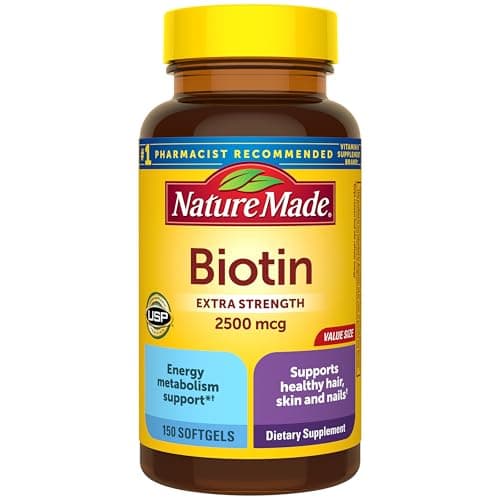
Nature Made — Biotin 2500 mcg Extra Strength (150 softgels)
2500 mcg biotin per softgel, 150 softgels (about a 5-month supply), gluten-free, from a brand with USP-verified products in its range
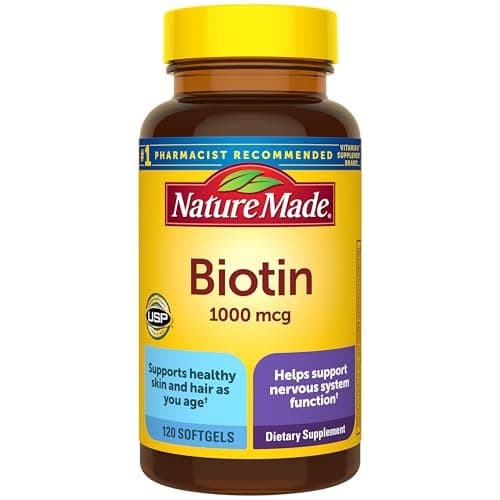
Nature Made — Biotin 1000 mcg (120 softgels)
At a glance
Tap a row to check price · tap a header to sort| # | Best for | Price | ||
|---|---|---|---|---|
| 1 | | Best overall | 7.9/10 | $17.40$20.99 |
| 2 | | Best low dose | 7.7/10 | $12.28$14.79 |
| 3 | 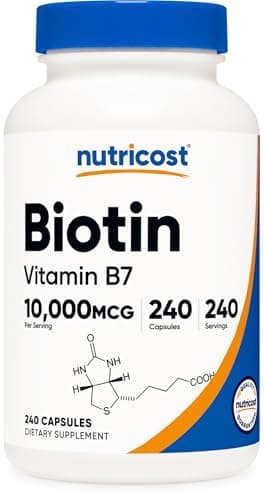 | Best value | 7.4/10 | $11.12$14.95 |
| 4 | 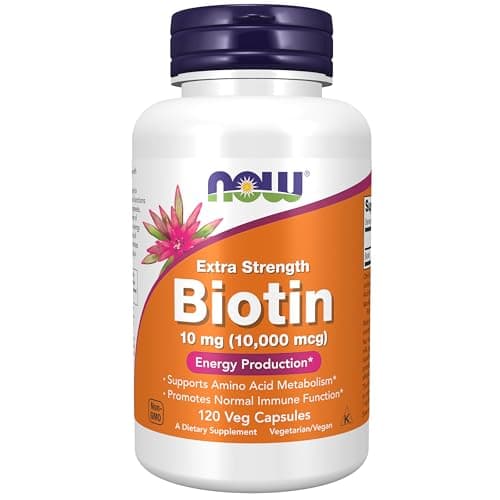 | Best high-dose transparency | 7.2/10 | $13.78$23.99 |
| 5 | 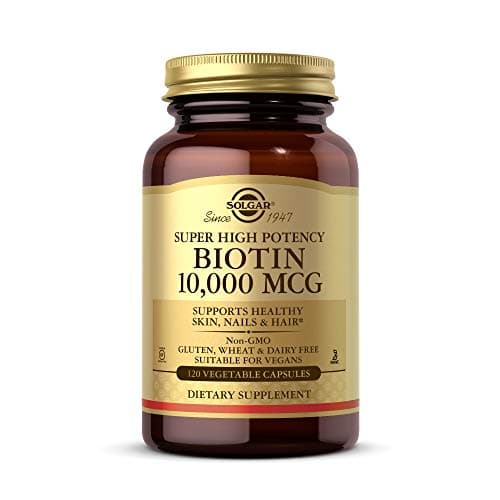 | Best premium veg-cap | 7/10 | $23.17 |
| 6 | 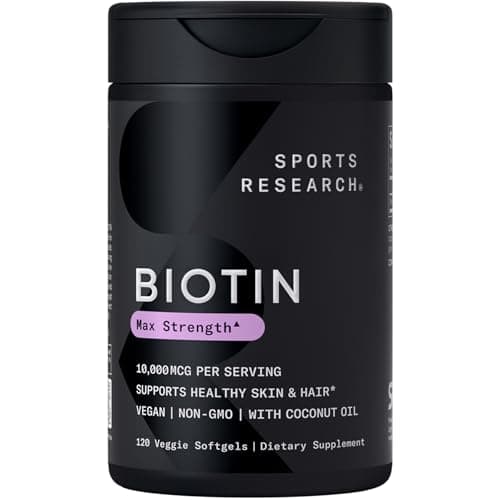 | Best softgel | 6.8/10 | $19.95 |
| 7 | 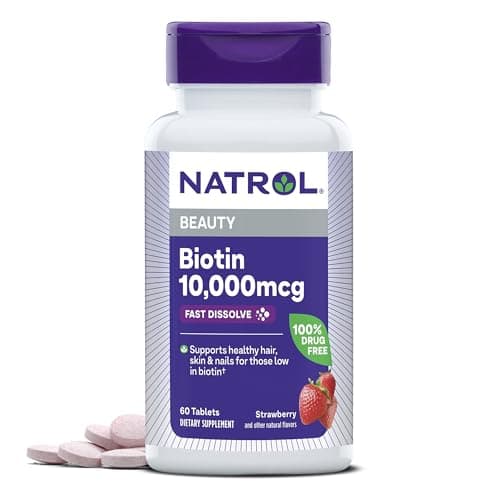 | Most convenient | 6.5/10 | $9.52$11.39 |
Prices pulled from Amazon as of Sep 16, 2026 and are subject to change. The price shown on Amazon at checkout applies.
How we scored
Every product below is scored on six metrics, 0-10 each, with the weighting described on how we review. The criteria specific to this category:
- An honest reason to take it at all — this scores the positioning, not just the pill. A biotin aimed at the narrow group who benefit (a diagnosed deficiency, brittle-nail syndrome, or a clinician's recommendation) scores up; one sold to the general public as a guaranteed hair-growth fix scores down, because the NIH says the hair/skin/nail claims for non-deficient people rest on 'only a few case reports and small studies.'
- A sane dose, understood for what it is — the adult AI is 30 mcg, and there's no evidence that 10,000 mcg regrows hair in someone with normal levels that a modest dose wouldn't. We treat the lower doses on the shelf as the sensible default, reserve megadoses for a clinician-directed reason, and never read 'more mcg' as 'more results.' A megadose also makes the lab-interference problem below worse.
- Clear disclosure of the lab-interference risk — the best labels acknowledge, and the best brands don't bury, the FDA warning that high-dose biotin can skew blood tests. We score up products and doses that make it easy to be responsible about bloodwork, and we flag every megadose because that's where the interference risk is greatest.
- Third-party testing you can point to — biotin is cheap raw material, so the real risk is potency and purity drift rather than adulteration, but an independent NSF or USP mark, or a brand-published third-party potency check, still beats any 'clinical strength' or 'beauty' badge printed by the seller.
- A short, clean label — a single-ingredient biotin beats one buried in a 'hair, skin, and nails' complex stacked with collagen, keratin, and a proprietary blend you can't dose. Per this site's minimal-label bias, buy biotin as biotin; if you want collagen, buy collagen separately at a studied dose.
- Value measured per real serving — the right comparison is cost per day at a sensible dose across the full bottle, not the sticker or the pill count. A giant megadose bottle isn't a better value if the dose is more than you need; we normalize on a reasonable daily serving over the life of the bottle.
What to know before buying
- Most people don't need biotin at all. The adult AI is 30 mcg per day, biotin is abundant in ordinary foods — eggs, meat, fish, nuts, seeds, and vegetables — and gut bacteria make more, which is why the NIH says severe deficiency in healthy people eating a normal diet has never been reported. If you eat a varied diet, your intake is almost certainly fine, and 'my hair is thinning' is usually not a biotin problem. Thinning hair has many causes (genetics, thyroid, iron, stress, medications), so the responsible first move is to find the cause, not to reach for a megadose.
- The single most important thing: tell your doctor and lab you take biotin before bloodwork. This is the real headline. The FDA has repeatedly warned that high-dose biotin interferes with many common blood tests because those assays use biotin-based technology. It can produce falsely high or falsely low results for troponin (used to diagnose heart attacks), thyroid hormones (TSH, T4), vitamin D, and hormones like hCG and testosterone. The FDA documented a case where biotin interference caused a falsely low troponin result. Practical rule: disclose your biotin use to whoever orders and runs your labs, and stop it for a couple of days before testing if they advise — especially before any cardiac or thyroid workup.
- The beauty benefit is real only in deficiency. Biotin genuinely helps hair, skin, and nails when someone is actually deficient or has a specific condition like brittle-nail syndrome — that's not in dispute. What's weak is the evidence that it helps people whose levels are already normal. The NIH is direct that the hair/skin/nail claims are 'supported, at best, by only a few case reports and small studies.' So if you're not deficient, temper your expectations: a supplement can't out-supplement adequate levels.
- A megadose isn't more effective — it's just more interference. There's no good evidence that 10,000 mcg does more for hair or nails in a non-deficient person than a modest dose would. What a megadose reliably does is raise the odds of throwing off your lab results. Given that the benefit plateaus and the risk rises, the sane move is to take the smallest dose that fits your reason for taking it, and to reserve the big numbers for a clinician-directed situation.
- There are legitimate reasons a clinician might recommend biotin. Certain situations do call for it: a diagnosed biotin deficiency, the rare genetic condition biotinidase deficiency, prolonged use of some anti-seizure medications that can lower biotin, long-term tube feeding, and occasionally brittle-nail syndrome. In those cases, follow your clinician's dose — this section isn't an argument against ever taking biotin, it's an argument against buying a megadose to fix ordinary hair concerns you haven't had evaluated.
- Skip the 'hair, skin, and nails' complexes if you want to know what you're taking. Many biotin products are actually multi-ingredient beauty blends with collagen, keratin, vitamin C, and a proprietary mix you can't dose. That's the opposite of a clean label. If you want collagen, buy collagen peptides at a studied dose; if you want biotin, buy single-ingredient biotin. Bundling them into one gummy or capsule mostly makes it harder to tell what, if anything, is doing something.
- Water-soluble and generally safe — but 'no upper limit' isn't a green light to megadose. Biotin has no established Tolerable Upper Intake Level because the body excretes the surplus and toxicity hasn't been documented, which is exactly how the aisle justifies 10,000 mcg with no warning. But the absence of a toxicity ceiling doesn't make a megadose useful, and it doesn't erase the lab-interference issue. Take the amount your actual reason justifies, not the biggest number on the shelf.
Our picks
Nature Made — Biotin 2500 mcg Extra Strength (150 softgels)
Key specs: 2500 mcg biotin per softgel, 150 softgels (about a 5-month supply), gluten-free, from a brand with USP-verified products in its range
Pros
- 2500 mcg is a far more restrained dose than the 10,000 mcg megadoses that dominate the shelf — still well above the 30 mcg AI, but a saner default that reduces the lab-interference risk
- Nature Made carries USP verification across much of its lineup, so brand-level quality control beats the bargain average (check the specific bottle for the seal)
- A roughly five-month supply at a drugstore price keeps the cost per day near the bottom of this list
Cons
- Still roughly 80 times the AI — reasonable, but more than most people who aren't deficient actually need
- Softgels use gelatin, so it's not vegetarian, and it's marketed on hair-skin-nails benefits that mainly apply if you were low to begin with
Nature Made — Biotin 2500 mcg Extra Strength (150 softgels)
- Third-party testing8/10
- Bioavailability9/10
- Clinical evidence6/10
- Value8/10
- Brand transparency8/10
- Form & absorption7/10
Nature Made — Biotin 1000 mcg (120 softgels)
Key specs: 1000 mcg biotin per softgel, 120 softgels, gluten-free, from a brand with USP-verified products in its range
Pros
- 1000 mcg is the most restrained dose in this roundup — the closest to a sensible amount, and the least likely to cause the lab-test interference the FDA warns about
- Cheap, widely available, and from a reputable mainstream brand with USP verification across much of its range
- Single-ingredient label with no keratin-and-collagen beauty blend riding along
Cons
- Even 1000 mcg is more than 30 times the AI, so it's a modest dose, not a minimal one — but that's the low end of what the market sells
- Gelatin softgel (not vegetarian), and like every biotin product its hair/nail benefit is meaningful mainly in genuine deficiency
Nature Made — Biotin 1000 mcg (120 softgels)
- Third-party testing8/10
- Bioavailability9/10
- Clinical evidence6/10
- Value8/10
- Brand transparency8/10
- Form & absorption7/10
Nutricost — Biotin (Vitamin B7) 10,000 mcg (240 capsules)
Key specs: 10,000 mcg biotin per capsule, 240 capsules (about an 8-month supply), non-GMO, gluten-free, third-party tested
Pros
- 240 capsules for a few dollars is the lowest cost per serving here, and it's a clean single-ingredient capsule with no beauty-blend padding
- Nutricost publishes third-party testing, so the potency claim has something behind it despite the low price
- If a clinician has told you to take a high dose, this is a cheap, no-frills way to do it
Cons
- 10,000 mcg is a megadose — over 300 times the AI — with no evidence it out-performs a modest dose in a non-deficient person
- This high a dose is exactly where the FDA's lab-interference warning bites hardest; if you take it, be diligent about disclosing it before any bloodwork
Nutricost — Biotin (Vitamin B7) 10,000 mcg (240 capsules)
- Third-party testing6/10
- Bioavailability9/10
- Clinical evidence6/10
- Value10/10
- Brand transparency7/10
- Form & absorption7/10
NOW Foods — Biotin 10,000 mcg Extra Strength (120 veg capsules)
Key specs: 10,000 mcg (10 mg) biotin per veg capsule, 120 capsules, vegetarian/vegan, non-GMO, GMP-tested in NOW's own labs
Pros
- NOW runs its own GMP-certified testing labs and publishes quality documentation, which is unusual transparency for a value-priced brand
- Vegetarian/vegan capsule and a single-ingredient label — no keratin, collagen, or proprietary beauty blend
- A trusted, long-established brand if you specifically need a high-dose biotin
Cons
- It's still a 10,000 mcg megadose with the same lab-interference caveat, and the label leans on 'energy production' framing that doesn't apply unless you're deficient
- No NSF or USP consumer seal — you're trusting NOW's in-house program rather than an independent certifier
NOW Foods — Biotin 10,000 mcg Extra Strength (120 veg capsules)
- Third-party testing7/10
- Bioavailability9/10
- Clinical evidence6/10
- Value7/10
- Brand transparency8/10
- Form & absorption7/10
Solgar — Biotin 10,000 mcg (120 vegetable capsules)
Key specs: 10,000 mcg biotin per vegetable capsule, 120 capsules, non-GMO, gluten-free, dairy-free, vegan
Pros
- A clean, single-ingredient vegan capsule from a long-respected brand, free of gluten, dairy, and common allergens
- Solgar's quality reputation and straightforward label make it an easy premium choice if you want a high-dose biotin without a beauty blend
- Vegetable capsule suits plant-based readers who can't use gelatin softgels
Cons
- You pay a noticeable premium for the brand, and it's still a 10,000 mcg megadose most people don't need
- Same lab-interference caution as every megadose, and no independent NSF/USP seal to point to
Solgar — Biotin 10,000 mcg (120 vegetable capsules)
- Third-party testing7/10
- Bioavailability9/10
- Clinical evidence6/10
- Value5/10
- Brand transparency7/10
- Form & absorption7/10
Sports Research — Biotin 10,000 mcg with Coconut Oil (120 softgels)
Key specs: 10,000 mcg biotin with organic coconut oil per vegan softgel (Plantgel), 120 count, non-GMO verified, third-party tested
Pros
- Vegan softgels (Plantgels) are a rarity — most softgels use gelatin — so this suits plant-based readers who prefer a softgel to a capsule
- Non-GMO Project verified and third-party tested, so the identity and potency claims have support
- Single-ingredient biotin with a coconut oil base rather than a multi-ingredient beauty blend
Cons
- The coconut-oil 'for absorption' angle is marketing — biotin is water-soluble and already well absorbed, so it doesn't need a fat carrier
- Still a 10,000 mcg megadose, priced above the cheapest picks, with the standard lab-interference caveat
Sports Research — Biotin 10,000 mcg with Coconut Oil (120 softgels)
- Third-party testing7/10
- Bioavailability9/10
- Clinical evidence6/10
- Value6/10
- Brand transparency7/10
- Form & absorption7/10
Natrol — Biotin 10,000 mcg Fast Dissolve (60 tablets)
Key specs: 10,000 mcg biotin per fast-dissolve tablet, 60 tablets (up to a 60-day supply), strawberry flavor, dissolves without water
Pros
- A fast-dissolve tablet that melts in the mouth is genuinely convenient for anyone who dislikes swallowing pills
- Widely available and inexpensive, from a mainstream brand
- Easy to take on the go without water
Cons
- Sold hard on 'energy metabolism' and beauty benefits — both overstate what biotin does unless you're actually deficient
- The flavored fast-dissolve format adds sweeteners and flavoring, there's no third-party seal to point to, it's a 10,000 mcg megadose, and 60 tablets is a short run that raises the real cost per day
Natrol — Biotin 10,000 mcg Fast Dissolve (60 tablets)
- Third-party testing6/10
- Bioavailability9/10
- Clinical evidence6/10
- Value7/10
- Brand transparency6/10
- Form & absorption6/10
Frequently asked questions
Only reliably if you were deficient to begin with. Biotin genuinely improves hair, skin, and nails in people with a true biotin deficiency or a specific condition like brittle-nail syndrome — but deficiency is rare, and the evidence that biotin helps hair growth in people whose levels are already normal is weak. The NIH notes the popular hair/skin/nail claims are 'supported, at best, by only a few case reports and small studies.' If your hair is thinning, the cause is far more likely to be genetics, thyroid issues, low iron, stress, or a medication — worth getting evaluated rather than assuming it's a biotin gap.
Related reading
- → Best hair growth supplements (where biotin actually ranks against everything else sold for hair)
- → Best collagen peptides (the other hair/skin/nail supplement — bought separately beats a bundled 'beauty' blend)
- → Best multivitamin (most already include biotin near the AI — check yours before buying a standalone megadose)
- → Best B12 (the other B vitamin sold in megadoses 'for energy' — where the claim is real and where it isn't)
Sources
- Biotin — Fact Sheet for Health Professionals (adult AI 30 mcg, biotin widespread in food and made by gut bacteria, 'severe biotin deficiency in healthy individuals eating a normal mixed diet has never been reported,' hair/skin/nail claims 'supported, at best, by only a few case reports and small studies') — NIH Office of Dietary Supplements, 2022
- Biotin (Vitamin B7): Safety information — high-dose biotin can significantly interfere with certain lab tests (troponin, thyroid, hormone assays), causing falsely high or low results; supplements can contain up to 20 mg biotin, more than 650 times the recommended amount — U.S. Food and Drug Administration (FDA), 2019
- The FDA Warns that Biotin May Interfere with Lab Tests: FDA Safety Communication (documented falsely low troponin result; advice to disclose biotin use to clinicians and labs) — U.S. Food and Drug Administration (FDA), 2019
Last verified: August 1, 2026. See our editorial policy and how we review for details on scoring and update cadence. Canonical URL: https://trustedhealthgear.com/reviews/best-biotin-supplement.
Nature Made — Biotin 2500 mcg Extra Strength (150 softgels)
$17.40 · on Amazon