Best Vitamin B12 Supplements, Scored on a Public Rubric
Vitamin B12 (cobalamin) is genuinely essential — your body needs it to make red blood cells, build the myelin that insulates your nerves, and copy DNA — and it is also the supplement whose marketing is most disconnected from who actually benefits. The adult RDA is a tiny 2.4 mcg per day (NIH's Office of Dietary Supplements), an amount that meat, fish, eggs, and dairy supply easily, so if you eat animal foods and your stomach absorbs normally, your diet almost certainly has you covered and a pill is answering a question you don't have. Two things make the aisle strange. The first is the megadose: bottles are labeled 500, 1,000, even 5,000 mcg for a 2.4 mcg need, which looks absurd until you understand the physics. B12 has to bind intrinsic factor to be actively absorbed, and that pathway saturates at just 1-2 mcg per meal; above the cap, absorption drops to passive diffusion — NIH pegs it at about 2% of a 500 mcg dose and 1.3% of a 1,000 mcg dose. So a 500 mcg tablet is engineered around that 1%, not around a dose you should chase higher. The second oddity is the form premium: methylcobalamin is sold as the 'natural, active' form at a markup over cyanocobalamin, the cheap, stable, most-studied form — but NIH is blunt that 'no evidence indicates that absorption rates of vitamin B12 in supplements vary by form,' which makes the methyl upcharge the CoQ10 ubiquinol story all over again. And the biggest myth of all is 'B12 for energy': NIH states plainly that supplementation 'appears to have no beneficial effect on performance in the absence of a nutritional deficit,' so the shot, the energy-drink dose, and the cherry 'converts food into energy' chewable are all trading on a real biochemical role to imply a benefit that only shows up if you were low to begin with. Where B12 genuinely matters is narrower and more important: strict vegans and vegetarians (B12 is essentially animal-food-only, the one nutrient a plant-based diet truly can't supply), adults past about 50 (atrophic gastritis affects 8-9% of people over 65 and blunts absorption), people on metformin or long-term acid reducers, and anyone with pernicious anemia — an autoimmune loss of intrinsic factor that is a medical condition, not a shelf decision. So the rubric here is unglamorous: figure out whether you're actually in one of those groups, then buy a third-party-tested B12 at a sane dose in whatever form costs least, and don't pay a cent extra for 'active form' or 'energy' on the label.
Top pick
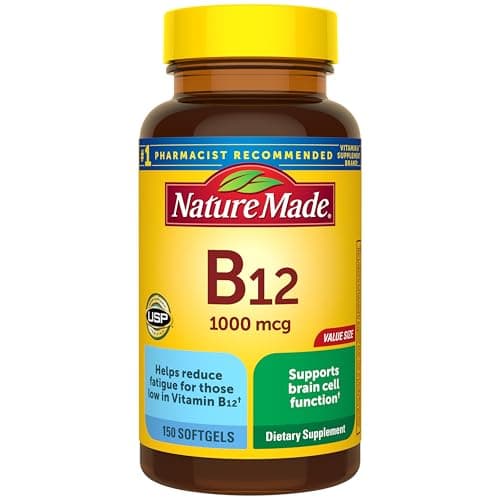
Nature Made — Vitamin B12 1000 mcg Softgels (150 count)
1000 mcg cyanocobalamin per softgel, 150 softgels (about a 5-month supply), USP Verified, gluten-free
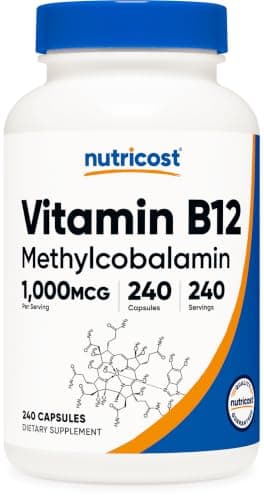
Nutricost — Vitamin B12 (Methylcobalamin) 1000 mcg (240 capsules)
At a glance
Tap a row to check price · tap a header to sort| # | Best for | Price | ||
|---|---|---|---|---|
| 1 | | Best overall | 8.4/10 | $13.42$23.89 |
| 2 | | Best value | 8/10 | $13.95 |
| 3 | 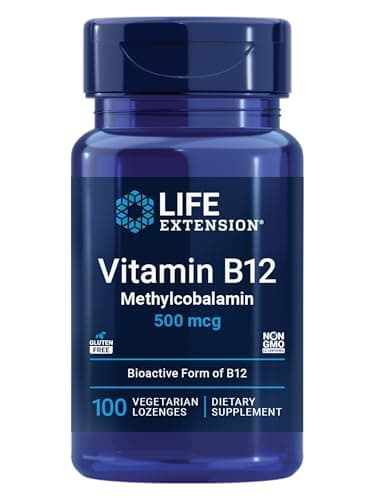 | Best sublingual | 7.7/10 | $6.56 |
| 4 | 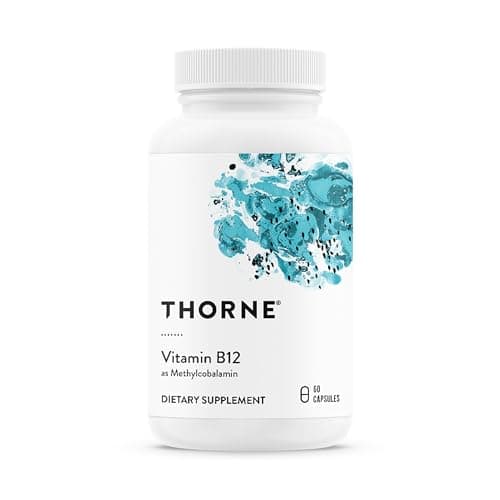 | Best third-party assurance | 7.6/10 | $24.00 |
| 5 | 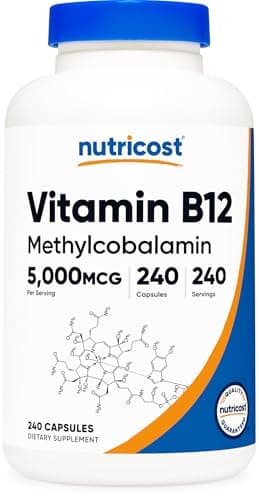 | Best high dose | 7.2/10 | $22.95 |
| 6 | 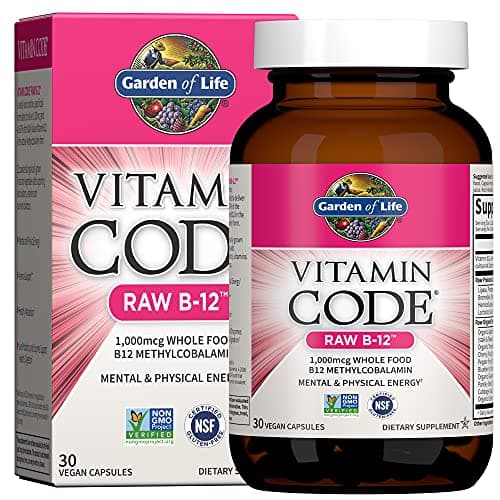 | Best for a whole-food-minded vegan | 7/10 | $13.29$18.99 |
| 7 | 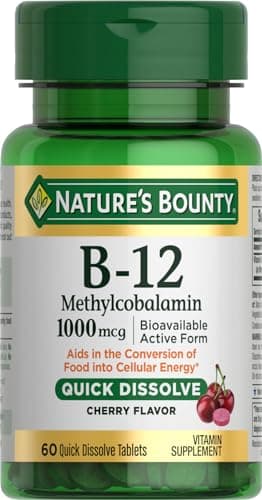 | Most available | 6.7/10 | $9.12 |
Prices pulled from Amazon as of Sep 13, 2026 and are subject to change. The price shown on Amazon at checkout applies.
How we scored
Every product below is scored on six metrics, 0-10 each, with the weighting described on how we review. The criteria specific to this category:
- A real reason to be taking it at all — this scores the honesty of the positioning, not a product's chemistry. A single-nutrient B12 aimed at the people who actually benefit (vegans/vegetarians, adults 50+, metformin or long-term PPI/H2 users, a diagnosed deficiency) scores up; a B12 sold to the general public as an 'energy' booster scores down, because NIH is explicit that supplementing does nothing for energy or performance unless you're deficient.
- Form-neutral, and priced accordingly — NIH found no evidence absorption varies by form, so cyanocobalamin (cheap, stable, most-studied) is the sensible default and methylcobalamin has to earn its price rather than be assumed superior. We don't reward the 'active form' label; we reward whichever form delivers the same tested dose for less money.
- A sane dose, understood for what it is — the RDA is 2.4 mcg, but because oral B12 relies on roughly 1% passive absorption above the 1-2 mcg intrinsic-factor cap, a 500-1,000 mcg tablet is dosed to that physics, not to a need you should push higher. We treat 500-1,000 mcg as the default, reserve 2,500-5,000 mcg for diagnosed malabsorption or pernicious anemia under a clinician, and never read 'more mcg' as 'better.'
- Third-party testing you can actually point to — B12 is inexpensive raw material, so the risk is potency drift more than adulteration, but an independent NSF, USP, or brand-published third-party potency check still beats any 'high absorption' or 'clinical strength' badge printed by the seller.
- Delivery honesty over delivery hype — sublingual lozenges, sprays, and swallowed tablets all raise blood B12 to a comparable degree (a randomized trial found sublingual and oral equivalent), so we score up the format you'll take consistently and score down any 'better-absorbing sublingual' premium the trials don't support.
- A short label — a single-ingredient B12 beats one buried in an 'energy complex,' a probiotic-and-enzyme blend, or a high-dose B6-plus-B12 combo. Per this site's minimal-label bias you should buy B12 as B12, and there's one real safety reason (below) to avoid casual high-dose combinations.
What to know before buying
- Most people who eat animal foods simply don't need this. The RDA is 2.4 mcg per day and B12 is abundant in meat, fish, eggs, and dairy, so an omnivore who absorbs normally is very likely already covered. The clear reasons to consider a supplement are listed below — 'I feel tired' is not one of them unless a blood test says you're actually low. Buying B12 to fix ordinary fatigue is the single most common way money is wasted in this category.
- If you're vegan or vegetarian, this is the supplement you shouldn't skip. Natural B12 is essentially limited to animal foods (NIH), which makes it the one nutrient a plant-based diet genuinely cannot supply. This site is whole-food-first, but there's no reliable whole-plant source of meaningful B12 — so a supplement, or consistently fortified foods, isn't optional here, it's the responsible move. A daily 500-1,000 mcg, or a larger dose a couple of times a week, covers it comfortably.
- Past about 50, absorption is the problem more than intake. With age many people develop atrophic gastritis — NIH puts it at 8-9% of adults over 65 — which reduces the stomach acid and intrinsic factor needed to free B12 from food. Depending on the cutoff used, between 3% and 43% of older adults show low B12. Because the supplemental form isn't bound to food protein, it sidesteps part of that problem, which is exactly why NIH advises older adults to get their B12 from fortified foods or supplements. This is a real, evidence-based reason to take it.
- On metformin or a long-term acid reducer? Check your B12. Metformin can measurably lower serum B12 over time, and PPIs and H2 blockers interfere with the acid-dependent step that releases B12 from food (NIH). Neither is a reason to stop a medication you need — it's a reason to have B12 checked periodically and to supplement if you're trending low.
- 'For energy' is the myth that moves the most product. Unless you are actually deficient, B12 does nothing for energy or exercise performance — NIH states supplementation 'appears to have no beneficial effect on performance in the absence of a nutritional deficit.' The B12 shot, the B12 in your energy drink, the cherry chewable that 'helps convert food into energy': all of them lean on B12's genuine role as a cofactor in energy metabolism to imply a benefit that only materializes if you were low to begin with.
- Methylcobalamin versus cyanocobalamin is mostly a price question. Methylcobalamin is marketed as the 'natural, active' form and priced above cyanocobalamin, the synthetic form that happens to be the cheapest, the most stable, and by far the most-studied. But NIH is direct: 'No evidence indicates that absorption rates of vitamin B12 in supplements vary by form.' Your body handles both. There are narrow exceptions a clinician manages — rare inborn errors of cobalamin metabolism, and some preference to avoid the trace cyanide in cyanocobalamin in advanced kidney disease or heavy smokers — but for the general shopper, form is not a reason to pay more.
- Sublingual and spray formats aren't magic; they're just fine. Lozenges, sprays, and swallowed tablets all raise blood B12 to a similar degree. A randomized trial (Sharabi 2003) put 500 mcg sublingual head-to-head against 500 mcg oral in deficient adults and found both corrected levels comparably over four weeks. So buy the format you'll actually take every day — but don't pay a premium for a 'better-absorbing sublingual' claim the trials don't support.
- Don't megadose casually — and know the one real caution. B12 has no established Tolerable Upper Intake Level and is generally considered safe because the body excretes the surplus, which is how the aisle sells 5,000 mcg without a warning label. But 'no UL' is not 'more is better.' A large observational study (Brasky 2017, the VITAL cohort of more than 77,000 people) linked long-term high-dose B12 from standalone supplements — over 55 mcg/day averaged across a decade — to roughly double the lung cancer risk in men, and about four times the risk in male smokers, with no such signal in women or from multivitamins. It's one observational study, not proof of cause, but paired with the fact that most people gain nothing from a megadose, it's a solid reason to take the smallest dose that does the job. A diagnosed absorption problem is when the big dose earns its place.
Our picks
Nature Made — Vitamin B12 1000 mcg Softgels (150 count)
Key specs: 1000 mcg cyanocobalamin per softgel, 150 softgels (about a 5-month supply), USP Verified, gluten-free
Pros
- USP Verified — an independent check on identity, potency, and manufacturing quality, which is the single most useful mark on a B12 label and something most of the category skips entirely
- Uses cyanocobalamin, the cheapest and most-studied form; since NIH found no form absorbs better, you're paying for testing and a sane dose rather than an 'active form' markup
- A roughly five-month supply at a drugstore price puts the cost per dose near the bottom of this list
Cons
- Marketed for 'energy metabolism support,' which oversells the benefit for anyone who isn't actually deficient — the softgel is good, the framing isn't
- 1000 mcg sits far above the 2.4 mcg RDA; that's normal for oral B12, but it's a reminder the label number reflects absorption physics, not a dose you should chase higher
Nature Made — Vitamin B12 1000 mcg Softgels (150 count)
- Third-party testing9/10
- Bioavailability8/10
- Clinical evidence8/10
- Value8/10
- Brand transparency8/10
- Form & absorption8/10
Nutricost — Vitamin B12 (Methylcobalamin) 1000 mcg (240 capsules)
Key specs: 1000 mcg methylcobalamin per capsule, 240 capsules (about an 8-month supply), non-GMO, gluten-free
Pros
- 240 servings for around twelve dollars is the cheapest cost per dose here — and it happens to be methylcobalamin, which quietly disproves the idea that the 'active form' has to cost more
- A clean, single-ingredient capsule with no energy blend or bolt-on ingredients riding along
- Practically the same result as the cyanocobalamin picks, since NIH found no form absorbs better — you're simply not paying a premium for the label
Cons
- No NSF or USP mark; Nutricost publishes its own third-party testing, so you're trusting the brand's program rather than an independent seal
- Nothing about the methylcobalamin form earns a health edge over cheaper cyanocobalamin — its only real advantage here is that it isn't priced like a premium
Nutricost — Vitamin B12 (Methylcobalamin) 1000 mcg (240 capsules)
- Third-party testing6/10
- Bioavailability8/10
- Clinical evidence8/10
- Value10/10
- Brand transparency7/10
- Form & absorption7/10
Life Extension — Vitamin B12 Methylcobalamin 500 mcg Lozenges (100 count)
Key specs: 500 mcg methylcobalamin per vegetarian lozenge, 100 lozenges, sugar-free, dissolves in the mouth
Pros
- 500 mcg is the sanest dose on this list — more than enough for maintenance given how B12 absorption works, without leaping to a megadose
- The cheapest bottle here, and a dissolvable lozenge suits anyone who dislikes swallowing pills
- Vegetarian and single-ingredient, which fits both a plant-based user (a core B12 audience) and the site's minimal-label preference
Cons
- The 'sublingual absorbs better' pitch isn't supported — a randomized trial found sublingual and swallowed B12 raise blood levels comparably, so the lozenge is a convenience, not an upgrade
- 100 lozenges is a shorter run than the 240-count value picks, so the per-dose price isn't quite as low as the sticker makes it look
Life Extension — Vitamin B12 Methylcobalamin 500 mcg Lozenges (100 count)
- Third-party testing6/10
- Bioavailability8/10
- Clinical evidence9/10
- Value8/10
- Brand transparency7/10
- Form & absorption7/10
Thorne — Vitamin B12 (Methylcobalamin) 1000 mcg (60 capsules)
Key specs: 1000 mcg methylcobalamin per capsule, 60 capsules, third-party certified, gluten/dairy/soy-free
Pros
- Third-party certification is Thorne's hallmark, and an independent potency check is the most defensible reason to spend more on any supplement
- A clean, single-ingredient label with no energy-blend padding
- The form and dose are unremarkable in the best way — 1000 mcg, once a day, nothing exotic to pay for
Cons
- By a wide margin the most expensive pick per dose, and only 60 capsules per bottle — you're paying for the testing and the brand, not for a better or different B12
- It's methylcobalamin at a premium, and NIH's no-difference-by-form finding means that premium buys reassurance, not a clinical edge
Thorne — Vitamin B12 (Methylcobalamin) 1000 mcg (60 capsules)
- Third-party testing10/10
- Bioavailability8/10
- Clinical evidence8/10
- Value4/10
- Brand transparency9/10
- Form & absorption8/10
Nutricost — Vitamin B12 (Methylcobalamin) 5000 mcg (240 capsules)
Key specs: 5000 mcg methylcobalamin per capsule, 240 capsules, non-GMO, gluten-free
Pros
- When a big oral dose is genuinely warranted — high-dose oral B12 is an evidence-based alternative to injections in pernicious anemia, and strict vegans or people with absorption problems sometimes need more — this delivers it cheaply, 240 capsules deep
- Because only about 1% of a large oral dose is absorbed by passive diffusion, a 5000 mcg dose does put a usefully larger absolute amount into circulation than 500 mcg for someone who is malabsorbing
- Single-ingredient and inexpensive per capsule
Cons
- Overkill for anyone not in one of those specific groups — a healthy omnivore gains nothing from 5000 mcg over 500 mcg
- This is exactly the standalone high-dose B12 the Brasky lung-cancer signal concerned, so it's the one to reserve for a real indication — and to avoid casually if you're a male smoker
Nutricost — Vitamin B12 (Methylcobalamin) 5000 mcg (240 capsules)
- Third-party testing6/10
- Bioavailability8/10
- Clinical evidence7/10
- Value8/10
- Brand transparency7/10
- Form & absorption7/10
Garden of Life — Vitamin Code RAW B-12 1000 mcg (30 capsules)
Key specs: 1000 mcg methylcobalamin per capsule, 30 vegan capsules, RAW food-created blend with added probiotics and enzymes, gluten-free
Pros
- A vegan, whole-food-styled B12 for readers who want their supplement to match a whole-food-first pantry — and B12 is the one nutrient a plant-based eater truly must supplement
- Methylcobalamin in a clean vegan capsule, with no fillers or synthetic binders
- From a brand built around food-created formulas, if that framing matters to you
Cons
- 30 capsules is a one-month supply, which makes the cost per day the highest of this group despite a reasonable sticker price
- The 'RAW/whole food' framing doesn't change how B12 absorbs (NIH: no form difference), and the added probiotic-and-enzyme blend is the kind of bolt-on this site is skeptical of — buy those separately if you want them
Garden of Life — Vitamin Code RAW B-12 1000 mcg (30 capsules)
- Third-party testing6/10
- Bioavailability8/10
- Clinical evidence8/10
- Value5/10
- Brand transparency7/10
- Form & absorption7/10
Nature's Bounty — Vitamin B-12 1000 mcg Quick Dissolve, Cherry (60 count)
Key specs: 1000 mcg B12 per quick-dissolve tablet, 60 tablets, natural cherry flavor, dissolves without water
Pros
- Cheap, everywhere, and easy to take — a cherry tablet that dissolves without water is genuinely convenient
- 1000 mcg is a standard maintenance dose, and at this price it's a fine way to cover a vegan or older-adult gap if you don't need a certification seal
Cons
- Sold hard on 'aids in the conversion of food into cellular energy' — technically true of B12's role, but NIH is explicit that supplementing does nothing for energy unless you're deficient, so treat the headline as marketing
- A flavored chewable adds sweeteners and flavoring to a supplement that doesn't need them, and there's no third-party seal to point to
Nature's Bounty — Vitamin B-12 1000 mcg Quick Dissolve, Cherry (60 count)
- Third-party testing5/10
- Bioavailability8/10
- Clinical evidence7/10
- Value8/10
- Brand transparency6/10
- Form & absorption6/10
Frequently asked questions
Probably not, if you eat animal foods and absorb normally. The adult RDA is just 2.4 mcg per day, and B12 is plentiful in meat, fish, eggs, and dairy, so most omnivores are already covered by diet. The people who genuinely benefit are a defined list: vegans and vegetarians (B12 is essentially animal-food-only), adults past about 50 (age-related atrophic gastritis blunts absorption), anyone on metformin or a long-term acid reducer (both lower B12 over time), and people with pernicious anemia or other malabsorption. If you're not in one of those groups and you're taking B12 for 'energy,' the evidence says you're spending money on a benefit you won't feel.
Related reading
- → How much protein you actually need (animal foods — meat, fish, eggs, dairy — are the natural home of B12, which is why a plant-based diet has to supplement it)
- → Best multivitamin (most already deliver well over the B12 RDA — check yours before buying a standalone)
- → Best iron supplement (the other half of an anemia workup — B12 and iron deficiency cause different anemias)
- → Best vitamin D (the other vitamin sold in megadoses — and when a bigger dose is actually justified)
- → Best supplements for energy (where the 'B12 for energy' myth ranks against what actually works)
Sources
- Vitamin B12 — Fact Sheet for Health Professionals (RDA 2.4 mcg, no UL, intrinsic-factor cap, ~1-2% passive absorption at 500-1,000 mcg, no absorption difference by form, no performance benefit without a deficit, at-risk groups, drug interactions) — NIH Office of Dietary Supplements, 2024
- Replacement therapy for vitamin B12 deficiency: comparison between the sublingual and oral route (500 mcg sublingual vs oral, comparable correction at 4 weeks) — British Journal of Clinical Pharmacology (Sharabi et al.), 2003
- Long-Term, Supplemental, One-Carbon Metabolism-Related Vitamin B Use in Relation to Lung Cancer Risk in the VITAL Cohort (B12 >55 mcg/day: HR 1.98 in men, ~4x in male smokers) — Journal of Clinical Oncology (Brasky, White, Chen), 2017
- Vitamin B12 — Fact Sheet for Consumers — NIH Office of Dietary Supplements, 2024
- USP Dietary Supplement Verification Program (what the USP Verified mark tests) — US Pharmacopeia
Last verified: July 30, 2026. See our editorial policy and how we review for details on scoring and update cadence. Canonical URL: https://trustedhealthgear.com/reviews/best-b12.
Nature Made — Vitamin B12 1000 mcg Softgels (150 count)
$13.42 · on Amazon