Does Vitamin C Prevent Colds?
The honest answer in one line: no, not for most people — but yes, meaningfully, for one specific group. The most-cited evidence here is a Cochrane review of regular vitamin C supplementation, and it found that in the general adult population, taking vitamin C every day did not reduce how often people caught colds. What it did do was shorten them modestly, by roughly 8% in adults and 14% in children across the trials. The exception is the interesting part: in people exposed to short bursts of extreme physical stress — marathon runners, skiers, soldiers on subarctic exercises — regular supplementation roughly halved cold incidence. That is a genuinely large effect in a narrow population, and it is the single evidence-based reason to take 1,000 mg a day rather than 500 mg. And the other half of the folklore fails outright: starting vitamin C after you already feel a cold coming on has not been shown to help consistently, which means the bottle you buy at the pharmacy on day one of a sore throat is the least useful purchase in this whole category. So the practical verdict is unglamorous. If you train hard, especially in cold weather or at endurance volumes, a daily 1,000 mg dose has a real evidence base behind it and costs pennies — Sports Research High Potency 1000 mg is the pick for that. If you are an ordinary adult who wants cheap insurance against a dietary gap, 500 mg a day is the right dose and the Nature Made tablet does it for about six cents. If you want that same dose with someone independent having verified the capsule, Thorne's 500 mg is worth the premium. What nobody should be buying is a 1,700 mg liposomal capsule or a maximum-strength gummy, because both are selling you a number past the point where your body stops absorbing it.
Affiliate disclosure: Trusted Health Gear is an Amazon Associate. If you buy through links on this page, we may earn a commission at no extra cost to you. Commission does not influence our rankings. Full policy.
What the Cochrane review actually found
The headline finding is the one most summaries get backwards, so it is worth stating precisely. The Cochrane review pooled trials of regular, ongoing vitamin C supplementation — people taking it daily before they got sick — and asked two separate questions: does it stop you catching colds, and does it change the cold once you have one. On incidence in the general community population, the answer was no: across the trials, people taking vitamin C regularly caught colds about as often as people who did not. On duration, there was a small but consistent effect: colds were shortened by roughly 8% in adults and 14% in children. On severity, there were modest reductions too. Then there is the subgroup that breaks the pattern. In five trials of people subjected to brief periods of severe physical stress — marathon runners, skiers, and soldiers training in subarctic conditions — regular vitamin C roughly halved the incidence of colds. That is not a small effect and it has been replicated across quite different populations. Separately, trials of therapeutic vitamin C started after symptoms appeared did not show consistent benefit. So the structure of the evidence is: daily use helps a little with duration for everyone, helps a lot with incidence for the heavily stressed, and starting it late does roughly nothing.
Why 'under extreme physical stress' probably includes you less often than you think
It is tempting to read the athlete finding and conclude that anyone who trains counts, so here is the shape of those populations. The trials involved marathon and ultramarathon runners, competitive skiers, and military personnel on exercises in subarctic conditions — people doing prolonged, near-maximal endurance work, often in cold and often while sleep-deprived and under-fed. The plausible mechanism is that this kind of load transiently suppresses immune function and raises oxidative stress, and that vitamin C blunts part of that. Three hard gym sessions a week does not resemble that. A 70-mile running week in February, a multi-day competition, a military selection course or a heavy block of two-a-day endurance training does. If your training sits somewhere in between, the practical answer is that 1,000 mg a day costs almost nothing and has an upper limit of 2,000 mg, so the downside of taking it during a heavy block is essentially zero — it is simply not supported by evidence in the way it is for the extreme group. What we would not do is extrapolate the halved-incidence number to ordinary training and then feel let down when it does not happen.
The dose ceiling: why bigger numbers stop working
Vitamin C is one of the few supplements where the absorption curve is well characterised, and it explains almost every bad product in the category. The NIH puts absorption at roughly 70-90% at moderate intakes of about 30-180 mg a day. Above that, the fraction absorbed falls steadily, and once a single dose exceeds roughly 1,000 mg, absorption drops below 50% — with the unabsorbed remainder passing through and the absorbed excess excreted in urine. Plasma concentrations effectively saturate; you cannot stack vitamin C up in your blood by taking more of it at once. The tolerable upper limit for adults is 2,000 mg a day, and the usual consequence of exceeding it is osmotic diarrhea and cramping rather than anything dangerous. Two practical rules fall out of this. First, if you want a higher daily total, split it — 500 mg twice is absorbed far better than 1,000 mg once. Second, treat any product whose selling point is a bigger number as selling you the part you excrete. A 1,700 mg liposomal capsule is 85% of the upper limit in one serving, delivered at the point on the curve where absorption has already collapsed.
What to look for when the absorption claims are all equivalent
Once you accept that 500 mg of plain ascorbic acid is physiologically equivalent to 500 mg of ascorbic acid with bioflavonoids, Ester-C, or acerola extract — and the NIH cites a study finding exactly that, with no bioavailability difference among those forms — the question becomes what is left to judge. Three things. First, third-party verification: vitamin C is cheap and simple to manufacture, which means the only unknown is whether the capsule contains what the label says, and a certification (USP, NSF, or a brand with a published testing program) is the only way to resolve that from the outside. Second, dose sanity: 500 mg for general use, 1,000 mg if you are in the extreme-stress group, and nothing above that in a single serving. Third, format honesty: a buffered mineral ascorbate genuinely is gentler on an acid-sensitive stomach, which is a real reason to pay slightly more, whereas a gummy is a sugar delivery system with a vitamin claim attached and four of them to make one serving. Everything else on a vitamin C label — fat-soluble, liposomal, whole-food, maximum strength — is a pricing strategy. Food comes first, as always: half a cup of raw red pepper is roughly 95 mg and a medium orange about 70 mg.
What we'd buy, by situation
Every pick below is already reviewed and scored in our roundups — same products, same specs, with live Amazon prices.
| Attribute | Sports Research High Potency Vitamin C 1000 mg (240 vegan capsules)Our pick | Nature Made Vitamin C 500 mg Tablets (100 count) | Thorne Vitamin C 500 mg with Citrus Bioflavonoids (90 servings) | Thorne Zinc Picolinate 15 mg (60 capsules) |
|---|---|---|---|---|
| Best for | Best for hard training — the dose the athlete trials used | Best value — the $6 bottle that does the same physiological job | Best overall — third-party certified at a dose that actually absorbs | Best overall — third-party certified at a dose that respects the ceiling |
| Who it's for | For the one group the evidence actually supports: marathon runners, skiers, soldiers and anyone in a prolonged heavy endurance block. 1,000 mg is the dose used in the extreme-stress trials where cold incidence roughly halved, and 240 capsules makes a winter training block cheap to run. | For every ordinary adult who just wants cheap insurance against a dietary gap. 500 mg once a day sits where absorption is at its practical best, and this is the cheapest honest way to take it — about six cents a day and 100 days per bottle. | For anyone who wants the same 500 mg dose with independent verification behind the capsule. You are paying for the testing program rather than the citrus bioflavonoids, which NIH found make no difference to absorption. | For the acute end of this question, where vitamin C is the weaker tool — a modest 15 mg zinc from a third-party-tested brand as a daily immune-support dose. For shortening a cold already underway, zinc lozenges taken in the first day have the better evidence. |
| Key specs | Ascorbic acid 1000 mg, vegan veggie capsules, Non-GMO Project Verified, gluten free, 240 count | Vitamin C 500 mg per tablet, 100 tablets, 100-day supply, no artificial flavors, no added color, no preservatives, gluten free | Vitamin C 500 mg with citrus bioflavonoids from oranges, capsule, 90 servings, third-party certified | Zinc picolinate 15 mg, capsule, 60 servings, third-party certified, gluten/dairy/soy-free |
| Our score | 7.4/10 | 8.1/10 | 8.4/10 | 8.3/10 |
| Where to buy |
Prices pulled from Amazon as of October 18, 2026 and are subject to change. The price shown on Amazon at checkout applies.
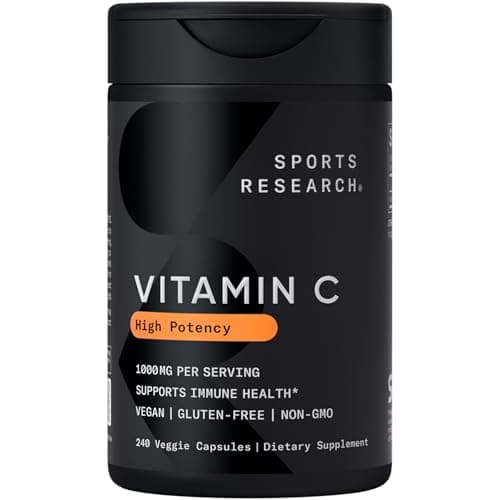
Sports Research — High Potency Vitamin C 1000 mg (240 vegan capsules)
For the one group the evidence actually supports: marathon runners, skiers, soldiers and anyone in a prolonged heavy endurance block. 1,000 mg is the dose used in the extreme-stress trials where cold incidence roughly halved, and 240 capsules makes a winter training block cheap to run.
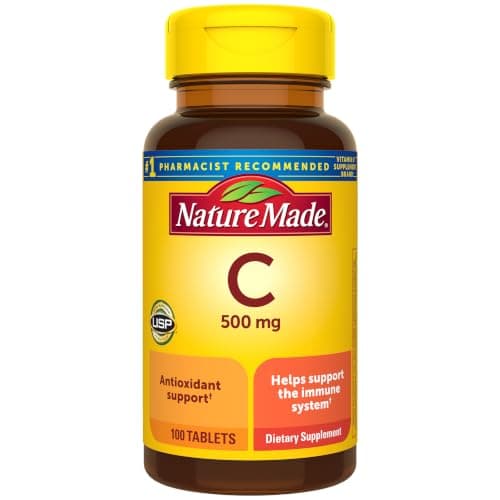
Nature Made — Vitamin C 500 mg Tablets (100 count)
For every ordinary adult who just wants cheap insurance against a dietary gap. 500 mg once a day sits where absorption is at its practical best, and this is the cheapest honest way to take it — about six cents a day and 100 days per bottle.
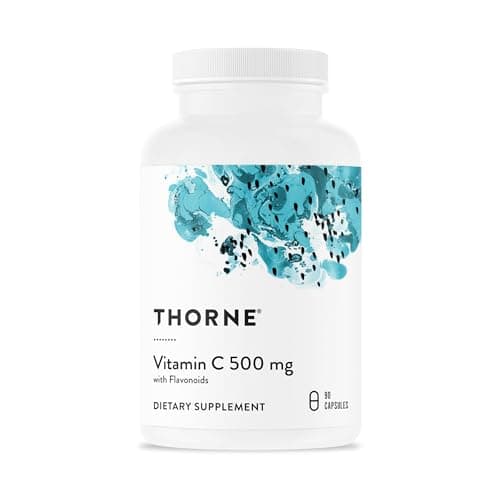
Thorne — Vitamin C 500 mg with Citrus Bioflavonoids (90 servings)
For anyone who wants the same 500 mg dose with independent verification behind the capsule. You are paying for the testing program rather than the citrus bioflavonoids, which NIH found make no difference to absorption.
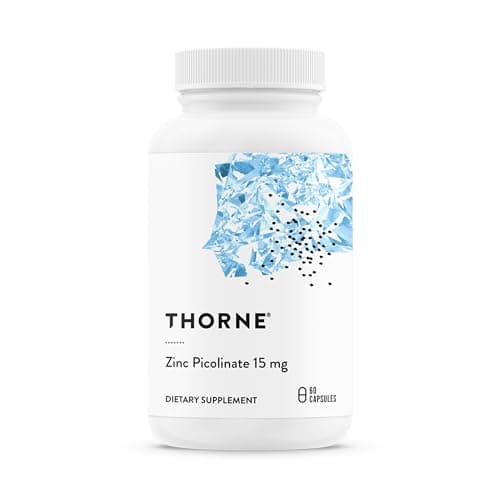
Thorne — Zinc Picolinate 15 mg (60 capsules)
For the acute end of this question, where vitamin C is the weaker tool — a modest 15 mg zinc from a third-party-tested brand as a daily immune-support dose. For shortening a cold already underway, zinc lozenges taken in the first day have the better evidence.
Zinc, not vitamin C, is the one worth having on the shelf
If the actual goal is shortening a cold once it has started, the evidence points at zinc rather than vitamin C — and it points at a specific form and a specific timing. Zinc lozenges taken within the first day or so of symptoms have the better track record for reducing cold duration, and the proposed mechanism is local: zinc ions interfering with rhinovirus replication in the nasopharynx, which is why lozenges that dissolve in the mouth are studied rather than swallowed capsules. The caveats are real. Doses used in trials are high enough that taste disturbance and nausea are common complaints, long-term high-dose zinc interferes with copper absorption, and the trials are heterogeneous enough that enthusiasm should stay measured. For ongoing daily use rather than acute treatment, a modest 15-30 mg zinc supplement is a reasonable part of an immune-support stack, which is how our zinc and immune-support pages treat it. The point for this page is simply that vitamin C and zinc are not interchangeable: vitamin C is a daily-habit nutrient with a small duration effect, and zinc is the acute-onset tool.
What we would actually do
Three cases, three answers. If you are an ordinary adult: take 500 mg a day if you want cheap insurance against a dietary shortfall, expect a slightly shorter cold rather than fewer colds, and spend the money you saved on vegetables. If you are in a heavy endurance block, competing, or doing prolonged work in the cold: 1,000 mg a day during the block has the best evidence in this entire article behind it, and it is the one situation where the bigger dose is justified rather than wasteful. If you already feel a cold starting: vitamin C will not help much, so reach for zinc lozenges within the first day, sleep more, and keep fluids up — and note that sleep is the variable with the largest effect on immune function and the one nobody sells in a bottle. Across all three cases the same constraints apply: do not exceed 2,000 mg a day, split doses above 500 mg, buy verified product, and treat any label promising better absorption as marketing. If you are taking an iron supplement, pairing it with vitamin C is the one combination here that does something genuinely useful, because vitamin C improves non-heme iron absorption.
Frequently asked questions
Not in the general population. The Cochrane review of regular vitamin C supplementation found no reduction in how often ordinary adults caught colds, though it did shorten them by roughly 8% in adults and 14% in children. The exception is substantial: in people exposed to brief periods of extreme physical stress — marathon runners, skiers, soldiers on subarctic exercises — regular supplementation roughly halved cold incidence across five trials. So the accurate statement is that vitamin C does not prevent colds for most people, slightly shortens them for everyone who takes it daily, and does meaningfully reduce how often you get them if you are doing prolonged near-maximal endurance work, often in the cold.
Related reading
Sources
- Vitamin C for preventing and treating the common cold (no reduction in incidence in the general population; ~8% shorter colds in adults and ~14% in children; roughly halved incidence in people under brief extreme physical stress; inconsistent results for therapeutic dosing started at onset) — Cochrane Database of Systematic Reviews
- Vitamin C — Health Professional Fact Sheet (70-90% absorption at 30-180 mg/day falling below 50% above 1 g single doses; RDA 90 mg men / 75 mg women; 2,000 mg upper limit; no bioavailability difference among ascorbic acid, Ester-C and ascorbic acid with bioflavonoids; food sources) — NIH Office of Dietary Supplements
- Zinc — Health Professional Fact Sheet (zinc lozenges and cold duration; copper interaction at high intakes; adverse effects) — NIH Office of Dietary Supplements
- Product titles, doses, counts, certifications, live prices and availability for the supplements referenced — retrieved via the Amazon product data layer — Amazon product listing data, 2026
Sports Research — High Potency Vitamin C 1000 mg (240 vegan capsules)
$22.95 · on Amazon