How Often Should You Use a Massage Gun?
The practical answer: roughly one to two minutes per muscle group, once or twice a day, and no more than about fifteen minutes in a single session across your whole body. That is the dosing most manufacturers specify and it matches what the research has actually measured — the studies on percussive therapy are short-duration protocols, typically a couple of minutes per site, not twenty-minute sessions. Daily use is fine within those limits if it feels good; it is not better than every other day, and more is not more. The reason to respect the ceiling is that the clearest, best-replicated effect of a massage gun is an acute increase in range of motion — one review reported improvements up to around 11% for the hamstrings — and that effect arrives within a minute or two and does not keep growing. Grinding away for ten minutes on one calf buys you nothing extra and does carry risk: a rapid scoping review of handheld percussive therapy documented four adverse events including rhabdomyolysis, a vertebral artery dissection and a dislocated eye lens, three of them occurring when the device was used without guidance from a healthcare professional. So the honest framing is this: a massage gun is a good, convenient tool for warming up tissue and feeling looser, used in short bursts. Our pick for most people is the Hyperice Hypervolt 2 Pro. Below is the dosing by situation, the places it must never go, and what the evidence does and does not support.
Affiliate disclosure: Trusted Health Gear is an Amazon Associate. If you buy through links on this page, we may earn a commission at no extra cost to you. Commission does not influence our rankings. Full policy.
The baseline dose: 1-2 minutes per muscle, 15 minutes total
Start with the numbers and then adjust. One to two minutes on a muscle group is the working dose — long enough to produce the acute range-of-motion change that percussive therapy reliably delivers, short enough to stay inside what has actually been studied. Keep a whole session under about fifteen minutes across all areas; if you are spending longer than that, you are either treating too many areas or spending too long on each. Move the head continuously rather than parking it in one spot, glide along the length of the muscle rather than drilling into a single point, and keep the pressure moderate — pressing hard enough to blanch the tissue or make you hold your breath is past the point of usefulness. Twice a day is a reasonable ceiling for a given area, once a day is plenty for most people, and there is no evidence that daily use beats every-other-day use for any outcome. If an area is still sore and tight after a week of this, the answer is not more minutes with the gun; it is looking at training load, sleep, and whether something needs assessing.
Before training: 30-60 seconds, and keep it brisk
This is the use case with the best support, and it is a short one. Thirty to sixty seconds per muscle group on a lower speed setting, as part of a warm-up that also includes general movement and the actual exercise you are about to do at light load. The mechanism you are buying is the acute range-of-motion increase — the most consistently observed effect in reviews of handheld percussive therapy — which is genuinely useful if a tight calf, hip or lat is limiting a position you need to get into. Two cautions specific to pre-training use. Do not substitute it for a warm-up: a gun does nothing for heart rate, core temperature or neural readiness, and there is no evidence it prevents injury. And do not spend so long on it that your warm-up becomes a massage session — the point is to unlock a position, then go and train. If you only have ten minutes, five minutes of movement plus a light first set beats five minutes with the gun.
After training and on sore days: short, gentle, optional
Post-training use is where expectations need managing. One to two minutes per worked muscle group on a low to moderate setting is a reasonable routine, and many people genuinely find it reduces how sore they feel. The evidence here is weaker than for range of motion: reviewers note that although percussive massage is widely used as a recovery tool, support for its effectiveness compared with simpler approaches such as static stretching is limited, and the studies that exist are short-term, mostly not randomised and not blinded. Foam rolling, for comparison, has been found to reduce delayed-onset soreness at 48 and 72 hours, and a meta-analysis found pre-workout vibration reduced muscle pain at 24, 48 and 72 hours — so these tools occupy a similar space and neither is dramatic. On a genuinely sore day, go gentler and shorter rather than harder and longer, and keep it away from anything that feels sharp rather than tender. If a muscle is acutely injured — a strain, a pull, a bruise — a percussive device is the wrong tool entirely until a clinician has looked at it.
Where never to use it
This is the section that matters most, because the reported harms from these devices cluster around misuse. Do not use a massage gun on the front or sides of the neck, over the carotid arteries, or at the base of the skull — a vertebral artery dissection has been reported in connection with percussive device use, and the neck is not a place to apply high-frequency force. Keep it off the head and face entirely; a dislocated eye lens is among the documented adverse events. Avoid bony prominences, the spine itself, the kidneys and the abdomen, and any joint rather than the muscle around it. Do not use it over broken skin, a fresh bruise, a suspected fracture, varicose veins, a known blood clot or an area of numbness, and do not use it over an acute injury. If you are pregnant, on anticoagulants, or managing a nerve condition, circulatory condition or any diagnosed musculoskeletal problem, ask your clinician or physiotherapist first — in the documented adverse events, three of the four occurred when the device was used without guidance from a healthcare professional. Finally, rhabdomyolysis has been reported after aggressive percussive use, which is the clearest possible argument for short sessions at moderate pressure rather than long sessions at maximum.
Reading the specs: speed, amplitude and stall force
Three numbers determine how a gun feels and how long you should spend with it. Amplitude is how far the head travels — around 12 mm and up is considered deep-tissue territory, while shorter strokes feel more like vibration than percussion. Stall force is how much pressure the motor tolerates before it stops: a low stall force means the gun quits exactly when you lean into it, which is the main complaint about cheap models. Speed, measured in percussions per minute, is the least important of the three despite getting the most marketing attention; lower speeds with good amplitude are often more comfortable and more useful than the top setting. For dosing, the practical implication is that a high-amplitude, high-stall-force device does more per minute, so you should spend less time with it, not more. Attachment choice follows the same logic: a large ball or flat head for big muscle groups, a fork or bullet head used sparingly and never on a joint or a bony edge. And on noise — a quieter gun gets used more, which matters more for consistency than any spec on the box.
The guns we'd buy for this routine
Every pick below is already reviewed and scored in our roundups — same products, same specs, with live Amazon prices.
| Attribute | Hyperice Hypervolt 2 ProOur pick | Ekrin Athletics Ekrin Athletics B37 (v2) | Bob and Brad C2 Massage Gun |
|---|---|---|---|
| Best for | Best overall — power, quietness, and battery without the flagship tax | Best value for hard training — flagship power, mid-tier price, lifetime warranty | Best overall — the most verified substance per dollar, with the strongest stall force here |
| Who it's for | For the reader who wants one device that does not stall when you lean into it: high amplitude and stall force mean each minute does more, which is exactly why you should keep sessions short with it. | For the lifter or athlete who wants deep-tissue capability at a sane price — the sensible middle of the range, with enough stall force for daily pre-training use on big muscle groups. | For the reader who wants to find out whether they will actually use one before spending real money — enough device for 60-90 second pre-training work, without the deep-tissue pressure tolerance. |
| Key specs | 14mm amplitude · ~60-70 lb stall force · 5 speeds, 1,700-2,700 PPM · 90W high-torque brushless motor · up to ~3 hrs battery · ~54-65 dB · Bluetooth (HyperSmart app) · ~2.6 lbs | 12mm amplitude · 56 lb stall force · 5 speeds, 1,400-3,200 RPM · level-3 brushless motor · up to 8 hrs battery · USB-C PD · 4 attachments · lifetime warranty · ~2.2 lbs | 8mm amplitude, 5 speeds (2,000-3,200 ppm), ~35lb stall, brushless motor, USB-C quick charge, ~1.5 lbs, typically ~$100 |
| Our score | 9/10 | 8.4/10 | 8/10 |
| Where to buy |
Prices pulled from Amazon as of October 18, 2026 and are subject to change. The price shown on Amazon at checkout applies.
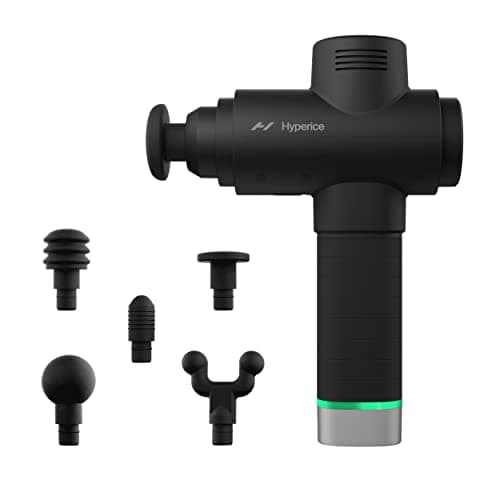
Hyperice — Hypervolt 2 Pro
For the reader who wants one device that does not stall when you lean into it: high amplitude and stall force mean each minute does more, which is exactly why you should keep sessions short with it.
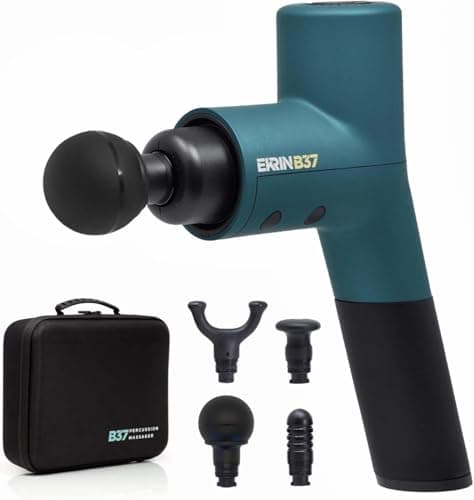
Ekrin Athletics — Ekrin Athletics B37 (v2)
For the lifter or athlete who wants deep-tissue capability at a sane price — the sensible middle of the range, with enough stall force for daily pre-training use on big muscle groups.
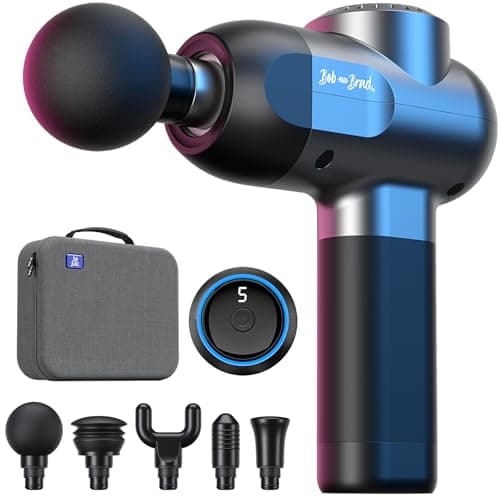
Bob and Brad — C2 Massage Gun
For the reader who wants to find out whether they will actually use one before spending real money — enough device for 60-90 second pre-training work, without the deep-tissue pressure tolerance.
Cheaper and simpler alternatives
A massage gun is a convenience purchase, and it is worth knowing what it competes with before deciding how often to use it — or whether to buy one. A lacrosse ball costs a fraction of the cheapest gun and covers glutes, calves, feet, pecs and the muscles around the shoulder blade better than any attachment, because your body weight provides pressure a hand-held motor cannot. A firm foam roller covers the large muscle groups and has the better evidence for delayed-onset soreness specifically. A vibrating roller splits the difference. And the free interventions remain the ones that actually determine how you feel: enough sleep, not jumping training volume, eating enough, and moving on rest days. The sensible framing for frequency is therefore about habit rather than dose-chasing — a gun used for ninety seconds before every session, three or four times a week, delivers everything these devices reliably deliver. If you find yourself using one for twenty minutes a night and still feeling wrecked, the problem is upstream of the tool.
Frequently asked questions
One to two minutes per muscle group, once or twice a day, and under about fifteen minutes total in a session. That is what manufacturers specify and it matches the protocols the research has actually used — the studies on percussive therapy are short, typically a couple of minutes per site. Daily use within those limits is fine, but it is not better than every other day, and the main effect these devices reliably produce — an acute increase in range of motion — arrives within a minute or two and does not keep growing. The reason the ceiling matters is safety: reported adverse events from percussive devices include rhabdomyolysis after aggressive use, which is a strong argument for short sessions at moderate pressure.
Related reading
Sources
- The Effective Method of Handheld Percussive Therapy Massage Gun: A Rapid Scoping Review (range of motion the most frequently observed effect; four adverse events reported — rhabdomyolysis, lens subluxation, vertebral artery dissection and increased pain — three without healthcare-professional guidance) — World Physiotherapy (congress proceeding)
- The effects of massage guns on performance and recovery: a systematic review (short-term outcomes only; limited evidence for percussive massage as a recovery tool compared with simpler methods) — Frontiers in Public Health, 2025
- Hyperice Hypervolt 2 Pro — amplitude, stall force and noise specifications — Massage Gun Advice
- Ekrin Athletics B37 — 56 lb stall force, 12 mm amplitude, warranty — Massage Gun Advice
- Bob and Brad C2 massage gun — stall force, amplitude and noise measurements — Massage Gun Advice
- Product titles, stated amplitudes, speed settings, attachments, live prices and availability for the massage guns referenced — retrieved via the Amazon product data layer — Amazon product listing data, 2026
Hyperice — Hypervolt 2 Pro
$349.00 · on Amazon