Massage Gun Benefits: Do Percussive Therapy Devices Actually Work?
Massage guns work for what the research actually tests them on: they reliably produce a short-term increase in range of motion and a modest reduction in perceived muscle soreness (DOMS) in the hours and days after hard training. That's a real, repeatable effect — not a placebo. What the evidence does not support is the bigger marketing story: there's weak-to-no proof that percussive therapy boosts long-term strength or performance, and the idea that it 'breaks up scar tissue' or 'flushes lactic acid' is not backed by the literature. Treat a massage gun as a useful comfort-and-mobility tool that pairs with sleep, protein, and whole foods — not as a recovery shortcut that replaces them.
Affiliate disclosure: Trusted Health Gear is an Amazon Associate. If you buy through links on this page, we may earn a commission at no extra cost to you. Commission does not influence our rankings. Full policy.
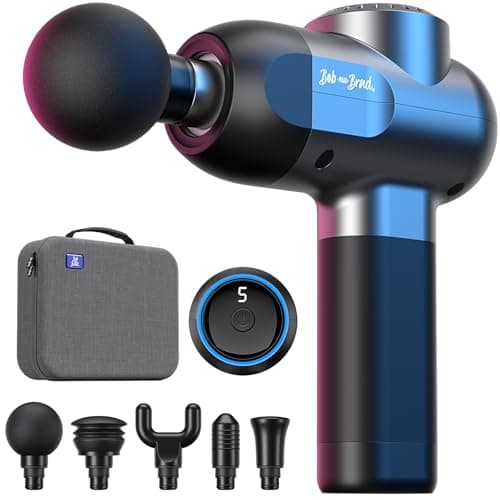
Bob and Brad — Bob and Brad C2
Best budget — the most gun you can buy for the money for general recovery
What percussive therapy actually is
A massage gun (percussive or 'vibration' therapy device) drives a padded head into soft tissue at a high frequency — typically 20-60 Hz, several thousand pulses per minute — penetrating a few millimeters with each stroke. It's a mechanical cousin of hands-on massage and foam rolling, just faster and more localized. The proposed mechanisms are plausible and modest: stimulating mechanoreceptors to reduce pain perception, transiently increasing local blood flow, and reducing the stiffness of muscle and connective tissue so a joint moves more freely. None of those mechanisms imply a magical metabolic effect — they're about comfort, perception, and acute tissue compliance, which is exactly what the controlled studies measure.
DOMS and recovery: a real but modest effect
Delayed-onset muscle soreness is where massage guns have their best evidence — but read it honestly. Meta-analyses of vibration and massage interventions (Lu et al., 2019; Dupuy et al., 2018) find a small-to-moderate reduction in perceived soreness in the 24-72 hours after eccentric or unaccustomed exercise. The catch: the effect is mostly on how sore you feel, not on objective damage markers. Studies frequently show no meaningful change in creatine kinase, leg volume, or other tissue-damage measures even when soreness ratings drop. So a massage gun can genuinely make the days after a heavy CrossFit or lifting session feel better and keep you moving — which has real training value — but it isn't accelerating the underlying repair the way the ads imply.
Range of motion: the most consistent benefit
If there's one benefit the data backs cleanly, it's acute range of motion. Konrad et al. (2020) applied a 5-minute Hypervolt treatment to the calf and measured a 5.4-degree (+18.4%) increase in dorsiflexion range of motion with a large effect size — and, importantly, no loss of strength. That last point matters: unlike long static stretching before lifting, a massage gun improves mobility without blunting force output, which makes it a sensible warm-up tool before heavy or explosive work. The honest caveat: a 2023 systematic review (Sams et al.) found percussive therapy was no better than ordinary static stretching for flexibility. It's effective — just not uniquely so. Use it because it's fast and convenient, not because it's magic.
What a massage gun won't do
Be skeptical of three common claims. First, 'breaks up scar tissue / adhesions' — there is no evidence a handheld device delivers enough force to remodel mature scar tissue or fascia, and the systematic review literature doesn't support it. Second, 'flushes out lactic acid' — lactate clears on its own within an hour or two of stopping exercise regardless of what you do; it is not the cause of next-day soreness, so 'flushing' it is solving a problem that doesn't exist. Third, 'improves long-term performance or strength' — single treatments show no reliable change in maximal strength, and the longer-term performance evidence is thin and inconsistent. A massage gun is a recovery-comfort and mobility tool, full stop.
How often, and how to use it safely
Practical dosing from the studies: 30-120 seconds per muscle group, at a comfortable intensity, used pre-workout for mobility or post-workout/on rest days for soreness. More is not better — most controlled benefits come from short applications. Safety rules: keep the head on muscle belly, never directly on bone, joints, the spine, the front of the neck, or the abdomen. Avoid bruises, acute injuries, varicose veins, and any area of numbness or open skin. Skip it entirely if you're on blood thinners, have a clotting disorder, neuropathy, or are pregnant without clearing it with a clinician. If something hurts sharply rather than feeling like deep pressure, stop — soreness relief should never require pain.
Who actually benefits
The people who get the most from a massage gun are exactly the high-intensity, heavy-lifting, CrossFit-style trainees this site is built for: athletes who accumulate real DOMS, need daily mobility to hit positions safely (squat depth, overhead, ankle dorsiflexion), and train often enough that feeling less sore between sessions translates into more consistent work. It's also a reasonable convenience tool for desk-bound lifters who want a 60-second mobility primer. Who shouldn't over-invest: anyone hoping a device will substitute for the things that actually drive recovery. The hierarchy is unchanged — adequate sleep, sufficient protein, whole-food nutrition, and sane training load do the heavy lifting. A massage gun sits on top of that foundation; it doesn't replace any layer of it.
The bottom line
Massage guns are a legitimately useful tool whose benefits are real but bounded. The evidence supports two things well — a short-term increase in range of motion and a modest drop in perceived soreness — and a third thing tentatively: feeling recovered enough to train consistently. It does not support scar-tissue remodeling, lactic-acid flushing, or long-term performance gains. Buy one if you train hard and value fast mobility work and soreness relief; just hold the right expectations and keep sleep, protein, and whole foods as your primary recovery pillars.
Frequently asked questions
They work for specific, measurable outcomes: a short-term increase in joint range of motion and a modest reduction in how sore you feel after hard training. Those effects show up in controlled studies, so it's more than placebo. What's overstated is the impact on objective muscle-damage markers and long-term performance.
Related reading
Sources
- The Acute Effects of a Percussive Massage Treatment with a Hypervolt Device on Plantar Flexor Muscles' Range of Motion and Performance — Journal of Sports Science & Medicine, 2020
- The Effect of Percussive Therapy on Musculoskeletal Performance and Experiences of Pain: A Systematic Literature Review — International Journal of Sports Physical Therapy, 2023
- Does vibration benefit delayed-onset muscle soreness?: a meta-analysis and systematic review — Journal of International Medical Research, 2019
- An Evidence-Based Approach for Choosing Post-exercise Recovery Techniques to Reduce Markers of Muscle Damage, Soreness, Fatigue, and Inflammation: A Systematic Review With Meta-Analysis — Frontiers in Physiology, 2018
- The effect of percussion massage therapy on the recovery of delayed onset muscle soreness in physically active young men — a randomized controlled trial — Frontiers in Public Health, 2025
Bob and Brad — Bob and Brad C2
$69.99 · on Amazon