How Long Does Ashwagandha Take to Work?
Plan on eight weeks, and do not judge it before four. That is not a hedge — it is the shape of the trial literature. A 2025 systematic review in BJPsych Open pooling 14 randomized trials of Withania somnifera in people with mental disorders reports a median follow-up of 8 weeks at a median dose of 600 mg a day, which tells you what researchers consider a fair test. The two best-known stress trials ran 60 days: Chandrasekhar's 2012 study gave 64 chronically stressed adults 300 mg of a high-concentration full-spectrum root extract twice daily and did its final efficacy assessment on Day 60, and Lopresti's 2019 trial gave 60 stressed adults 240 mg of a standardized extract once daily for 60 days. Salve's 2019 eight-week dose-response trial is the most useful one for timing, because it actually measured in between: Perceived Stress Scale scores were taken at baseline, four weeks and eight weeks, and significant reductions showed at both 250 mg and 600 mg a day by the end. Sleep is slower still. Langade's 2019 insomnia trial measured sleep at five weeks and ten weeks and found sleep onset latency improved in both the ashwagandha and the placebo arms at five weeks — it only separated from placebo significantly at ten weeks. So the honest timeline is: nothing reliable in the first week or two, early subjective changes in calm and sleep quality somewhere in weeks two to four, the measurable effect at six to eight weeks, and sleep endpoints out at eight to ten. Ashwagandha is not caffeine or melatonin. There is no acute dose you take before a stressful meeting, and a bottle you quit after ten days has told you nothing. The flip side is the part most pages leave out: if you have taken a researched extract at a researched dose consistently for eight to ten weeks and nothing has changed, that is your answer, and the right move is to stop rather than to double the dose. NCCIH also puts short-term safety at up to three months with long-term safety unknown, which makes an eight-to-twelve-week trial with a decision at the end the sensible way to use this herb regardless.
Affiliate disclosure: Trusted Health Gear is an Amazon Associate. If you buy through links on this page, we may earn a commission at no extra cost to you. Commission does not influence our rankings. Full policy.
What the trial clock actually looks like
Lay the studies end to end and a pattern appears that has nothing to do with how supplements are marketed. Chandrasekhar and colleagues (2012, Indian Journal of Psychological Medicine) enrolled 64 adults with a history of chronic stress, randomized them to 300 mg of a high-concentration full-spectrum ashwagandha root extract twice daily or placebo, telephoned them on Days 15, 30 and 45 purely to check compliance, and ran the final safety and efficacy assessment on Day 60 — where the treatment group showed significant reductions on all the stress scales (P<0.0001) and substantially lower serum cortisol (P=0.0006). Note the design: the researchers did not expect a measurable answer at two weeks, so they did not look for one. Lopresti and colleagues (2019, Medicine) ran the same 60-day window at a much smaller dose, 240 mg of a standardized extract once daily, and found a significant reduction on the Hamilton Anxiety Rating Scale (P=.040), a reduction on the DASS-21 that only approached significance (P=.096), and greater reductions in morning cortisol (P<.001) and DHEA-S (P=.004) than placebo. Salve and colleagues (2019, Cureus) ran eight weeks with three arms — 125 mg twice daily, 300 mg twice daily, or placebo — in 60 stressed adults whose baseline Perceived Stress Scale score was above 20, measuring stress at baseline, four weeks and eight weeks; both active doses beat placebo by the end, with the higher dose showing the stronger effect (P<0.001 versus P<0.05). The elderly well-being trial (Cureus 2020) ran 12 weeks at 600 mg a day. Across all of them the shortest credible test is eight weeks. Nothing in this literature supports a one-week verdict.
Sleep takes the longest, and the five-week data proves it
The single most instructive timing result in the ashwagandha literature is Langade's 2019 insomnia and anxiety trial (Cureus), because it has an intermediate measurement that most trials skip. Sixty patients were randomized 2:1 to 300 mg of a full-spectrum root extract twice daily or a starch placebo for ten weeks, with sleep measured objectively by actigraphy — sleep onset latency, total sleep time, sleep efficiency and wake after sleep onset — plus the Pittsburgh Sleep Quality Index and the Hamilton Anxiety Rating Scale. Sleep onset latency improved in both groups at five weeks. Read that sentence twice, because it is the whole story: at the five-week mark, the placebo arm was also falling asleep faster, so an unblinded person taking ashwagandha at week five would have had every reason to credit the capsule and no way to know whether they should. The separation came at ten weeks, where sleep onset latency was significantly shorter on the extract than on placebo (p 0.019) and sleep efficiency had risen from 75.63 to 83.48 against 75.14 to 79.68 for placebo, with sleep quality significantly better (p 0.002). The practical consequence for anyone taking this for sleep: your week-two impression is mostly noise and your week-five impression is partly placebo. Give it ten weeks of consistent nightly dosing before you decide, and if sleep is the only reason you are taking it, be honest that melatonin and magnesium work on a much shorter clock — we compare the three in our melatonin versus magnesium piece.
What you might notice in week one or two (and why to distrust it)
People do report something early. Subjective calm, taking the edge off reactivity, falling asleep a bit easier — these show up in the first two to four weeks in anecdote and in the open-label portions of some trials. We would not tell you that is imaginary, but we would tell you three things about it. First, the placebo response in stress and sleep research is large, which is exactly what Langade's five-week data demonstrates in a controlled setting. Second, the hormonal changes that plausibly mediate the effect are not instant: the mechanism Lopresti proposes is a moderating effect on the hypothalamic-pituitary-adrenal axis, measured as lower morning cortisol after 60 days, and an axis does not reset in 48 hours. Third, early 'nothing' is equally uninformative in the other direction — plenty of people who ended up as responders in these trials would have felt nothing at day ten. The correct posture is to treat weeks one through three as a tolerance check rather than an efficacy test. Are you sleepy during the day? Is your stomach fine? NCCIH lists drowsiness, stomach upset, diarrhea and vomiting as possible side effects, and that is the question the first two weeks can actually answer. Save the does-it-work judgment for week eight, and write down a baseline before you start so you have something to compare against. A one-line note on sleep quality and stress for a week before the first capsule is worth more than any amount of retrospective impression.
Dose and extract change the timeline more than brand does
Two variables genuinely move the clock, and neither is the logo on the bottle. The first is whether you are taking a standardized extract at a studied dose. The BJPsych Open 2025 review puts the median trial dose at 600 mg a day; Akhgarjand's 2022 dose-response meta-analysis in Phytotherapy Research, pooling 12 trials in 1,002 participants, found a favorable effect on stress specifically in the 300-600 mg a day band. A 'root powder' at some unstated extract ratio is not the same product as KSM-66 at 5% withanolides or Sensoril at 10%, and it will not run the same timeline because it may not deliver the same withanolide load at all. Our ashwagandha dosage guide walks through extract identity in detail; the short version is that the label needs to name the extract and the withanolide percentage, or you are guessing. The second variable is consistency. Every result above comes from daily dosing, usually twice daily, for the full study period — not five days a week, not whenever you remember. If you are eight weeks in and unsure whether you took it half the time, you have not run the trial. Dose is also where the two underpowered temptations live: taking far less than 300 mg a day because that is what the capsule happens to contain, and jumping far above 600 mg a day because nothing has happened yet. Akhgarjand's analysis did find anxiety benefits extending to much higher intakes, but it also graded the certainty of the evidence as low, and the stress signal sat in the 300-600 mg band. Start at a studied dose, stay there, and judge at eight weeks.
What we'd buy for an eight-week trial
Every pick below is already reviewed and scored in our roundups — same products, same specs, with live Amazon prices.
| Attribute | Nutricost Ashwagandha KSM-66Our pick | NOW Foods Ashwagandha KSM-66 | Life Extension Life Extension Optimized Ashwagandha |
|---|---|---|---|
| Best for | Best KSM-66 at low per-serving cost | Best mainstream brand KSM-66 | Sensoril extract option |
| Who it's for | The default for an eight-week trial: genuine KSM-66 at 600 mg per capsule, which lands squarely in the 300-600 mg a day band where Akhgarjand's dose-response analysis found the stress effect, at the lowest cost per clinically relevant dose here. Buying cheap matters when the plan is to run a fixed trial and stop if it does nothing. | 450 mg of KSM-66 from a brand with in-house ISO-certified testing and a published COA. The smaller per-capsule dose is a feature if you want to split it morning and evening the way the 60-day trials did — two capsules a day puts you at 900 mg, one puts you at 450. | The Sensoril option, at 125 mg and 10% withanolides per capsule. Sensoril is a root-plus-leaf extract with its own, smaller research base and its own dose range (125-250 mg a day), so this is the pick if you want to run the other studied extract rather than a second KSM-66 bottle. |
| Key specs | 600mg KSM-66 per capsule, 5% withanolides, 120-count | 450mg KSM-66, 5% withanolides, 90 veg capsules | 125mg Sensoril ashwagandha per capsule, 10% withanolides, 60-count |
| Our score | 8.2/10 | 8.2/10 | 7.8/10 |
| Where to buy |
Prices pulled from Amazon as of October 26, 2026 and are subject to change. The price shown on Amazon at checkout applies.
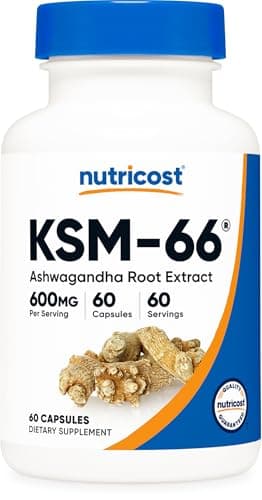
Nutricost — Ashwagandha KSM-66
The default for an eight-week trial: genuine KSM-66 at 600 mg per capsule, which lands squarely in the 300-600 mg a day band where Akhgarjand's dose-response analysis found the stress effect, at the lowest cost per clinically relevant dose here. Buying cheap matters when the plan is to run a fixed trial and stop if it does nothing.

NOW Foods — Ashwagandha KSM-66
450 mg of KSM-66 from a brand with in-house ISO-certified testing and a published COA. The smaller per-capsule dose is a feature if you want to split it morning and evening the way the 60-day trials did — two capsules a day puts you at 900 mg, one puts you at 450.

Life Extension — Life Extension Optimized Ashwagandha
The Sensoril option, at 125 mg and 10% withanolides per capsule. Sensoril is a root-plus-leaf extract with its own, smaller research base and its own dose range (125-250 mg a day), so this is the pick if you want to run the other studied extract rather than a second KSM-66 bottle.
How strong is the underlying effect anyway?
Worth knowing before you commit two months, because the timeline only matters if there is something at the end of it. The meta-analytic picture is genuinely positive and genuinely shaky. Akhgarjand and colleagues (2022) found ashwagandha significantly reduced anxiety (SMD -1.55) and stress (SMD -1.75) versus placebo across 12 trials — large effect sizes — but with heterogeneity of 93.8% and 83.1% respectively, and they rated the certainty of the evidence as low for both outcomes. A 2024 review in Explore pooling nine trials in 558 patients found mean reductions of 4.72 points on the Perceived Stress Scale, 2.19 on the Hamilton Anxiety Scale and 2.58 on serum cortisol versus placebo. The 2025 BJPsych Open review found effects on anxiety that survived correction for outliers (SMD -1.13) and confirmation in a Bayesian model, with weaker and unconfirmed signals for depression. NCCIH's own summary is deliberately plainer: research shows that some ashwagandha preparations may be effective for insomnia and stress, while the evidence is unclear about its effects on anxiety, and many trials are small and used different preparations, which makes the results hard to generalize. Put those together and the honest expectation is a modest-to-moderate effect on self-reported stress and sleep quality in people who start out stressed, demonstrated mostly in small trials of varying quality, measurable at eight weeks. That is a reasonable thing to spend eight weeks and fifteen dollars testing. It is not a reason to expect a transformation, and it is certainly not a reason to keep buying it for a year on the theory that it must be doing something.
The 12-week decision point, and the safety reason for it
There is a second, better reason to run this as a fixed-length trial rather than an open-ended habit: nobody knows what long-term use does. NCCIH states that ashwagandha appears to be safe when taken for up to three months and that its long-term safety is unknown. The same page notes that although liver injury is rare, there have been a number of cases that link liver injury to ashwagandha supplements — which is the kind of signal that argues for a defined endpoint rather than a permanent shelf position. So structure it: pick a standardized extract, take a studied dose daily, assess at eight weeks, and make a decision at twelve. If it helped, you can discuss continuing with a clinician who knows your medications. If it did not, you have saved yourself the open-ended subscription that this category runs on. The interaction list is not short either, and it is worth checking before you start rather than after: NCCIH reports possible interactions with medications for diabetes and high blood pressure, immunosuppressants, sedatives, anticonvulsants and thyroid hormone drugs. It should be avoided in pregnancy and while breastfeeding, is not recommended before surgery or for people with autoimmune or thyroid disorders, and should be avoided by people with hormone-sensitive prostate cancer because it may raise testosterone. Our roundup carries the same caution on every pick. None of that makes ashwagandha a dangerous supplement; it makes it a supplement that deserves a start date and an end date.
What we'd actually do
Write down a one-line baseline for a week — how you slept, how reactive you felt — before you open the bottle. Then take a named standardized extract at a studied dose, daily, for eight weeks: 300-600 mg a day of KSM-66 at 5% withanolides, or 125-250 mg a day of Sensoril at 10%, split into one or two doses. Use the first two weeks to check tolerance, not efficacy. Do not stack it with a new sleep supplement in the same window or you will not know which one did anything. At week eight, compare against your baseline note. If stress or sleep is clearly better, decide with a clinician whether to continue past three months. If it is ambiguous, give sleep endpoints until week ten, because that is where Langade's trial found separation. If it is nothing, stop — a bigger dose is not the answer, and the evidence for the 300-600 mg band does not improve above it. And keep the frame right: in NCCIH's own words about stress generally, there is no drug to cure stress, and its stress page covers breathing, mindfulness, meditation and progressive muscle relaxation without mentioning supplements at all. Ashwagandha is a plausible, modestly evidenced adjunct to sleep, training and whole food — not a substitute for any of them. This is general information, not medical advice; talk to a clinician before starting any supplement, especially if you take prescription medication.
Frequently asked questions
Eight weeks is the fair test, and four weeks is the earliest point worth judging. The trial literature is consistent on this: a 2025 BJPsych Open review of 14 randomized trials reports a median follow-up of 8 weeks at a median dose of 600 mg a day; Chandrasekhar's 2012 stress trial and Lopresti's 2019 trial both ran 60 days with their primary assessment at the end; Salve's 2019 trial measured Perceived Stress Scale scores at baseline, four weeks and eight weeks and found significant reductions at both 250 mg and 600 mg a day. Sleep is slower — Langade's 2019 insomnia trial found sleep onset latency improved in the placebo arm too at five weeks and only separated from placebo significantly at ten weeks. Expect nothing reliable in week one, possible subjective changes in weeks two to four, the measurable effect at six to eight weeks, and sleep endpoints at eight to ten.
Related reading
- → Best ashwagandha supplements, scored on a public rubric
- → Ashwagandha dosage: what the research actually uses
- → What supplements help with stress (and which ones don't)
- → Ashwagandha vs rhodiola
- → Best supplements for sleep
- → Melatonin vs magnesium: which one your sleep problem actually needs
- → How to read a supplement label
Sources
- Ashwagandha (research shows some preparations may be effective for insomnia and stress while evidence is unclear for anxiety; many trials small and using different preparations; appears safe short term for up to 3 months with long-term safety unknown; possible side effects drowsiness, stomach upset, diarrhea and vomiting; rare but reported cases linking liver injury to ashwagandha supplements; interactions with medications for diabetes and high blood pressure, immunosuppressants, sedatives, anticonvulsants and thyroid hormone drugs; avoid in pregnancy and breastfeeding, before surgery, and in autoimmune, thyroid and hormone-sensitive prostate cancer) — NIH National Center for Complementary and Integrative Health
- A prospective, randomized double-blind, placebo-controlled study of safety and efficacy of a high-concentration full-spectrum extract of ashwagandha root in reducing stress and anxiety in adults (Chandrasekhar K, Kapoor J, Anishetty S — 64 adults with chronic stress, 300 mg twice daily for 60 days, compliance calls on Days 15/30/45, final assessment Day 60; significant reductions on all stress scales P<0.0001 and serum cortisol P=0.0006) — Indian Journal of Psychological Medicine, 2012
- Adaptogenic and Anxiolytic Effects of Ashwagandha Root Extract in Healthy Adults: A Double-blind, Randomized, Placebo-controlled Clinical Study (Salve J, Pate S, Debnath K, Langade D — eight weeks, 60 adults with baseline PSS above 20, 125 mg or 300 mg twice daily vs placebo, stress measured at baseline, four weeks and eight weeks; PSS reduced at 250 mg/day P<0.05 and 600 mg/day P<0.001, serum cortisol reduced at both doses) — Cureus, 2019
- Efficacy and Safety of Ashwagandha (Withania somnifera) Root Extract in Insomnia and Anxiety: A Double-blind, Randomized, Placebo-controlled Study (Langade D et al. — 60 patients randomized 2:1 to 300 mg twice daily or placebo for 10 weeks with actigraphy; sleep onset latency improved in BOTH arms at five weeks and was significantly shorter than placebo only at ten weeks, p 0.019; sleep efficiency rose 75.63 to 83.48 vs 75.14 to 79.68; sleep quality p 0.002) — Cureus, 2019
- An investigation into the stress-relieving and pharmacological actions of an ashwagandha (Withania somnifera) extract: A randomized, double-blind, placebo-controlled study (Lopresti AL et al. — 60-day trial, 60 stressed healthy adults, 240 mg standardized extract once daily; HAM-A reduction P=.040, DASS-21 P=.096, morning cortisol P<.001, DHEA-S P=.004; proposed HPA-axis mechanism) — Medicine, 2019
- Does Ashwagandha supplementation have a beneficial effect on the management of anxiety and stress? A systematic review and meta-analysis of randomized controlled trials (Akhgarjand C et al. — 12 trials, 1,002 participants; anxiety SMD -1.55 and stress SMD -1.75 vs placebo with I2 of 93.8% and 83.1%; dose-response favorable for stress at 300-600 mg/day; certainty of evidence rated LOW for both outcomes) — Phytotherapy Research, 2022
- The effect of Withania somnifera on mental health symptoms in individuals with mental disorders: a systematic review and meta-analysis (14 studies, 360 treated and 353 controls; 13 trials oral at a median dose of 600 mg/day; MEDIAN FOLLOW-UP 8 WEEKS; outlier-corrected anxiety SMD -1.13, stress SMD -0.95, sleep quality SMD -1.35; no safety or tolerability difference vs comparators) — BJPsych Open, 2025
- Effects of Ashwagandha (Withania Somnifera) on stress and anxiety: A systematic review and meta-analysis (nine randomized controlled trials, 558 patients; Perceived Stress Scale MD -4.72, Hamilton Anxiety Scale MD -2.19, serum cortisol MD -2.58 vs placebo; four studies reported mild to moderate adverse events) — Explore, 2024
- Efficacy and Tolerability of Ashwagandha Root Extract in the Elderly for Improvement of General Well-being and Sleep: A Prospective, Randomized, Double-blind, Placebo-controlled Study (12-week trial, 50 adults aged 65-80, 600 mg/day; significant improvement in WHOQOL-BREF, sleep quality P<0.0001 and mental alertness P<0.034) — Cureus, 2020
- Stress (complementary approaches with evidence for stress include deep breathing, biofeedback, progressive muscle relaxation, mindfulness, meditation and yoga; the page states there is no drug to cure stress and does not list dietary supplements among the approaches covered) — NIH National Center for Complementary and Integrative Health
- Product titles, extract types, withanolide percentages, counts, certifications, live prices and availability for the ashwagandha supplements referenced — retrieved via the Amazon product data layer — Amazon product listing data, 2026
Nutricost — Ashwagandha KSM-66
$14.95 · on Amazon