Do Electrolyte Powders Actually Work?
Yes, but for a narrower job than the packaging suggests. An electrolyte powder is mostly salt with flavoring, and salt does something real: when you have lost a lot of fluid and sodium through sweat, replacing both together restores blood volume faster and more durably than water alone. The evidence for that is solid in the setting it was built for — long sessions, hot conditions, heavy sweaters, and people eating low-carb whose kidneys are actively dumping sodium. Outside that setting the case gets thin fast. The average American already eats about 3,400 mg of sodium a day against a recommended ceiling of 2,300 mg, so for a 45-minute air-conditioned gym session the powder is solving a shortage you do not have. It gets thinner still on the claims stacked around the edges of the label: in a randomized trial of 13 drinks, a sports drink retained no better than plain still water, while milk and an oral rehydration solution both beat it. And the cramp claim — the one on half the packaging in the category — is the weakest thing in the entire product story, unsupported by the prospective evidence. Our read is that electrolyte powders are a legitimate tool with a real use case that the industry has inflated into an all-day habit. Buy one if you sweat hard, train long, or eat low-carb. If you do not, the money is better spent on food.
Affiliate disclosure: Trusted Health Gear is an Amazon Associate. If you buy through links on this page, we may earn a commission at no extra cost to you. Commission does not influence our rankings. Full policy.
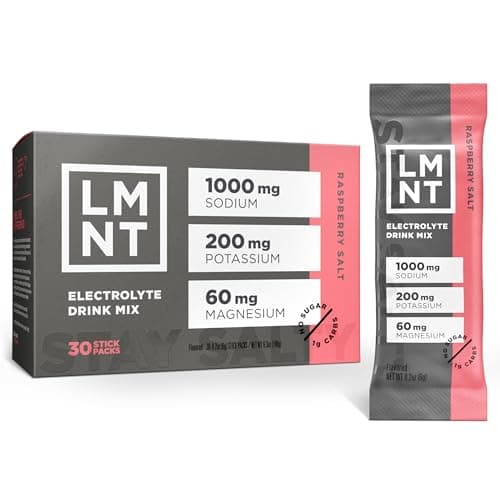
LMNT — LMNT Recharge Electrolyte Drink Mix
Highest sodium dose — low-carb, keto, and heavy-sweat athletes
What you are actually buying
Strip the branding off any electrolyte powder and you are left with sodium, potassium, some magnesium, a flavor system and a sweetener. Sodium is the active ingredient. It is the electrolyte you lose in meaningful quantity through sweat, it is the one that governs how much fluid your body holds onto, and it is the one whose dose separates a serious mix from flavored dust. Everything else on a hydration label is either a rounding error, a marketing input, or a nutrient you are better off getting from food — potassium in particular, where a single baked potato or a cup of beans delivers more than most stick packs. That framing matters because it tells you what question to ask. You are not asking whether "electrolytes" work; sodium and potassium are not optional nutrients, and nobody disputes that your body runs on them. You are asking whether you are currently losing enough of them, fast enough, that food and water cannot keep up. For most people on most days the answer is no. For a specific set of situations the answer is clearly yes, and those situations are worth knowing precisely rather than assuming you are always in one.
What the sweat data actually shows
The most useful number in this category is how much sodium you personally lose per liter of sweat, and the honest answer is that it varies enormously between people. In a study of 157 experienced marathon runners published in the Journal of the International Society of Sports Nutrition, average sweat sodium concentration came out at 42.9 mmol/L — roughly 990 mg of sodium per liter of sweat, using the standard 23 mg per mmol conversion. But the spread ran from 7.0 to 95.5 mmol/L, which is about 160 mg per liter at the low end and 2,200 mg per liter at the high end. That is a fourteen-fold difference between two runners in the same race. About 20% of that group exceeded 60 mmol/L (roughly 1,380 mg per liter), the threshold the researchers used to flag people who might genuinely need a personalized sodium strategy. Women averaged lower than men, and no female runner in the study crossed that threshold. Notably, sweat sodium did not track with sweat rate, age, body size, training history or experience — so you cannot infer it from how sweaty you feel. Two caveats keep this honest. That study used forearm patches, and a 2017 review in Sports Medicine on sweat-testing methodology makes the point that collection site, timing, skin cleaning and analysis method all shift the result, with regional patches generally reading higher than whole-body collection. And the concentration only matters alongside volume: losing 2,200 mg per liter is irrelevant if you only produced 300 ml of sweat. The practical takeaway is that the salty, high-volume sweater and the light sweater have genuinely different needs, and a single product recommendation for both of them is marketing rather than physiology.
Where electrolyte powders clearly earn their place
Three situations make the case on their own. The first is long, hot, hard work — endurance sessions past the hour mark in heat, back-to-back training days in summer, outdoor labor. Here the fluid and sodium losses are large enough that food and water on their own leave you playing catch-up, and replacing both together is the whole point of the product. The second is being a demonstrably heavy or salty sweater: the white crust on a black shirt, the sting in your eyes, the one-in-five profile from the marathon data. The third is low-carbohydrate eating, and this one is the most under-appreciated. When carbohydrate intake drops, insulin drops, and insulin is the hormone that tells your kidneys to hold onto sodium. Remove that signal and you excrete more of it. A 2025 scoping review in Frontiers in Nutrition on symptoms during keto initiation describes exactly this: sodium and potassium excretion is greatest between days one and four of the diet, and the elevated losses generally subside after about 14 days. The symptom cluster people call "keto flu" maps onto that window — the review's tables put fatigue at 18–25% of adults, headache at 8–25%, light-headedness at 15–21% and muscle cramps at 3–37%. The review is also candid that the standard fix — an extra 1–2 grams of sodium a day from broth — rests on clinical experience and mechanism rather than randomized trials. That is a real evidence gap, and it is the reason we frame added sodium on keto as a sensible first thing to try rather than a proven treatment. If you train hard on low-carb, this is the strongest reason on the page to keep a sodium-forward mix in the cupboard.
Where the everyday-hydration story falls apart
The category's growth has not come from marathoners; it has come from people drinking a stick pack at a desk. That version of the pitch runs into two problems. The first is that you are almost certainly not short of sodium. The FDA puts average American intake at about 3,400 mg a day against a Dietary Guidelines ceiling of less than 2,300 mg, with over 70% of it coming from packaged and prepared food rather than the salt shaker — and its own explainer notes that the body needs sodium in relatively small amounts "provided that substantial sweating does not occur." That parenthetical is the entire argument. Adding 500 to 1,000 mg on top of an intake already above the recommended limit is not correcting a deficiency, and if you have high blood pressure or kidney disease it is a conversation to have with your doctor rather than a wellness habit to adopt. The second problem is that the powder may not even be hydrating you better than water. A 2016 randomized trial in the American Journal of Clinical Nutrition tested 13 common drinks in 72 euhydrated men, measuring how much of a liter each one retained over the following hours to build what the authors called a beverage hydration index. An oral rehydration solution, full-fat milk and skim milk all produced significantly less urine than still water. A sports drink did not — its output was statistically indistinguishable from plain water, as were cola, coffee, tea, orange juice and sparkling water. If you are already hydrated, the flavored mix in your glass is doing approximately what the glass of water would have done. Milk did better than the sports drink, which is a useful thing to know and an inconvenient one to put on a stick pack.
The cramp claim is the weakest thing on the label
Half this category is sold on cramping, and it is the claim with the least behind it. A review in the British Journal of Sports Medicine examined the evidence for the two competing explanations of exercise-associated muscle cramps and found that support for the electrolyte-depletion and dehydration hypotheses came mainly from anecdotal clinical observation, case series totaling 18 people, and one small case-control study of 10 — while four prospective cohort studies did not support them. The alternative explanation, altered neuromuscular control, is backed by human cramp models, epidemiological data in cramping athletes and animal work, and it is where the evidence has been accumulating. The 2015 international consensus statement on exercise-associated hyponatremia makes the same point from a different direction, stating plainly that high fluid intake — water, sports drinks or other hypotonic beverages — will not necessarily prevent muscle cramps or exertional heat stroke. None of that means your cramps are imaginary, and a salty drink is a harmless thing to try. It does mean that if cramping is your main reason for buying, you are buying against the weakest evidence in the category, and that fatigue, pacing and training load are more likely culprits than your sodium status.
The safety point nobody puts on the packaging
Drinking more is not automatically safer, and this is the one part of the topic where the stakes are real. Exercise-associated hyponatremia — a fall in blood sodium, diagnosed when serum sodium drops below the laboratory's normal range, typically under 135 mmol/L — is caused primarily by consuming hypotonic fluid in excess of sweat and urine losses. Crucially, the 2015 consensus statement is explicit that a sports drink does not protect you from it: every sports drink is itself hypotonic, carrying roughly 10 to 38 mmol/L of sodium (about 230 to 870 mg per liter) against a blood concentration near 140 mmol/L. Sodium supplementation can slow the decline when fluid intake roughly matches sweat losses, but it cannot prevent hyponatremia in someone who keeps overdrinking; the dilution overwhelms it. The consensus recommendation is unglamorous and free: let thirst set the pace. Thirst is described in the statement as a finely tuned regulatory mechanism that should be adequate stimulus to prevent excess dehydration while markedly reducing hyponatremia risk in all sports, and the old advice to drink ahead of thirst is named as having fostered the misconception that thirst is a poor guide. The risk profile here is concentrated in long events — over four hours, slower finishers, inexperienced participants — not in the person having a stick pack with lunch. But it is worth knowing that the failure mode in this category runs in both directions, and that "more electrolytes, more fluid, all day" is not a conservative default. If you feel unwell during or after a long event, that is a medical question, not a supplement question.
How to read the label, and what we would actually buy
Four numbers decide whether a powder is worth your money. Sodium per serving is the first and most important: sodium-forward mixes land around 500 to 1,000 mg, everyday mixes closer to 200 to 400 mg, and if the front of the pack sells hydration while the back lists 60 mg of sodium, you are buying flavored sweetener. Added sugar is second, and it is context-dependent rather than good or bad — zero sugar is right for daily use and low-carb eating, while real carbohydrate is functional fuel in an endurance session past an hour. Third is potassium and magnesium, useful in a serious mix but never the reason to buy one. Fourth is cost per serving, which is where this category is at its most absurd: the same sodium and potassium can cost 30 cents or two dollars depending on whose name is on the packet. Beyond that, look for a full ingredient panel with real amounts rather than a proprietary blend, and prefer brands that publish third-party testing. Our position, consistent with everything else on this site: food first. Salting your own cooking, eating potassium-rich whole foods, and drinking water to thirst covers most people most of the time, and it is cheaper and better than any powder. Where a mix genuinely earns its place — long hot sessions, a salty-sweater profile, keto or carnivore eating, heavy CrossFit-style volume in summer — buy a boring, sodium-first, zero-sugar option and judge it on cost per serving rather than on the story. That is the logic behind our top-scored pick in this category, which wins on the one metric that actually determines whether the product does its job: how much sodium is in the scoop.
Frequently asked questions
Both, depending on who is drinking one. The underlying mechanism is real — replacing fluid and sodium together restores blood volume more effectively than water alone after substantial sweat losses, which is why oral rehydration solutions exist. What is marketing is the extension of that finding to everyone, all day. If you are training long in heat, sweating heavily, or eating low-carb, a powder is doing a real job. If you are hydrated and sedentary, a randomized trial found a sports drink retained no better than plain water, and you already eat more sodium than the Dietary Guidelines recommend.
Related reading
- → Best supplements for runners
- → Best electrolyte powders — six mixes scored on sodium dose, sugar and price per serving
- → Best electrolytes for keto — sodium-first picks for low-carb eating
- → Best electrolyte tablets and capsules for training and travel
- → Best sodium and salt supplements for heavy sweaters
- → Electrolyte tablets vs powder: which format suits your training
- → LMNT vs Liquid IV: sodium dose and sugar compared
- → How to read a supplement label and spot a proprietary blend
Sources
- Interindividual variability in sweat electrolyte concentration in marathoners (Muñoz CX, Del Coso J, et al.) — 157 marathon runners; mean sweat sodium 42.9 ± 18.7 mmol/L, range 7.0–95.5 mmol/L; 20% above 60 mmol/L; women lower than men — Journal of the International Society of Sports Nutrition, 2016
- Sweating Rate and Sweat Sodium Concentration in Athletes: A Review of Methodology and Intra/Interindividual Variability (Baker LB) — how collection method, timing and analysis change measured sweat sodium — Sports Medicine, 2017
- Statement of the Third International Exercise-Associated Hyponatremia Consensus Development Conference, Carlsbad, California, 2015 (Hew-Butler T, Rosner MH, et al.) — drinking to thirst as prevention; sports drink sodium 10–38 mmol/L vs serum ~140 mmol/L; sodium supplementation cannot prevent EAH under fluid overload — Clinical Journal of Sport Medicine, 2015
- A randomized trial to assess the potential of different beverages to affect hydration status: development of a beverage hydration index (Maughan RJ, et al.) — 13 drinks, 72 euhydrated men; oral rehydration solution and milk retained better than water, sports drink did not differ from water — The American Journal of Clinical Nutrition, 2016
- Cause of exercise associated muscle cramps — altered neuromuscular control, dehydration or electrolyte depletion? (Schwellnus MP) — four prospective cohort studies do not support the electrolyte-depletion and dehydration hypotheses — British Journal of Sports Medicine, 2009
- Symptoms during initiation of a ketogenic diet: a scoping review of occurrence rates, mechanisms and relief strategies (Skartun O, Smith CR, Laupsa-Borge J, Dankel SN) — natriuresis greatest on days 1–4 and subsiding after 14 days; adult symptom rates for fatigue, headache, light-headedness and cramps — Frontiers in Nutrition, 2025
- Sodium in Your Diet — average US intake about 3,400 mg/day, Dietary Guidelines limit under 2,300 mg/day, over 70% from packaged and prepared foods — U.S. Food and Drug Administration
- Dietary Reference Intakes for Sodium and Potassium — sodium Adequate Intake 1,500 mg/day for ages 14+, Chronic Disease Risk Reduction Intake to reduce sodium if above 2,300 mg/day; potassium AIs range 2,300–3,400 mg/day by age and sex — National Academies of Sciences, Engineering, and Medicine, 2019
LMNT — LMNT Recharge Electrolyte Drink Mix
$45.00 · on Amazon