The Best Home Blood Pressure Monitors (2026)
Blood pressure tracking is one of the few things you can genuinely do at home with a $20-$100 device — but only if the device is accurate and the cuff actually fits your arm. These are consumer devices, not a substitute for a clinician's measurement, so treat a home monitor as a way to gather trend data to discuss with your doctor, not to diagnose or treat anything yourself. We ranked these on the specs that decide whether a reading is trustworthy: clinical validation (has the device been tested against a reference standard, and does it appear on the US Blood Pressure Validated Device Listing at validatebp.org?), correct cuff size for your upper-arm circumference, one-button ease of use, display readability, and app or Bluetooth logging if you want trend history. We favor upper-arm cuff monitors over wrist units, which are more position-sensitive and generally less reliable. Below are six real upper-arm monitors spanning ultra-budget to premium, with honest trade-offs on each.
Top pick
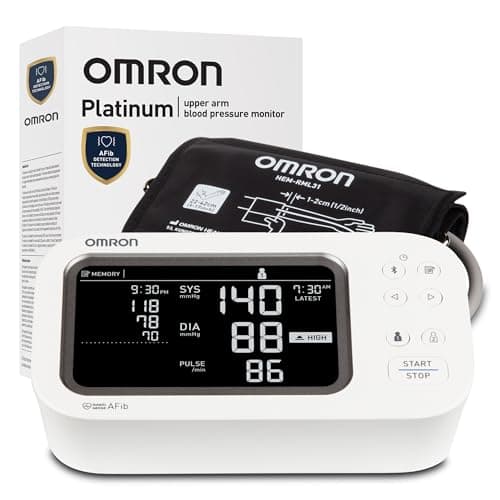
OMRON — OMRON Platinum Blood Pressure Monitor
Upper-arm oscillometric monitor · multiple-reading averaging (takes 3 consecutive readings about a minute apart and averages them) · dual-user memory · backlit dual-color display with above/within-range indicator · Bluetooth to the free OMRON Connect app (iOS/Android) · ships with OMRON's wide-range cuff (fits most adult arms, roughly 9-17 in / 22-42 cm) · irregular-heartbeat and body-movement indicators
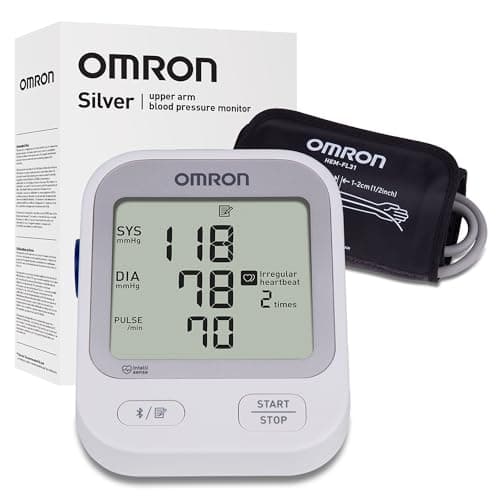
OMRON — OMRON Silver Blood Pressure Monitor
At a glance
Tap a row to check price · tap a header to sort| # | Best for | Price | ||
|---|---|---|---|---|
| 1 | | Best overall | 9.1/10 | Check price |
| 2 | | Best everyday value | 8.8/10 | $64.79 |
| 3 | 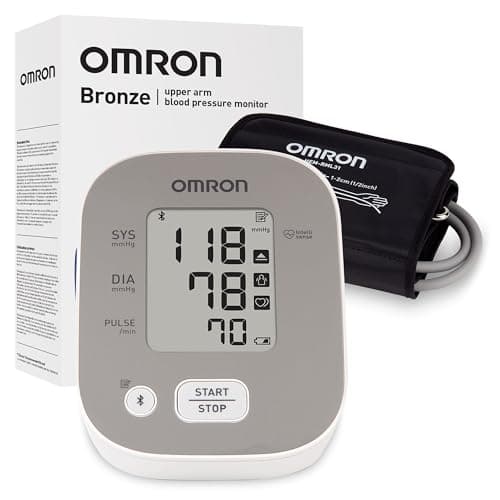 | Best no-frills validated pick | 8.2/10 | $46.54 |
| 4 | 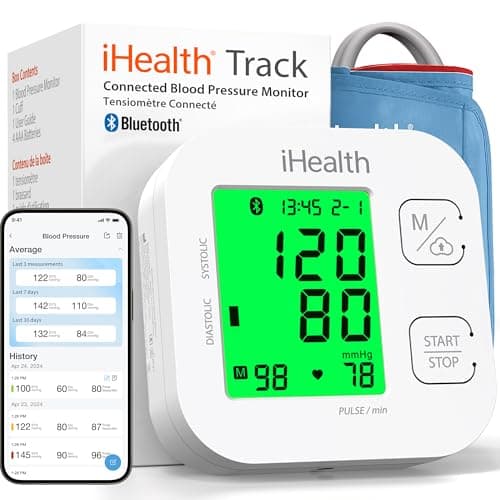 | Best budget smart monitor | 7.9/10 | $39.99$49.98 |
| 5 | 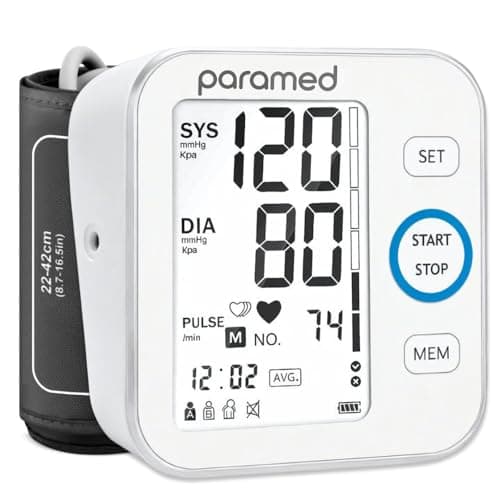 | Best large-display budget | 7.2/10 | $29.95 |
| 6 | 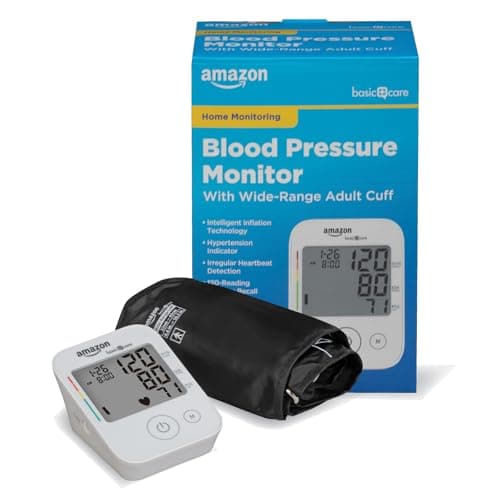 | Best ultra-budget | 6.9/10 | $18.95 |
Prices pulled from Amazon as of Sep 15, 2026 and are subject to change. The price shown on Amazon at checkout applies.
How we scored
Every product below is scored on six metrics, 0-10 each, with the weighting described on how we review. The criteria specific to this category:
- Clinical validation — whether the device has been tested against a reference standard and appears on the US Blood Pressure Validated Device Listing (validatebp.org); a validated monitor is the single most important spec, far more so than feature count.
- Correct cuff size — the cuff must match your upper-arm circumference, so measure the middle of your bare arm and check the listed range; a cuff that is too small tends to read high and one that is too large tends to read low.
- Monitor type — upper-arm oscillometric cuffs are the recommended home standard, while wrist monitors are far more sensitive to arm position and generally less reliable for routine tracking.
- Ease of use — one-button operation, automatic inflation, and clear prompts matter because a fiddly device is a device you will not use consistently.
- Display and readability — a large, backlit, high-contrast screen (and optional voice readout) keeps the numbers legible for older users or anyone with low vision.
- App, memory, and value — Bluetooth logging, multi-user memory, and multiple-reading averaging add convenience, but weigh them against price, because a plain validated cuff beats a fancy un-validated one every time.
What to know before buying
- Validation is the spec that matters most. Look up the exact model on the US Blood Pressure Validated Device Listing (validatebp.org) or your regional equivalent before you buy. Phrases like "FDA cleared" and "clinically tested" on the box are marketing language that does not guarantee independent validation — a spot on the validated-device list does. OMRON is the brand most consistently represented there.
- Measure your arm before you buy. Cuff fit is the most common cause of bad home readings. Wrap a tape measure around the middle of your bare upper arm; most standard cuffs cover roughly 9-17 in (22-42 cm), but larger or smaller arms need a specific cuff. A cuff that does not fit will skew every reading no matter how good the electronics are.
- Upper-arm beats wrist. Wrist monitors are tempting because they are small and cheap, but wrist arteries are narrower and the device is very sensitive to how high you hold your wrist relative to your heart. For most people an upper-arm cuff is the more trustworthy choice; reserve a wrist unit for someone who genuinely cannot fit an arm cuff, and keep the wrist at heart level.
- Technique changes the number as much as the device does. Sit with your back supported, feet flat, arm resting at heart level, and do not talk; rest quietly for five minutes first. Even a validated monitor gives junk numbers right after coffee, a cigarette, or a walk up the stairs. Our guide on how to measure blood pressure at home walks through the full routine.
- A home monitor is a tracking tool, not a diagnosis. These are consumer devices. Single readings bounce around, so trends over days and weeks are what is useful — bring the log to your doctor and do not start, stop, or change anything based on home numbers alone.
Our picks
OMRON — OMRON Platinum Blood Pressure Monitor
Key specs: Upper-arm oscillometric monitor · multiple-reading averaging (takes 3 consecutive readings about a minute apart and averages them) · dual-user memory · backlit dual-color display with above/within-range indicator · Bluetooth to the free OMRON Connect app (iOS/Android) · ships with OMRON's wide-range cuff (fits most adult arms, roughly 9-17 in / 22-42 cm) · irregular-heartbeat and body-movement indicators
Pros
- OMRON is the brand most consistently found on the US Blood Pressure Validated Device Listing, and this top-tier line is built around accuracy consistency — the one thing that matters most in a home monitor
- Multiple-reading averaging automatically takes three consecutive readings and averages them, smoothing out the reading-to-reading bounce that trips up single-shot monitors
- Dual-user memory plus Bluetooth sync to OMRON Connect lets two people keep separate trend logs that are easy to hand to a doctor
- Backlit dual-color display is easy to read and flags when a reading is above the usual range as information, without pretending to diagnose anything
Cons
- The most expensive pick here; the averaging and dual-user features are convenience, not accuracy magic, so a cheaper validated OMRON measures nearly as well
- App setup and Bluetooth pairing add friction that some users — especially older ones — would rather skip
- Ships with one cuff size, so very large or very small arms may need a separately purchased cuff to read accurately
OMRON — OMRON Platinum Blood Pressure Monitor
- Accuracy / validation10/10
- Ease of use8/10
- Display / readability9/10
- App / connectivity9/10
- Value7/10
OMRON — OMRON Silver Blood Pressure Monitor
Key specs: Upper-arm oscillometric monitor · single-user on-device memory · Bluetooth to the OMRON Connect app · high-morning-average indicator · backlit display · irregular-heartbeat detection · ships with OMRON's wide-range cuff (fits most adult arms, roughly 9-17 in / 22-42 cm)
Pros
- Same OMRON accuracy pedigree as the pricier models in a simpler single-user package — for most households this is the sweet spot
- Bluetooth sync to OMRON Connect keeps an automatic log you can hand to your doctor, without the Platinum's price tag
- High-morning-average indicator surfaces the morning readings clinicians often ask about, presented as data rather than advice
- Comfortable wide-range cuff fits most adult arms and inflates automatically at a single button press
Cons
- Single-user memory only — two people sharing it will muddle their on-device logs unless one tracks in the app
- No multiple-reading auto-averaging; you take repeat readings manually and average them yourself
- Still costs several times more than a basic cuff for features some people will not use
OMRON — OMRON Silver Blood Pressure Monitor
- Accuracy / validation9/10
- Ease of use9/10
- Display / readability8/10
- App / connectivity8/10
- Value8/10
OMRON — OMRON Bronze Blood Pressure Monitor
Key specs: Upper-arm oscillometric monitor · single-user on-device memory (no phone required) · large-digit display · irregular-heartbeat detection · one-button automatic inflation · ships with OMRON's wide-range cuff (fits most adult arms, roughly 9-17 in / 22-42 cm) · no Bluetooth or app
Pros
- Gives you OMRON's accuracy reputation without any phone, account, or Bluetooth pairing — press one button and read the screen
- On-device memory stores recent readings so you can still watch a trend without an app
- Simple large-digit display is friendly for older users who find app-connected monitors frustrating
- The cheapest way into the OMRON lineup while keeping the brand's core accuracy focus
Cons
- No app or Bluetooth, so logging a longer history means writing the numbers down by hand
- Limited on-device memory compared with the Silver and Platinum
- Single user, and it skips the dual-color above-range backlight of the pricier models
OMRON — OMRON Bronze Blood Pressure Monitor
- Accuracy / validation9/10
- Ease of use9/10
- Display / readability7/10
- App / connectivity4/10
- Value8/10
iHealth — iHealth Track Smart Upper Arm Blood Pressure Monitor
Key specs: Upper-arm oscillometric monitor · wide-range cuff (fits roughly 8.7-16.5 in / 22-42 cm) · Bluetooth to the free iHealth app (iOS/Android) · unlimited app-based reading history with multi-user support · color-coded on-device indicator · one-button operation
Pros
- Much cheaper than the connected OMRONs while still offering tidy Bluetooth logging and unlimited history in the iHealth app
- App supports multiple users and exports readings, which makes it easy to share a clean log with a clinician
- Wide-range cuff and simple one-button inflation make it beginner-friendly
- Color-coded feedback shows where a reading falls versus standard ranges as information, not diagnosis
Cons
- Relies on the app for memory and history — there is minimal on-device storage, so it is a poor fit for anyone who does not want to use a phone
- Not as consistently represented on validated-device listings as OMRON, so confirm the exact model before relying on it
- Plastic build and cuff feel are budget-grade
iHealth — iHealth Track Smart Upper Arm Blood Pressure Monitor
- Accuracy / validation7/10
- Ease of use8/10
- Display / readability7/10
- App / connectivity8/10
- Value9/10
Paramed — Paramed Automatic Upper Arm Blood Pressure Monitor
Key specs: Upper-arm oscillometric monitor · adjustable cuff (fits 8.7-16.5 in / 22-42 cm) · large LCD display · stores 120 readings (2 users x 60) · irregular-heartbeat indicator · includes storage bag and batteries · one-button automatic operation
Pros
- Large, easy-to-read LCD is one of the more legible screens at this price — good for older users or low vision
- Stores 120 readings across two users on the device itself, with no app or phone required
- Comes complete with a carry bag and batteries, so it works out of the box
- A genuinely inexpensive way to get a full-size upper-arm cuff rather than settling for a compromise wrist unit
Cons
- Budget brand without OMRON's validation track record, so treat readings as trend data and cross-check accuracy against a clinic cuff
- No Bluetooth or app; tracking beyond the on-device 120 readings means writing numbers down
- Cuff and housing are lightweight, value-grade components
Paramed — Paramed Automatic Upper Arm Blood Pressure Monitor
- Accuracy / validation6/10
- Ease of use8/10
- Display / readability9/10
- App / connectivity3/10
- Value9/10
Amazon Basic Care — Amazon Basic Care Blood Pressure Monitor
Key specs: Upper-arm oscillometric monitor · wide-range arm cuff · intelligent (gradual) inflation · hypertension-range indicator · irregular-heartbeat detection · large on-device display · basic reading memory · sold under Amazon's Basic Care line (previously Healthwise)
Pros
- Among the cheapest full-size upper-arm cuffs available, so it is an easy first monitor or a spare for a second location
- Intelligent inflation raises pressure gradually, which is more comfortable than older fixed-inflation cuffs
- Wide-range cuff covers most adult arms and the display is large and legible
- Hypertension-range and irregular-heartbeat indicators present readings as information to discuss with a doctor
Cons
- House-brand device without a public validated-device-listing pedigree, so use it for trends and cross-check against a clinic measurement
- No Bluetooth, app, or meaningful multi-user memory
- Build quality and cuff durability are entry-level
Amazon Basic Care — Amazon Basic Care Blood Pressure Monitor
- Accuracy / validation6/10
- Ease of use8/10
- Display / readability7/10
- App / connectivity3/10
- Value9/10
Frequently asked questions
For most people, upper-arm. Wrist arteries are narrower and wrist monitors are very sensitive to position — hold the wrist too high or too low relative to your heart and the number shifts. Upper-arm cuffs, positioned at heart level by default, are the type recommended for routine home use. Reserve wrist units for someone who genuinely cannot fit an arm cuff, and even then keep the wrist supported at heart level while measuring.
Related reading
Sources
- Monitoring Your Blood Pressure at Home (home monitor guidance, cuff fit, technique) — American Heart Association (AHA), 2026
- US Blood Pressure Validated Device Listing (check whether your exact model is validated) — validatebp.org (American Medical Association), 2026
- Get the Most Out of Home Blood Pressure Monitoring (upper-arm vs wrist, measurement technique) — Mayo Clinic, 2026
- How to Buy and Use a Home Blood Pressure Monitor (validation, cuff sizing, accuracy) — Consumer Reports, 2026
Last verified: August 1, 2026. See our editorial policy and how we review for details on scoring and update cadence. Canonical URL: https://trustedhealthgear.com/reviews/best-blood-pressure-monitor.
OMRON — OMRON Platinum Blood Pressure Monitor
on Amazon