How Accurate Are Smart Scales? Accurate for Weight, Unreliable for Body Fat
Short answer: a decent smart scale is genuinely accurate for body weight — typically within a few tenths of a pound, and more importantly consistent from day to day, which is the property that actually matters. For body fat percentage it is not accurate in any absolute sense. Consumer scales estimate body composition using bioelectrical impedance analysis, which sends a tiny current through your body and infers fat mass from how much the current is impeded. Published comparisons of consumer BIA against reference methods like DXA commonly find discrepancies of several percentage points in either direction, and the error is larger in lean, muscular and very overweight people — the two ends of the range this site's readers tend to sit at. So use the weight number, treat the body fat number as a trend line rather than a measurement, and understand that a reading which drops three points overnight means you were dehydrated, not that you lost fat. Our pick for the scale that does the first job best is the Withings Body Smart, because accurate weight tracking with painless syncing is the thing worth paying for.
Affiliate disclosure: Trusted Health Gear is an Amazon Associate. If you buy through links on this page, we may earn a commission at no extra cost to you. Commission does not influence our rankings. Full policy.
What a smart scale actually measures
A smart scale does two separate things, and conflating them is the source of nearly all the confusion. The first is weighing you, which it does with load cells — strain gauges that deform under load and change resistance proportionally. This is mature, cheap, well-understood technology, and a reasonable consumer scale is accurate to within a few tenths of a pound and, crucially, repeatable. The second thing is estimating body composition, which it does with bioelectrical impedance analysis. BIA sends an imperceptible alternating current between electrodes and measures the impedance it meets. Lean tissue holds a lot of water and electrolytes and conducts well; fat tissue holds much less water and conducts poorly. The scale measures total impedance, then feeds that into a proprietary regression equation along with your height, age, sex and weight to produce an estimate of fat mass, muscle mass, body water and the rest. Note what just happened: your body fat percentage was not measured. It was predicted by a statistical model built on a reference population, using one electrical reading as the main input. That is the whole reason weight is reliable and body fat is not.
How accurate is the weight reading?
Accurate enough that you should trust it, with two caveats about how you use it. Load cells in consumer scales typically resolve to 0.1 or 0.2 lb and are more consistent than they are absolutely calibrated — meaning the scale might read you two tenths heavy compared with a calibrated clinical scale, but it will read you two tenths heavy every single time, which makes the day-to-day change valid even if the absolute number is slightly off. That consistency is what matters for tracking. The caveats: first, put the scale on a hard flat floor, because carpet lets the feet sink unevenly and genuinely degrades the reading — this is the single most common cause of a scale that seems to give random numbers. Second, your actual body weight fluctuates by one to four pounds across a normal day from food, fluid, sodium and glycogen, which dwarfs any error in the hardware. If your scale appears inaccurate, it is almost always measuring real fluctuation in you, correctly.
How inaccurate is the body fat reading, specifically?
Expect to be wrong by several percentage points, and expect the error to be systematic rather than random. Studies comparing consumer-grade foot-to-foot BIA with reference methods such as DXA and hydrostatic weighing have repeatedly found discrepancies commonly in the range of three to eight percentage points, with a tendency to underestimate body fat in leaner subjects and overestimate it in others. The error is also not evenly distributed across people: BIA's assumptions about hydration and body geometry break down in the very lean, the very muscular, and the very overweight, which means a heavy-training reader is exactly the kind of person the model handles worst. Two further wrinkles matter. Foot-to-foot scales pass current mainly through the lower body, so they effectively extrapolate your whole composition from your legs — which is why some models add a handle to run the current hand-to-foot and get a fuller picture. And every brand uses a different proprietary equation, so two scales can read the same body four points apart and neither is lying; they are using different models. The practical rule: never compare your body fat number to anyone else's, or to a different scale.
Why your body fat reading jumps around overnight
Because BIA is, at bottom, a hydration measurement, and your hydration changes constantly. Lean tissue conducts because it is wet; if you are dehydrated, impedance rises, the equation reads less lean tissue, and your body fat percentage goes UP — even though nothing about your fat has changed. This produces a set of entirely predictable artefacts. Weighing after a hard training session or a sauna shows higher body fat, because you sweated out conducting fluid. Weighing after a big salty meal or a few drinks shows lower body fat, because you are holding water. Morning readings differ from evening readings. Readings differ across the menstrual cycle. Cold feet, damp feet, callused heels and thick socks all change the contact resistance at the electrodes. None of that is a faulty scale. It is the method working exactly as designed on an input that is not what you wanted to measure. The implication for your routine is straightforward: standardise the conditions or the number is noise.
What to look for when buying one
Four things, in this order. First, decide whether you care about anything beyond weight — if the answer is no, buy a scale with good load cells, reliable sync, and a display you can read, and ignore the metric count entirely. Second, choose Wi-Fi over Bluetooth-only if you want weighing to be frictionless: a Wi-Fi scale uploads without you opening an app, which sounds trivial and is the difference between tracking for a year and quitting in March. Third, check that it syncs with whatever you already use — Apple Health, Google Fit, Fitbit, Samsung Health — because a scale that strands your data in a proprietary app is a scale you will abandon. Fourth, if you genuinely want the best available body composition estimate from a consumer device, look for 8-electrode hand-to-foot BIA rather than 4-electrode foot-to-foot, since passing current through the upper body as well as the legs removes one of the method's larger approximations. Features worth having beyond that: multi-user auto-recognition if the household shares it, a trend-only or 'eyes-closed' mode if seeing a daily number is unhelpful for you, and an athlete mode that applies a different equation for high lean mass. Features not worth paying for: dozens of derived metrics, 'metabolic age', and anything described as visceral fat, which a foot-to-foot scale cannot meaningfully measure.
The scales we'd actually buy
Every pick below is already reviewed and scored in our roundups — same products, same specs, with live Amazon prices.
| Attribute | Withings Withings Body SmartOur pick | Arboleaf Arboleaf 8-Electrode Body Composition Scale | Wyze Wyze Scale Ultra |
|---|---|---|---|
| Best for | Best overall — accurate, no-fuss Wi-Fi weight tracking with the most polished app and ecosystem | Best body-composition detail — 8-electrode hand-to-foot BIA with a handle for a fuller estimate | Best value all-rounder — Wi-Fi, body composition, and a heart-rate reading for around fifty dollars |
| Who it's for | For the reader who wants weight tracking to be effortless and accurate: Wi-Fi upload with no app-opening, a polished ecosystem, and a trend-only weigh mode if a daily number is unhelpful for you. | For the reader who genuinely wants the best body composition estimate a consumer device can give — 8-electrode hand-to-foot BIA passes current through the upper body too, removing one of the method's biggest approximations. | For the reader who only cares about reliable weight plus Wi-Fi sync and does not want to spend three figures to get it. |
| Key specs | Foot-to-foot bioelectrical-impedance scale · Wi-Fi and Bluetooth · syncs to the Withings Health Mate app and is Apple Health compatible · body weight, body-fat %, plus muscle, water, and bone estimates and BMI · 'eyes-closed'/trend-only weigh mode and an Athlete mode · multi-user auto-recognition · high-precision weight sensors | 8-electrode (hand-to-foot) bioelectrical-impedance scale with a retractable handle display · Bluetooth to the arboleaf companion app · 50+ body metrics including segmental body-fat, muscle mass, water, and BMI · multi-user support · rechargeable | Foot-to-foot bioelectrical-impedance scale · Wi-Fi and Bluetooth · Wyze app with body weight, body-fat %, muscle mass, BMI and more · on-scale heart-rate reading · multi-user recognition · syncs with Apple Health, Google Fit, and Fitbit |
| Our score | 9/10 | 8.4/10 | 8/10 |
| Where to buy |
Prices pulled from Amazon as of October 18, 2026 and are subject to change. The price shown on Amazon at checkout applies.
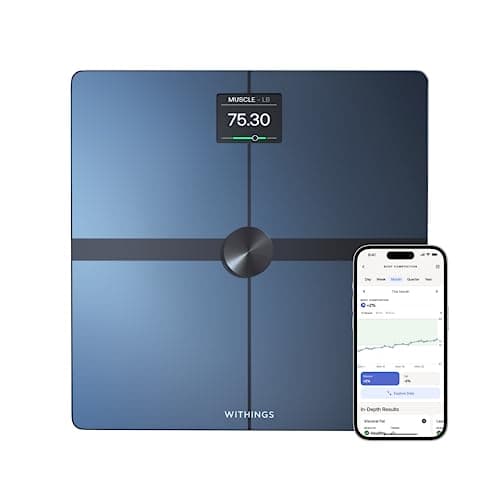
Withings — Withings Body Smart
For the reader who wants weight tracking to be effortless and accurate: Wi-Fi upload with no app-opening, a polished ecosystem, and a trend-only weigh mode if a daily number is unhelpful for you.
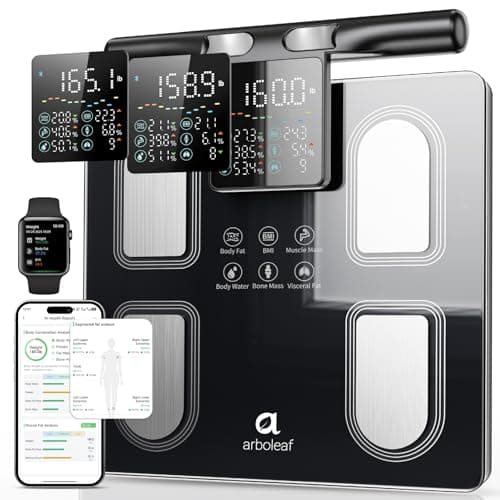
Arboleaf — Arboleaf 8-Electrode Body Composition Scale
For the reader who genuinely wants the best body composition estimate a consumer device can give — 8-electrode hand-to-foot BIA passes current through the upper body too, removing one of the method's biggest approximations.
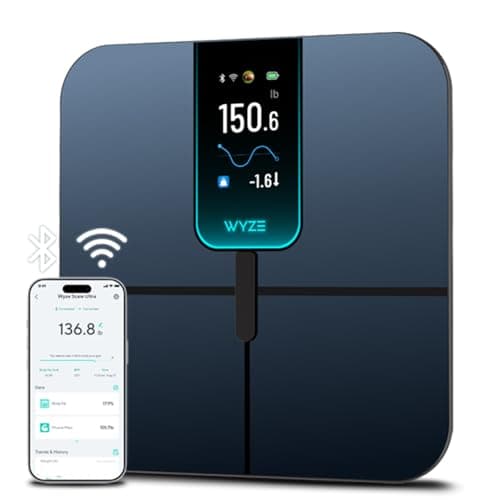
Wyze — Wyze Scale Ultra
For the reader who only cares about reliable weight plus Wi-Fi sync and does not want to spend three figures to get it.
How to weigh yourself so the number means something
Standardise everything you can and then look at the trend, never the point. The protocol: same time of day, first thing in the morning, after using the bathroom, before eating or drinking, with bare dry feet, on a hard floor, wearing the same amount of clothing (ideally none). Weigh daily if you can tolerate it — not because any single day matters but because daily readings let you average. Then judge progress on a seven-day rolling average compared with the previous seven-day average, which filters out the one-to-four-pound daily noise that makes individual weigh-ins so demoralising. Expect the scale to go up after a salty meal, after a hard session, after a day of travel, and during the premenstrual week; none of those is fat gain. For body composition, zoom out further still: look at the direction of the body fat line over four to eight weeks, and ignore every individual reading. And keep two non-scale measures alongside it, because they are more informative than the body fat estimate: a tape measure at the waist, and whether the weights in your training are going up. Those two together tell you what the scale's regression equation is guessing at.
When a scale is not the right tool at all
There are three situations where the scale will actively mislead you. The first is early resistance training, where you are gaining muscle and losing fat at roughly similar rates, so body weight barely moves while your body changes substantially — this is where a tape measure and your training log tell the truth and the scale does not. The second is the first few weeks of creatine supplementation, which draws water into muscle and reliably adds one to three pounds on the scale that is neither fat nor an error; expect it and do not panic. The third is any situation where daily weighing is bad for you: if you have a history of an eating disorder or a fraught relationship with the number, a scale with a trend-only mode, weekly weighing, or no scale at all are all legitimate choices, and that is a question for a clinician rather than a buying guide. Finally, if you want an actual body composition measurement rather than an estimate — for a medical reason, or because you are curious and willing to pay — a DXA scan at a clinic or university lab is the accessible reference method. One DXA scan plus a cheap scale for daily trends is a better combination than an expensive scale on its own.
Bottom line
Smart scales are accurate for the thing you should be using them for and unreliable for the thing the marketing emphasises. Buy one for weight tracking, pick it for load-cell quality, Wi-Fi sync and the app ecosystem you already live in, and treat body fat percentage as a long-term trend line produced by a proprietary guess rather than a measurement of you. Standardise your weighing conditions, average across seven days, pair it with a tape measure and your training log, and the device becomes genuinely useful. Compare your body fat number against a friend's scale, or react to a single day's reading, and it becomes a source of noise and frustration. If you want the best weight-tracking experience, the Withings Body Smart is our pick; if you specifically want the most defensible body composition estimate a consumer device can give, the 8-electrode hand-to-foot Arboleaf is the better buy; and if you just want a reliable number for under $50, the Wyze Scale Ultra does that job without fuss.
Frequently asked questions
Accurate enough to trust, and more importantly consistent. The load cells in a decent consumer scale resolve to about 0.1 to 0.2 lb, and while the absolute calibration may be slightly off compared with a clinical scale, the offset is the same every time — which means the day-to-day change is valid even if the absolute number is a couple of tenths out. That consistency is the property that matters for tracking. Two things will make a good scale look inaccurate and neither is the scale's fault. Putting it on carpet lets the feet sink unevenly and genuinely corrupts the reading, so use a hard flat floor. And your real body weight swings by one to four pounds across a normal day from food, fluid, sodium and glycogen, which is far larger than any hardware error — so if two weigh-ins hours apart disagree, the scale was right both times and you changed.
Related reading
Sources
- Bioelectrical impedance analysis — part I: review of principles and methods (assumptions, hydration dependence, limitations) — Clinical Nutrition (ESPEN guidelines), 2004
- Bioelectrical impedance analysis — part II: utilization in clinical practice — Clinical Nutrition (ESPEN guidelines), 2004
- Validity of consumer-grade bioelectrical impedance scales against DXA for body composition assessment — PubMed / U.S. National Library of Medicine
- Assessing Your Weight — waist circumference and BMI as practical health measures — Centers for Disease Control and Prevention
- International Society of Sports Nutrition Position Stand: Creatine Supplementation (water retention in early supplementation) — Journal of the International Society of Sports Nutrition, 2017
- Product specifications, electrode configurations, connectivity, live prices and availability for the scales referenced — retrieved via the Amazon product data layer — Amazon product listing data, 2026
Withings — Withings Body Smart
$129.95 · on Amazon