When Should You Use a Lifting Belt?
Wear a lifting belt for heavy, near-maximal compound lifts — squats, deadlifts, and standing overhead presses at roughly 80% of your one-rep max and above, or your last few grinding work sets. A belt gives your abs a firm surface to brace against, which raises intra-abdominal pressure and stiffens your trunk so you can move more load with a more stable spine. Skip it for warmups, light or high-rep work, accessory movements, and while you are still learning to brace — own a beltless brace first. A belt is a performance tool that amplifies good bracing. It is not a back brace, and it will not rescue sloppy technique or an under-braced core.
Affiliate disclosure: Trusted Health Gear is an Amazon Associate. If you buy through links on this page, we may earn a commission at no extra cost to you. Commission does not influence our rankings. Full policy.
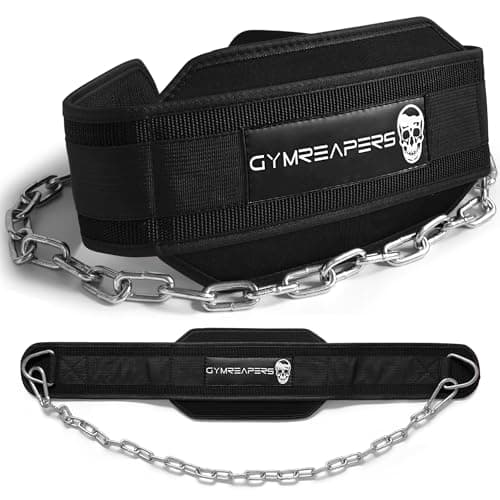
Gymreapers — Gymreapers Dip Belt With Chain
Best overall — a padded, neoprene-backed nylon belt with a heavy-duty steel chain that suits almost every home lifter
What a lifting belt actually does
A lifting belt does not hold your back together like a medical brace. It gives the muscles of your trunk a firm surface to push out against. When you take a big breath and brace, your diaphragm presses down and your abs push out; a belt around your midsection increases the pressure inside your abdominal cavity — intra-abdominal pressure — which acts like an internal cushion that stiffens the spine and helps it resist buckling under load. EMG and biomechanics research consistently shows greater intra-abdominal pressure, and often more trunk-muscle activity, when lifters wear a belt, not less. That is the mental model to keep: a belt is a bracing amplifier. Your abs still do the work; the belt just gives them something to press into so you can generate more pressure and hold a more rigid torso than you could bare-waisted.
When to wear a belt
Reach for the belt on heavy, spine-loaded compound lifts where trunk stability is the limiting factor: back and front squats, conventional and sumo deadlifts, and standing overhead presses. In practice, most lifters belt up on their top sets — roughly 80% of one-rep max and above, or the last couple of working sets before failure — where the extra intra-abdominal pressure translates into a more stable, and often stronger, lift. Belts shine when the load is high enough that a maximal brace genuinely matters. For heavy rack pulls, loaded carries, and grinding rep PRs, a belt earns its place. The goal is to use it where it adds meaningful stability, not to strap it on for every set of the day. Treat the belt as something you add once the weight becomes genuinely challenging.
When to skip the belt
Leave the belt off for warmup sets, light or high-rep work, and most accessory and isolation movements. Curls, lateral raises, leg extensions, and easy sets of rows do not need it. Warmups are exactly when you should rehearse a solid brace without a belt so the pattern stays ingrained. Beginners still learning to breathe and brace should spend real time beltless — if you strap on a belt before you can brace, you never learn the skill the belt is meant to amplify, and you build a crutch instead. There is also nothing wrong with training belt-free by choice; plenty of strong lifters use a belt only for their peak-strength blocks. If a movement is not heavy enough that maximal trunk stiffness is the bottleneck, you probably do not need the belt at all.
Belt types: lever, prong, and nylon
Belts come in a few flavors. A lever belt uses a hinged metal lever that snaps shut at a preset hole — the tightest, most consistent fit and the fastest on and off, but you need a screwdriver to change the setting. A prong belt uses one or two metal prongs through holes, like an oversized dress belt; it is slightly slower to fasten but easy to adjust between lifts, which suits lifters whose ideal tightness varies by exercise. Both are usually stiff leather, 10mm or 13mm thick, and the same width all the way around — that uniform width is what powerlifters want. Nylon or Velcro belts are softer, more flexible, and more comfortable; they are popular for CrossFit, Olympic lifting, and general training where you want some support without the rigidity of a thick leather powerlifting belt.
Fit and thickness
For a dedicated powerlifting belt, the standard is a uniform-width belt — commonly 4 inches wide and either 10mm or 13mm thick. The uniform width matters because you brace your abs against the front of the belt just as much as your back presses against the rear; contoured belts that narrow at the front give you less to push into. Thickness is a preference: 13mm is stiffer and more supportive but takes longer to break in and can dig into shorter torsos; 10mm is more forgiving and a safer default for most lifters. Fit should be snug but not cinched to the last hole — you need room to expand your belly into it when you brace. If you cannot take a full breath and push out against it, it is too tight. Break in stiff leather over several sessions.
Learn to brace beltless first
The strongest argument in belt training is also the simplest: learn to brace without one first. A belt amplifies intra-abdominal pressure, but only if you already know how to create it. Skip that skill and let the belt do the thinking, and you end up with a hard external shell around a soft, under-braced core — the worst of both worlds. Spend your early training and every warmup practicing the sequence: take a big breath into your belly, brace your abs as if you are about to be punched, and keep that pressure through the whole rep. Once a beltless brace is automatic, the belt becomes what it is meant to be — a tool that lets an already-good brace produce more pressure and stability. Skill first, equipment second. The belt is not a shortcut around learning to brace.
Common myths worth killing
A few myths deserve to die. 'A belt supports your back so you can lift with a rounder spine' — no; it increases the pressure you generate to hold a better position, it does not license bad mechanics. 'Belts make your core weak' — the research does not support this; trunk muscles are typically active, often more so, under a belt, and you still train plenty of work beltless anyway. 'A belt is only for advanced lifters' — the real prerequisite is being able to brace, not hitting a particular total. 'Tighter is always better' — over-cinching prevents the belly expansion that actually creates pressure, and it is just uncomfortable. And a belt will not prevent injury on its own; it is a performance tool that supports a good brace, not a guarantee against getting hurt with poor technique or ego loading.
Frequently asked questions
Not in the way people imagine. A belt does not hold your spine together like a medical brace. It gives your abs a firm surface to push against, which raises intra-abdominal pressure and stiffens your trunk. That extra stability comes from you bracing harder, not from the belt propping up your back — it amplifies a good brace, it does not replace one.
Related reading
Sources
- Essentials of Strength Training and Conditioning — trunk stability and bracing — National Strength and Conditioning Association (NSCA)
- Effects of a belt on intra-abdominal pressure during weight lifting — Medicine & Science in Sports & Exercise (Harman et al.), 1989
- The effectiveness of weight-belts during the squat exercise — Medicine & Science in Sports & Exercise (Lander et al.), 1990
- Weightlifting belts, core bracing, and intra-abdominal pressure — expert guidance — American Council on Exercise (ACE)
Gymreapers — Gymreapers Dip Belt With Chain
$39.99 · on Amazon