Power Rack vs Squat Stand: Which Should Anchor Your Home Gym?
A power rack is a full four-post cage: it surrounds you, catches a failed lift on adjustable safety bars, and doubles as a pull-up station, dip and landmine anchor, and mounting point for a huge range of attachments. A squat stand is a stripped-down two-post (or short-base) upright that holds the bar and, on better models, offers spotter arms — but it doesn't enclose you the same way. The rack buys you maximum safety, versatility, and stability at the cost of floor space, ceiling height, and money. The squat stand buys you a small footprint, easier moving, and a lower price at the cost of some safety margin and rock-solid stability under heavy loads. For a garage lifter training alone, the cage is usually worth it. For an apartment or shared space where footprint and price rule, a good squat stand does most of the job.
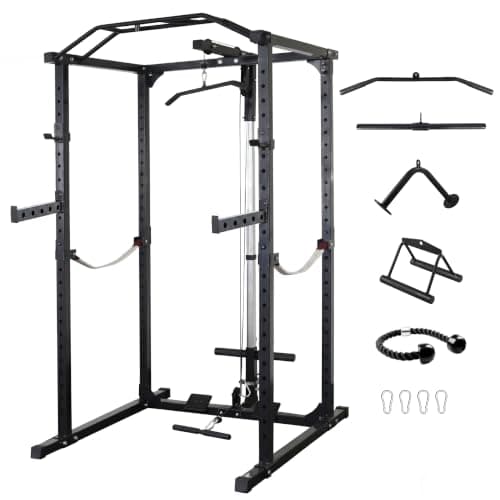
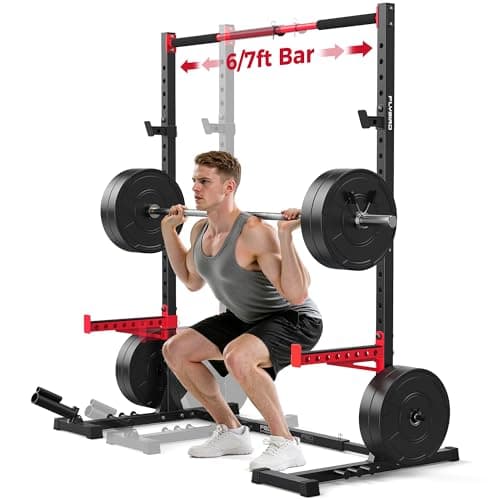
The verdict
Choose a power rack if you train alone and want the strongest safety net, the most versatility, and a bolt-down-stable platform for heavy squats and presses. Choose a squat stand if floor space, ceiling height, portability, or budget are the binding constraints and you can pair it with spotter arms or train conservatively. Solo garage lifters who push heavy singles lean rack; apartment and small-space lifters lean stand.
Side-by-side
| Attribute | Power Rack | Squat Stand |
|---|---|---|
| Best for | Max safety, versatility, and stability for heavy solo lifting | Small footprint, portability, and lower cost |
| Failed-lift safety | Excellent — full-length safety bars catch a dumped squat or bench inside the cage | Good only with spotter arms; base models offer less margin |
| Footprint | Large — a fixed 4-post box, typically ~4x4 ft plus room to load | Small — 2 posts on a short base; some fold flat against a wall |
| Ceiling height needed | Tall — 82-93 in common; check clearance before buying | Lower — shorter uprights fit basements and low garages |
| Stability under load | Very high — heavy, wide base; can be bolted down | Moderate — lighter stands may shift; better ones bolt or weight down |
| Versatility / attachments | Widest — pull-up bar, dip bars, lat pulldown, landmine, J-cups, safeties | Limited — bar holders and spotter arms; fewer add-ons |
| Portability | Low — heavy, semi-permanent once assembled | Higher — lighter, and folding/half-rack styles move or store easily |
| Cost | Higher — more steel and hardware | Lower — the cheapest way into safe-ish barbell training |
Who should pick which
Pick Power Rack
- Solo lifters who train heavy alone and want the strongest possible safety net on squats and presses.
- Garage-gym owners with the floor space and ceiling height who want one hub for squats, pull-ups, dips, and attachments.
- People who plan to add a pulley/lat system, landmine, or dip bars and want a single expandable platform.
Pick Squat Stand
- Apartment and small-space lifters where footprint, portability, and low ceilings are the binding constraints.
- Budget-first buyers who want to start barbell training now and would rather spend the savings on plates and a bar.
Safety is the real dividing line
The single biggest reason to buy a full cage is training heavy alone. A power rack's safety bars run the length of the cage, so if you miss a squat or fail a bench press, you set the bar down on the pins instead of getting pinned under it. That safety margin changes how hard you can push near your limit without a spotter. A squat stand only gives you that protection if it has proper spotter arms — and even then the catch zone is narrower and you have to bail more deliberately. Base-model stands with nothing but J-cups leave you fully exposed on a failed rep. If you routinely grind heavy singles at home with nobody around, the cage earns its space on safety alone.
Footprint, ceiling height, and where it lives
This is where the squat stand fights back. A power rack is a fixed four-post box — commonly around four feet square plus room on each side to load and unload plates — and many models want 82 to 93 inches of ceiling clearance for the pull-up bar and top frame. In a basement with low joists or a one-car garage that also parks a car, that footprint is a real problem. A squat stand takes two uprights on a short base, sits lower, and some fold flat against the wall or roll away between sessions. If your training space is shared, tight, or has a low ceiling, measure first — the stand often wins by simply fitting where the cage can't.
Stability and how heavy you plan to go
A power rack is heavy, wide-based, and can be bolted to the floor, so it barely notices heavy squats, rack pulls, or kipping pull-ups. That planted feel matters when the load climbs. Squat stands vary a lot: cheap lightweight ones can shift or tip if you rack a heavy bar carelessly or do dynamic work, while heavier stands with a wide base, connecting crossmembers, or floor bolts stay put. If you're chasing a big squat and deadlift, prioritize a stand that can be weighed down or anchored — or accept that the cage is simply the more confidence-inspiring platform under maximal loads.
Versatility: one hub vs one job
A power rack is a platform you build on. Out of the box it gives you squats, presses, a pull-up bar, and often dip stations, and the uprights accept a growing menu of attachments — a lat pulldown and low row, landmine, safety straps, plate storage, and band pegs. Over years it can become the center of the whole gym. A squat stand does the core barbell jobs well — squats, overhead press, and with spotter arms a bench press — but the attachment ecosystem is thinner. If you want your rack to keep expanding with your training, the cage is the more future-proof buy. If you mainly want to squat and press and add accessories elsewhere, the stand covers it.
Cost, portability, and the honest recommendation
A squat stand is the cheapest way into safe-ish barbell training, and the money saved can go toward the things that actually build strength: a good bar and enough plates. It's also lighter and easier to move if you rent or expect to relocate. The power rack costs more, uses more steel, and is semi-permanent once assembled — but that permanence is part of what makes it stable and safe. The honest split: solo garage lifters with space who push heavy should buy the rack; apartment, basement, and budget-first lifters should buy a solid squat stand with spotter arms and train smart. Both anchor a real home gym — the right pick is the one your space, wallet, and training style actually allow.
Frequently asked questions
Only if it has proper spotter arms set at the right height. A stand with just J-cups gives you no catch on a failed rep, which is risky for solo bench pressing and heavy squats. A squat stand with adjustable spotter arms bought as an add-on gets much closer to a rack's protection, though the catch zone is narrower and you have to bail more deliberately. If you train heavy alone often, a full cage is the safer choice.
Related reading
Sources
- Essentials of Strength Training and Conditioning — National Strength and Conditioning Association (NSCA)
- Power Rack vs Squat Stand: Buying Guide — Garage Gym Reviews
- How to Set Up a Home Gym — BarBend
- Resistance Training Safety and Spotting Guidelines — American Council on Exercise (ACE)
HulkFit — HulkFit Power Cage Squat Rack (800 lb)
on Amazon