How to Build a Home Gym on a Budget
You build a good budget home gym by buying versatile staples in the right order and ignoring the rest. Skip the wall of single-use machines and start with tools that cover the most movements per dollar: a way to load pushing, pulling, squatting, and hinging. For most people that means one pair of adjustable dumbbells or a kettlebell, a set of resistance bands, a pull-up bar, and eventually an adjustable bench. Under $150 gets you training today; $300-500 builds a genuinely capable setup; $1,000+ adds a rack and a barbell for serious strength. Buy used where it's safe, spend on the pieces you'll grip every session, and let progression — not new gear — drive your results.
Affiliate disclosure: Trusted Health Gear is an Amazon Associate. If you buy through links on this page, we may earn a commission at no extra cost to you. Commission does not influence our rankings. Full policy.
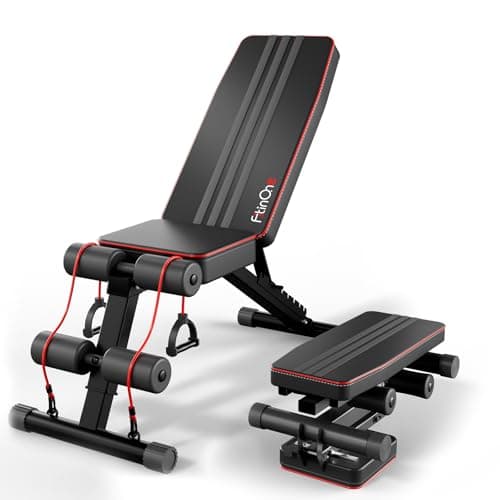
FitinOne — FitinOne Adjustable Weight Bench
Best budget — a fast-folding incline/decline bench for building out a starter home gym cheaply
Buy in the right order, not by wish list
The fastest way to waste money is to buy gear that looks like a gym instead of gear that trains you. Before spending a dollar, rank purchases by how many hard, compound movements each one unlocks. A single loadable implement — adjustable dumbbells or a kettlebell — covers squats, presses, rows, hinges, and carries, so it earns the top slot. Bands add pulling and pressing variety and assist pull-ups for almost nothing. A pull-up bar unlocks the best bodyweight back exercise there is. A bench turns your dumbbells into a full upper-body station. Everything after that is refinement. If you buy in this order, every stage of the build is already a complete workout — you're never stuck with a half-useful pile of iron waiting on one more purchase to become trainable.
The highest-ROI staples
Four categories do the heavy lifting in almost every budget build. First, one loadable tool: a pair of adjustable dumbbells replaces a whole rack in one footprint, while a single kettlebell is the cheapest way to train the hip hinge and carries hard. Second, resistance bands — a loop set costs little, weighs nothing, assists pull-ups, and travels, making it the best dollar-for-dollar purchase on this list. Third, a pull-up bar, either doorway-mounted or bolted, for the pulling strength dumbbells struggle to build. Fourth, an adjustable bench, which converts your dumbbells into flat, incline, and decline pressing plus a platform for rows and step-ups. Buy these four and you can train every major movement pattern hard for years. Anything else — racks, barbells, specialty bars — is an upgrade layered on top of this core, not a substitute for it.
Under $150: the true starter kit
On the tightest budget, resist the urge to buy one cheap gimmick and instead assemble a minimalist kit that still trains the whole body. A realistic under-$150 build is a resistance-band set plus one moderate kettlebell or a fixed dumbbell or two, and a doorway pull-up bar if a frame allows it. That combination covers squats and hinges (kettlebell), pressing and rows (bands and bell), and pulling (bar and bands). It fits in a closet and sets up in seconds. The trap at this tier is spreading the money across novelty items — vibrating gadgets, flimsy 'total gyms,' shake-weight-style toys. One solid kettlebell and a good band set will out-train a bin of junk every time. This is genuinely enough to get strong and conditioned for months; you add load and variety later as budget allows.
$300-500: a real training minimum
With a few hundred dollars you can build a setup that rivals a commercial gym for most goals. The centerpiece is a pair of adjustable dumbbells, which alone replace ten-plus fixed pairs and cover nearly every dumbbell exercise. Add an adjustable bench for pressing and supported work, keep your bands for assistance and finishers, and add a mounted or doorway pull-up bar. That four-piece kit — adjustable dumbbells, bench, bands, bar — is the sweet spot of the whole budget conversation: it trains every major pattern with real load, fits a corner of a room, and rarely leaves anyone wanting for years. If you prefer ballistic and hinge work, swap or supplement the dumbbells with two or three kettlebells. Spend the bulk of this budget on the dumbbells and bench, since those are the pieces you'll use every single session.
$1,000+: the do-it-all garage gym
Once you have real space and a four-figure budget, the build shifts toward barbell strength. The anchor purchase is a power rack or a sturdy squat stand with safeties, which lets you squat, bench, and press heavy alone without a spotter. Add an Olympic barbell and a set of plates, a flat or adjustable bench rated for barbell work, and you have a true strength gym. Keep the dumbbells, bands, and pull-up bar from earlier tiers — they don't become obsolete, they round out the barbell. This is also the tier where quality matters most: a good rack and bar last decades, so buy once rather than replacing a wobbly budget rack in a year. If ceiling height or space is tight, a half rack or squat stand delivers most of the capability of a full rack for less money and a smaller footprint.
Buy used, and what to skip
Iron doesn't wear out, which makes the used market a budget lifter's best friend. Plates, kettlebells, fixed dumbbells, barbells, and simple racks all sell used for a fraction of retail and are nearly impossible to ruin — check a barbell for straightness and smooth sleeve spin, and surface rust cleans off. Marketplace listings, closing gyms, and estate sales are gold. Be more cautious buying used adjustable dumbbells and benches, where the moving parts and welds can hide damage. As for what to skip entirely: single-function machines, most 'as-seen-on-TV' gadgets, cable towers you'll outgrow, and anything marketed on novelty rather than load or movement. You almost never need a leg-extension machine, a vibrating belt, or a shiny all-in-one contraption. Put that money into more plates or a better bar — versatile, durable, load-bearing gear is always the smarter buy.
Flooring, space, and progression
A little floor protection goes a long way and costs little. Rubber horse-stall mats or interlocking foam tiles protect the floor, quiet the room, and give you a stable, non-slip platform for lifts and bodyweight work — this is the one 'accessory' worth buying early. Measure your space before anything else, especially ceiling height if you'll press or jump overhead, and leave room to swing a kettlebell or lie down for floor presses. Then remember the real secret of a budget gym: results come from progression, not purchases. Add reps, sets, and load over weeks; keep a simple log; train consistently. The lifter with a kettlebell, a band, and a pull-up bar who shows up four times a week will out-progress the one with a full rack who trains twice a month. Buy the staples, protect your floor, and let the training do the work.
Frequently asked questions
One loadable tool — a pair of adjustable dumbbells or a single kettlebell — because it trains squats, presses, rows, hinges, and carries by itself. If money is extremely tight, a resistance-band set is the best few-dollar starting point and assists pull-ups too.
Related reading
Sources
- Physical Activity Guidelines for Americans, 2nd edition (muscle-strengthening recommendations) — U.S. Department of Health and Human Services, 2018
- How to Build a Home Gym: Equipment and Budget Guide — Garage Gym Reviews
- The Best Home Gym Equipment (buyer's guide) — BarBend
- Progression Models in Resistance Training for Healthy Adults (position stand) — American College of Sports Medicine / Medicine & Science in Sports & Exercise, 2009
FitinOne — FitinOne Adjustable Weight Bench
$59.98 · on Amazon