What Kettlebell Weight Should You Start With?
For most untrained-to-recreationally-active adults, a single starting bell works: women typically start swings with 8-12kg (18-26lb), men with 12-16kg (26-35lb). Grind lifts like presses and Turkish get-ups need a lighter load — knock roughly one or two sizes down from your swing weight. If you're athletic and already strength-train, size up; if you have zero training background or any shoulder issues, size down. The single most common mistake is buying too light for swings, because the swing is a hip-driven ballistic movement that can handle far more load than your arms suggest.
Affiliate disclosure: Trusted Health Gear is an Amazon Associate. If you buy through links on this page, we may earn a commission at no extra cost to you. Commission does not influence our rankings. Full policy.
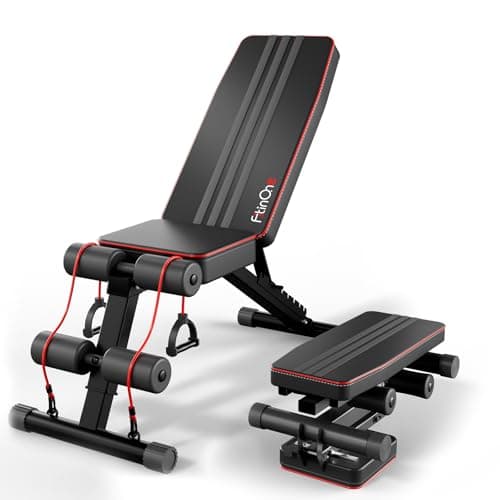
FitinOne — FitinOne Adjustable Weight Bench
Best budget — a fast-folding incline/decline bench for building out a starter home gym cheaply
Why ballistic and grind lifts need different weights
Kettlebell work splits into two buckets. Ballistic lifts (swings, cleans, snatches) are explosive and hip-driven — the legs and hips generate the power, your arms just guide the bell. Because the big muscles of the posterior chain do the work, you can handle a surprisingly heavy bell. Grind lifts (presses, Turkish get-ups, windmills) are slow, controlled, and limited by smaller stabilizing muscles and overhead shoulder strength. The practical takeaway: one bell will rarely be ideal for everything. A weight that's perfect for a strict press will be far too light for swings, and a swing-appropriate bell will crush you overhead at first.
Starting weights for women
A common starting point for women new to kettlebells is a 12kg (26lb) bell for swings — and many strength coaches argue even untrained women are better served by 12kg than the 8kg that gets recommended by default, because the swing is a hip hinge, not an arm lift. If you have no training background at all, 8-10kg (18-22lb) is a reasonable swing entry point. For goblet squats, that same swing bell usually works. For pressing and get-ups, drop to 6-8kg (13-18lb) to start. If you can only buy one bell, 12kg is the most versatile single choice for the average woman.
Starting weights for men
For men new to kettlebells, 16kg (35lb) is the classic starting bell for swings — it's the size hardstyle kettlebell programs are built around for a reason. If you're deconditioned or have no lifting background, start swings at 12kg (26lb). Athletic men who already lift can often start swings at 16-20kg (35-44lb). For pressing and get-ups, drop to 12kg (26lb) or even 8kg until the movement pattern is solid. If you buy one bell, 16kg is the standard recommendation for the average man.
Starting weights by exercise
Roughly, relative to a single body: Swings — heaviest, because hips drive them (women ~8-12kg, men ~12-16kg to start). Goblet squats — usually the same bell as your swing, since the legs are strong here too. Cleans — same ballpark as swings, but expect bruised forearms until your technique smooths out, so don't over-load while learning. Strict press — meaningfully lighter; the overhead limit is your shoulder, not your hips (often one to two sizes below your swing bell). Turkish get-up — start very light, even an empty hand or a shoe balanced on your fist, then a 6-8kg (women) / 8-12kg (men) bell once the pattern is grooved. The get-up is a movement-quality drill first and a strength lift second.
How to progress
Kettlebells come in fixed jumps (commonly 4kg increments: 8, 12, 16, 20, 24kg), so you can't add a pound at a time like a dumbbell. That means you progress by adding reps, sets, and density before you jump up in weight. A practical rule: when you can complete all your prescribed sets and reps with clean technique and a couple reps in reserve, you're ready to test the next bell. Expect to dwell at each size for weeks to months. Because the jumps are big, an adjustable kettlebell or buying bells in pairs of adjacent sizes (e.g., 12 and 16) smooths the transition.
One bell vs a few
One bell is genuinely enough to start, and plenty of people run effective programs with a single kettlebell for months. If you buy one, pick it for swings and goblet squats (your strongest movements) and simply scale the pressing work by using it for higher reps or strict tempo. The downside is that one swing-appropriate bell will be too heavy for clean get-ups and presses at first. The next-best setup is two or three bells: a lighter one for grinds and get-ups, a medium for general work, and a heavier one to grow into for swings. A common three-bell home setup is something like 8/12/16kg for women or 12/16/24kg for men.
Common mistakes
The biggest one is going too light on swings. People pick a bell their arms can lift overhead and then 'swing' it — but the swing is a hip snap, and a too-light bell teaches you to muscle it up with your arms and lower back instead of driving with your hips. Too light is actually a technique problem, not just a missed gains problem. The opposite mistake is going too heavy on get-ups and presses, where ego loading wrecks your shoulder mechanics and rushes you past the movement quality these lifts are meant to build. Other frequent errors: buying a cheap bell with a rough or oversized handle that tears your hands, and progressing by weight too fast instead of earning the jump with reps.
Frequently asked questions
For swings and goblet squats, 8-12kg (18-26lb) — many coaches favor 12kg even for beginners because the swing is hip-driven. For presses and Turkish get-ups, start lighter at 6-8kg (13-18lb).
Sources
- Simple & Sinister — kettlebell standards and starting loads — StrongFirst
- The Kettlebell Swing: A Complete Guide — American Council on Exercise
- Transference of Kettlebell Training to Strength, Power, and Endurance — Journal of Strength and Conditioning Research, 2012
- The Turkish Get-Up — American Council on Exercise
FitinOne — FitinOne Adjustable Weight Bench
$59.98 · on Amazon