Is a Home Gym Worth It? The Honest Math
For most people who train consistently, a home gym is worth it — a modest kit pays for itself in roughly one to two years compared with a gym membership, and after that it's essentially free training for years. But the real return isn't the money; it's convenience turning into consistency. No commute, no waiting for a rack, and the ability to train at 6 a.m. or 10 p.m. mean you actually show up more often, and consistency is what builds strength. The honest trade-offs are space, the variety of machines, coaching and social energy, and the heavy specialty equipment that's hard to fit at home. A home gym is a great fit for busy people who value convenience and do mostly free-weight and bodyweight work; a membership still wins if you need machines, heavy barbell capacity you can't house, or the atmosphere to stay motivated. The smartest move for many is a hybrid: a small home kit for daily training plus occasional gym access for the rest.
Affiliate disclosure: Trusted Health Gear is an Amazon Associate. If you buy through links on this page, we may earn a commission at no extra cost to you. Commission does not influence our rankings. Full policy.
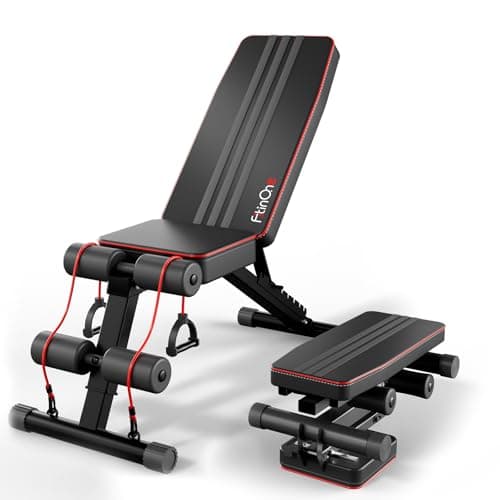
FitinOne — FitinOne Adjustable Weight Bench
Best budget — a fast-folding incline/decline bench for building out a starter home gym cheaply
The cost break-even vs a membership
Start with the arithmetic, because that's where most people get stuck. A typical gym membership runs somewhere in the range of a few hundred to eight hundred-plus dollars a year once you count sign-up fees and annual dues, and boutique or specialty gyms cost far more. A capable starter home gym — an adjustable dumbbell pair, a bench, a pull-up bar, some bands, and a mat — costs roughly what one to two years of a mid-range membership does. That means the break-even point lands around the one-to-two-year mark for most people, and everything after that is training you've already paid for. The equipment also holds its value: quality dumbbells, racks, and barbells last decades and resell well if your needs change, so the true lifetime cost per workout keeps dropping the longer you own them. Membership money, by contrast, is gone the moment it leaves your account. The catch is that the math only works if you actually use the gear — an unused home gym is more expensive per session than any membership, which is exactly why convenience matters as much as cost.
The real ROI: convenience becomes consistency
The dollars are the easy part; the bigger return is behavioral. Every barrier between you and a workout — a drive across town, packing a bag, finding parking, waiting for equipment, gym hours — is a chance to skip. A home gym deletes almost all of them. You can train in the ten-minute window you actually have, before the kids are up or after they're down, in whatever you're wearing, without small talk. That friction reduction is why home trainers so often report training more frequently and more consistently than they did with a membership. And consistency, not any single perfect session, is what drives long-term strength, muscle, and health. Public-health guidance is clear that regular muscle-strengthening on at least two days a week delivers real benefits, and the setup that makes those two-plus days easiest to hit is the one that works. For a lot of people, the home gym's greatest feature isn't a specific piece of equipment — it's that the gym is always open and always thirty seconds away.
What you give up
An honest accounting has to include the downsides, because they're real. First, space: even a compact setup needs a corner, a garage bay, or a spare room, and heavier barbell training needs ceiling height and a floor you can load. Second, variety: a commercial gym has a wall of machines — leg press, cable stacks, hack squat, specialty bars — that you simply won't replicate at home, and some people genuinely enjoy that menu. Third, the social and coaching side: training around other people, a class, or a coach who corrects your form provides motivation and accountability that an empty garage doesn't. Fourth, the heavy and specialty end: a full loaded barbell, a calibrated plate collection, sleds, and platforms get expensive and space-hungry fast. None of these are dealbreakers for most trainees, but pretending they don't exist is how people end up disappointed with a home setup that was never going to do everything a full gym does.
Who a home gym is best for
A home gym is an easy yes for a specific profile: busy people who value time, who train mostly with free weights and bodyweight, and who are self-motivated enough to work out alone. If your program is squats, presses, rows, deadlifts, carries, and conditioning, a dumbbell-and-rack setup covers nearly all of it. Parents, shift workers, rural residents with a long drive to the nearest gym, and anyone who's proven they'll train without a class to push them all tend to thrive at home. It's also ideal for people who dislike crowded gyms or feel self-conscious learning lifts in public. The common thread is that the home gym removes the exact barrier that was keeping you from being consistent — usually time and convenience — while not removing something you actually rely on, like coaching or camaraderie.
Who should keep the membership
A membership still makes more sense for a few groups. If you need the accountability of showing up somewhere, the energy of other people, or a coach to keep your technique honest, an empty room at home may quietly kill your consistency — and consistency is the whole point. If your training depends on machines you can't house — a leg press, a cable stack, a full rack of specialty bars — or on heavy barbell work at loads your floor and ceiling can't handle, the gym has capacity you can't buy affordably. Beginners who are still learning the big lifts often benefit from a period of in-person coaching before going solo, and anyone rehabbing an injury should have professional guidance rather than improvising alone. Renters with no space, tight budgets that can't cover the upfront kit, or a genuinely great, cheap gym nearby may also find the membership is simply the better deal. The right answer is the one that gets you training regularly, not the one that looks best on a spreadsheet.
Start small and scale (a buying order)
You don't buy a home gym; you build one, and the order matters. Start with the highest training-per-dollar pieces and add as you outgrow them. A sensible sequence: (1) one pair of adjustable dumbbells — the single most versatile purchase, covering presses, squats, rows, and curls; (2) a mat to protect the floor and let you work on the ground; (3) a doorway or wall pull-up bar plus a resistance-band set for pulling and assistance; (4) an adjustable bench to unlock incline pressing and more; (5) a kettlebell or two for swings, carries, and conditioning; and only later (6) a rack, barbell, and plates once you're chasing heavier squats, presses, and deadlifts and know you'll use them. Buying in this order means every stage is a complete, usable gym on its own, you spread the cost out, and you never overbuy for a phase you haven't reached. Most people are surprised how far the first three steps alone carry them. Detailed budgets and full shopping lists live in our cost and budget guides.
The hybrid approach: best of both
For a lot of people the smartest answer isn't home versus gym — it's both, sized to what each does best. Keep a compact home kit for the training you do most days: the consistent, convenient strength and conditioning work that benefits most from being frictionless. Then keep a cheap membership, a day pass habit, or access to a friend's garage for the occasional session that needs more — a genuinely heavy barbell squat or deadlift, a specialty machine, or the social push of training with others. This splits your money efficiently: you pay for capacity you rarely need only when you need it, while the everyday work happens at home for free. It also hedges the home gym's main risk — that you'll miss the machines or the atmosphere — without paying full membership price to sit unused. Convenience at home plus capacity elsewhere is, for many trainees, the setup that finally makes training stick.
Frequently asked questions
For most people, a modest starter kit pays for itself in about one to two years compared with a gym membership. Quality equipment then lasts for many more years and holds resale value, so the cost per workout keeps dropping. The math only works if you actually train with it consistently.
Related reading
Sources
- Physical Activity Guidelines for Americans, 2nd Edition (muscle-strengthening on 2+ days/week) — U.S. Department of Health and Human Services, 2018
- Adult Activity: An Overview (physical activity recommendations) — Centers for Disease Control and Prevention
- Resistance Training and Program Design Basics — National Strength and Conditioning Association
FitinOne — FitinOne Adjustable Weight Bench
$59.98 · on Amazon