How Much Does a Home Gym Cost?
A usable home gym costs anywhere from about $150 to $3,000+, and the honest answer depends on how you train. A minimalist kit — adjustable dumbbells or a kettlebell plus a mat and bands — runs $150-300 and covers most beginners. A solid setup with an adjustable bench, a barbell, and some plates lands around $500-1,000. A complete barbell gym with a power rack, Olympic bar, a full plate set, and a good bench runs $1,500-3,000 and up, before flooring. The biggest cost drivers are plates, the rack, and flooring — not the flashy accessories. Buy versatile staples used where you can, splurge on the bar and rack you'll keep for a decade, and the whole thing usually pays for itself against a gym membership within a year or two.
Affiliate disclosure: Trusted Health Gear is an Amazon Associate. If you buy through links on this page, we may earn a commission at no extra cost to you. Commission does not influence our rankings. Full policy.
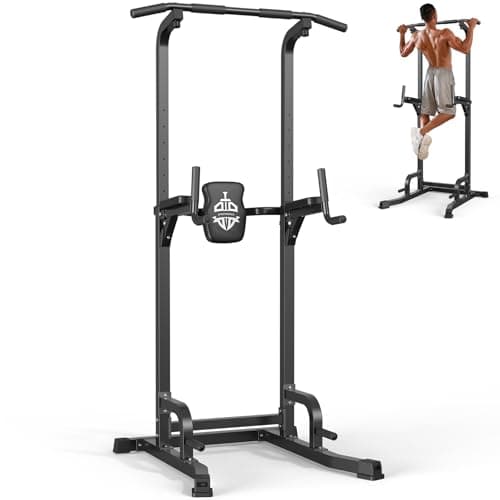
Sportsroyals — Sportsroyals Power Tower Pull-Up and Dip Station
Best freestanding option — no drilling, with pull-up, dip, and knee-raise stations in one frame
The honest cost tiers, before we split hairs
"A home gym" spans a huge range, so it helps to think in three tiers instead of one number. Tier one is the $150-300 minimalist kit: enough to train hard at home with almost no floor space. Tier two, $500-1,000, adds a bench and a barbell so you can do the big compound lifts that actually build strength. Tier three, $1,500-3,000+, is the complete barbell gym — rack, bar, a full plate set, and a bench — that most serious lifters end up wanting. None of these include the money you'll quietly spend later on flooring, shipping, and space. The good news: you can start at tier one and upgrade piece by piece without wasting anything, because the staples carry forward.
Tier one — the $150-300 minimalist kit
This is the highest-value gym most people will ever buy. A sample build: one pair of budget adjustable dumbbells or a single well-chosen kettlebell (roughly $80-200), a set of resistance bands ($20-40), and an exercise mat ($20-40). That covers presses, rows, squats, hinges, and carries — genuinely everything a beginner needs for a year or more. The trade-off is a weight ceiling and no barbell, so heavy squats and deadlifts are off the table. But for general strength, conditioning, and building a habit, this kit punches far above its price and stores in a closet. If money is tight, this is where to start — not a treadmill, and not a cable tower you'll use twice.
Tier two — the $500-1,000 solid setup
Here you graduate to the barbell, which is the single best return on strength per dollar in existence. A sample build: a good adjustable bench ($150-300), an Olympic barbell ($150-300), and a starter plate set of 150-200 lb ($200-400, and the priciest line item). Pair that with the dumbbells or kettlebell you already own and you can run nearly any serious strength program. Many people add wall-mounted folding rack arms or squat stands here for another $150-300 so they can bench and squat safely. This tier is where a home gym starts replacing a commercial one for most lifters. Buying the bar and plates used, if you can find them locally, can drop this whole tier toward the bottom of the range.
Tier three — the $1,500-3,000+ complete gym
This is the do-it-all barbell gym. A sample build: a full power rack with safeties and a pull-up bar ($400-800), a quality Olympic barbell ($200-400), a full plate set of 300-400+ lb ($400-700), and a solid flat or adjustable bench ($200-400). Add rubber flooring ($150-400) and you're realistically at $1,500-3,000 before accessories. Spend more and it climbs fast — a competition bar, bumper plates, a belt squat attachment, or a cable pulley each add hundreds. The honest truth is that past this point you're buying convenience and variety, not more strength. A rack, a bar, plates, and a bench are the core; everything beyond that is optional, so resist the urge to gimmick it up before the basics are in place.
The biggest cost drivers: plates, rack, and flooring
Three items quietly eat most of the budget. Plates are sold by the pound and it adds up — a full 400 lb set can cost more than the bar and rack combined, and this is exactly where used buying saves the most, since iron plates never wear out. The rack is the second big driver; a full power rack with safeties costs several times what a pair of squat stands does, and for many home lifters a squat stand plus spotter arms does the same job for less. Flooring is the driver people forget entirely — rubber mats or horse-stall mats to protect your floor and joints can run $150-400 depending on area. Knowing these three drivers lets you cut cost where it doesn't hurt the training.
Where to save vs where to splurge
Save on the boring, indestructible stuff: iron plates, a basic bench, and flooring are all fine bought used or budget, because they don't wear out and a scratch changes nothing. Marketplace listings for plates and racks routinely go for half of retail. Splurge, within reason, on the two things you touch every set and keep for a decade — the barbell and the rack. A cheap bar with sloppy knurl and weak sleeves is a daily annoyance and a safety question under load; a wobbly rack is worse. The site ethos in one line: buy versatile staples that do many jobs, spend the money on the pieces where quality is safety, and skip the single-purpose gadgets that promise shortcuts. That order keeps cost-per-use low and regret lower.
Hidden costs and cost-per-use vs a gym membership
Budget for the costs that don't show on the product page. Shipping and freight on racks and plates can add real money because they're heavy. Flooring is close to mandatory if you lift on a slab or upstairs. And space itself has a cost — a car left in the driveway, or a room you can't use for something else. Now weigh it against a membership: at a typical monthly gym fee, even a $1,000 setup breaks even in well under two years, and everything after that is essentially free training with no commute and no waiting for a rack. The math only works if you use it, so the smartest spend is the tier you'll actually train in consistently — usually less gear than you think, bought once and kept.
Sportsroyals — Sportsroyals Power Tower Pull-Up and Dip Station
Frequently asked questions
A minimalist kit of adjustable dumbbells or one kettlebell, resistance bands, and a mat runs about $150-300 and covers presses, rows, squats, and hinges for a year or more. It's the highest-value gym most people will ever buy and stores in a closet.
Related reading
Sources
- How Much Does a Home Gym Cost? — Garage Gym Reviews
- Home Gym Essentials and Budgeting Guide — BarBend
- Resistance Training Equipment Recommendations — American College of Sports Medicine
- Building Strength at Home — Equipment Fundamentals — National Strength and Conditioning Association
Sportsroyals — Sportsroyals Power Tower Pull-Up and Dip Station
$139.99 · on Amazon