How to Use a Weight Sled: Push, Pull, and Drag Training
A weight sled is one of the most useful tools in a garage gym because it builds conditioning, power, and leg strength while leaving you barely sore. The reason is simple: pushing, pulling, and dragging a sled is almost entirely concentric work — your muscles shorten under load but rarely lengthen under it, and it's that lengthening (eccentric) part of most lifts that drives next-day soreness. So you can train the sled hard and often. Warm up, start with a light load, keep a braced spine and good posture, and pick your variation for the goal: heavy short pushes for strength and power, moderate loads over longer distances or intervals for conditioning. Match the sled to your surface, progress by adding load or distance, and it becomes a low-impact workhorse.
Affiliate disclosure: Trusted Health Gear is an Amazon Associate. If you buy through links on this page, we may earn a commission at no extra cost to you. Commission does not influence our rankings. Full policy.
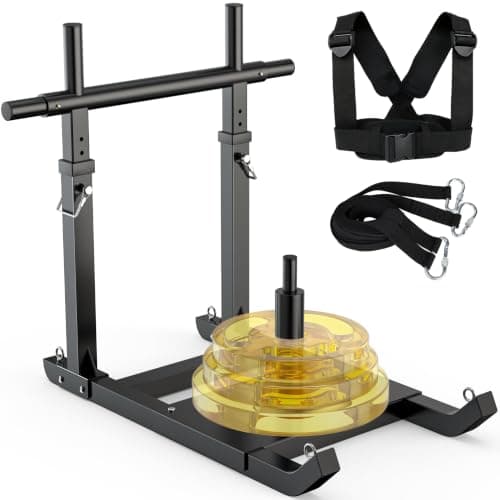
GanFindX — GanFindX Adjustable-Handle Weight Sled
Best budget push sled — a 5-level adjustable handle for push and pull training at an entry price
What sled training does and why it's low-impact
The sled's signature trait is that it's concentric-only. When you push, drag, or pull a loaded sled, your muscles are shortening to move the weight, but there's almost no eccentric phase — no lowering under tension, no braking a heavy bar. Since eccentric loading is what causes most delayed-onset muscle soreness, sled work lets you accumulate real training volume and intensity while feeling fine the next day. That makes it uniquely versatile: it builds cardiovascular conditioning and work capacity, develops leg drive and power, and can even be used on recovery days to move blood through sore muscles without adding damage. It's also joint-friendly. There's no impact like running and no heavy spinal loading like a barbell, so it's a smart way to train hard for people managing cranky knees, backs, or a lot of lifting volume. Few tools give this much return for so little cost to recovery.
Sled pushes: setup and posture
The push is the classic sled drill. Grab the posts — high uprights keep you more upright, low posts put you in a forward, sprinter-like drive — set your arms, and lean your whole body forward at roughly a forty-five-degree angle so your force goes into the sled, not the floor. Keep a long, neutral spine from head to hips; the most common fault is letting the hips pike up or the lower back round as you fatigue. Drive through the balls of your feet with powerful, deliberate strides, staying low and pushing continuously rather than lurching. Brace your core the whole way, breathe in rhythm with your steps, and keep your head in line with your spine instead of craning up. A high-handle push feels more like a march; a low, arms-extended push feels like an all-out acceleration. Both are excellent — just hold the posture and let your legs do the work.
Sled pulls and drags: technique
Pulling and dragging open up angles a push can't. A forward drag uses a waist harness or a belt with a strap: face away from the sled and walk or run forward, driving through the posterior chain — glutes, hamstrings, and calves. A backward drag flips it: face the sled, hold a strap or handles, stay tall with a slight lean back, and walk backward while extending the knees — this hammers the quads and is a well-loved, gentle way to train around knee issues. Rows and hand-over-hand pulls turn the sled into upper-back and grip work: set the sled at a distance, brace a hinged athletic stance, and reel the strap in hand over hand or row it toward you in reps. Across all of them, keep the chest up, the spine neutral, and the load moving smoothly instead of yanking. Vary the direction and you cover the whole body.
Loading and distance guidelines
Start light and warm up first — a few easy passes to prime your legs and groove the posture before you add plates. From there, load for the goal. For power and speed, use a light-to-moderate load you can move quickly with crisp turnover over short distances of roughly ten to thirty yards, resting fully between efforts so every pass is fast. For strength, load it heavy and keep the distance short — think ten to twenty yards of a grinding, deliberate push with full rest. For conditioning, drop to a moderate load and extend the distance or repeat shorter bouts on tight rest so your heart rate climbs and stays up. Whatever the goal, the load is right when your posture holds for the whole distance; if your back rounds or your stride falls apart, it's too heavy. Progress by adding a little weight or distance over the weeks, not by chasing soreness that the sled won't give you anyway.
Surfaces: turf, concrete, and grass
The surface changes both the feel and the wear, and not every sled suits every floor. Gym turf is the gold standard: it's smooth, glides predictably, and is easy on the sled's runners, which is why most facilities lay a turf strip for sled work. Concrete offers high friction and durability but is abrasive — a bare metal sled will grind, screech, and mark the floor, so use a push sled with plastic skids or replaceable feet designed for hard surfaces, or lay down a turf runner. Grass is variable: soft or long grass adds resistance and unevenness, which can be great for conditioning but tough to load consistently, and wet grass turns slick. Rubber gym flooring creates heavy drag and can grab a sled, making it a poor match for anything but the lightest loads. Match the sled type to where you'll actually use it, and check whether it has swappable feet for different surfaces.
Sample sled workouts
A few templates cover most goals. For conditioning: eight to ten rounds of a twenty-yard moderate-load push, walking back to the start as your only rest, keeping the effort brisk and continuous. For power: six to eight explosive fifteen-yard sprint pushes with a light load and full recovery between reps, prioritizing speed on every pass. For strength: five heavy twenty-yard pushes with two to three minutes of rest, treating each like a working set. For legs and knee health: several backward drags of thirty to forty yards at a moderate load, focused on tall posture and full knee extension. And as a finisher, alternate a heavy carry with a sled push — for example, a farmer's walk down and a sled push back for a handful of rounds. Warm up, start conservative on load, and stop a set the moment your posture breaks rather than grinding out ugly reps.
Programming for conditioning versus strength
Because the sled costs you so little in soreness, you can train it more often than most tools — one to three focused sessions a week, plus optional easy drags on recovery days to promote blood flow without adding fatigue. Steer the stimulus with load, distance, and rest. For conditioning and work capacity, favor moderate loads, longer distances or repeated bouts, and short rest so the sessions stay aerobic and metabolic. For strength and power, go heavier (or faster) over short distances with long, full rest, keeping the volume lower so every effort is high quality. Slot heavy sled work after your main lifts or on their own day; use conditioning sled work as a finisher or a standalone engine session. Progress the same way you would any lift — add a little load, distance, or density over time. The sled rewards consistency, and its light soreness footprint means you can actually be consistent.
Frequently asked questions
Because it's almost entirely concentric. Pushing, pulling, or dragging a sled means your muscles shorten to move the load, with virtually no eccentric (lengthening-under-load) phase. Since eccentric work is what drives most delayed-onset muscle soreness, sled training lets you work hard and accumulate volume while feeling fresh the next day. That's exactly why it's popular for conditioning, extra leg volume, and even active-recovery days.
Related reading
Sources
- The Complete Guide to Sled Training (push, pull, drag technique and programming) — BarBend
- Best Weight Sleds — Tested (sled types, surfaces, and construction) — Garage Gym Reviews, 2026
- ACE Exercise Library (lower-body and conditioning movement mechanics) — American Council on Exercise
- Essentials of Strength Training and Conditioning (concentric vs eccentric loading and conditioning methods) — National Strength and Conditioning Association (NSCA)
GanFindX — GanFindX Adjustable-Handle Weight Sled
on Amazon