How to Improve Your Grip Strength
The fastest way to build useful grip strength is to hold heavy things for time and pull heavy things without straps. Loaded carries (farmer's walks), dead hangs, and doing your deadlifts and rows bare-handed for a while train the grip that actually carries over to lifting. Add a little direct work — plate pinches for the fingers and thumb, and light wrist and forearm curls for the muscles that flex and extend the wrist — and train it a few times a week without grinding to failure daily. Grip recovers slower than you'd think, so more is not better. Then, on your heaviest pulls, use straps so a failing grip doesn't cap how much your back and legs actually get to work. Grip is a tool, not the goal.
Affiliate disclosure: Trusted Health Gear is an Amazon Associate. If you buy through links on this page, we may earn a commission at no extra cost to you. Commission does not influence our rankings. Full policy.
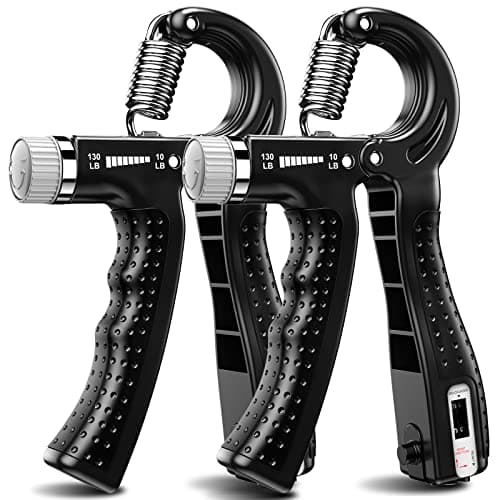
KDG — KDG Grip Strength Trainer (2-Pack Adjustable)
Best pair — two adjustable grippers to train both hands at once
The three kinds of grip (and why it matters)
Grip strength isn't one thing — it's usually broken into three types, and they don't fully transfer to each other, so it helps to know which you're training. Crush grip is the classic hand-closing action, squeezing the fingers into the palm — think a crushing handshake or a hand gripper. Support grip is holding onto something for time without it opening your hand, which is exactly what a heavy barbell or a loaded farmer's handle demands; for most lifters this is the type that matters most. Pinch grip is holding weight between your fingers and thumb with no support underneath, like gripping a smooth plate by its face — it's where the thumb earns its keep. There's also wrist and forearm strength underpinning all of it: the ability to keep the wrist stable and flexed under load. You don't need to obsess over the categories, but knowing them keeps you honest. If your deadlift grip fails, you need support-grip work, and squeezing a spring gripper (crush) won't fix it. Train the type you actually want to improve.
Why grip carries over to pulling, deadlifts, and rows
For most lifters, grip is the weak link in every pulling movement. On a heavy deadlift, the bar can only go up if your hands stay closed around it — and long before your back or legs give out, your fingers can start to open. The same is true of rows, pull-ups, and any heavy carry: the muscles that do the pulling are often stronger than the hands that connect you to the load. That's why a stronger grip has such obvious carryover. Build the hands and forearms up, and suddenly your working sets on deadlifts and rows aren't cut short by a slipping bar, so the target muscles get properly loaded. It also transfers beyond the gym, to carrying groceries, luggage, and anything heavy and awkward. The honest caveat is that grip carryover is somewhat specific — support-grip strength from carries and deadlifts helps your holding-a-bar grip far more than a novelty gripper does. So the most efficient path is to train grip through the same holding-and-pulling patterns you use in your actual lifting, then top it up with a little direct work.
The methods that actually work
Keep it simple and heavy. Loaded carries — farmer's walks with dumbbells, kettlebells, or handles — are the single best grip builder for most people because they train support grip under real load for time; walk 20 to 40 meters holding as heavy as you can control, for a few sets. Dead hangs from a pull-up bar do the same job with just your bodyweight: hang for time, building toward a solid minute, and add load with a belt or a held dumbbell as you progress. For a stretch of training, do your deadlifts and rows without straps, letting your grip work as hard as your back — this is where a lot of real grip strength is quietly built. Plate pinches (holding two smooth plates together, or one by its edge) train the pinch grip and thumb. Hand grippers train the crush grip and are fine as accessory work if you enjoy them, just don't expect them to fix a failing deadlift hold. Finish with a little direct forearm work: wrist curls, reverse wrist curls, and wrist rollers keep the flexors and extensors balanced.
Wrist and forearm work, and balancing the extensors
Almost everything on the grip menu trains the muscles that flex the wrist and close the fingers, because that's what gripping is. But constantly hammering the flexors while ignoring the extensors — the muscles on the back of the forearm that open the hand and extend the wrist — can leave you imbalanced and, for some people, cranky at the elbow. It's cheap insurance to train both. Reverse wrist curls (palms-down, curling the back of the hand up) and reverse curls with a barbell or dumbbells hit the extensors and the brachioradialis. Regular wrist curls (palms-up) and a wrist roller train the flexors. A wrist roller — a bar with a cord and a plate you roll up and down — is a brutal, cheap forearm builder that trains flexors and extensors in one go. You don't need much: a couple of sets of each, once or twice a week, tacked onto the end of a session. Keep the loads moderate and the reps in the 10-to-20 range; the forearms respond well to time under tension and don't need to be maxed out.
Programming: frequency, effort, and recovery
The most common grip-training mistake is doing too much, too hard, too often. The forearms and connective tissue of the hands recover more slowly than you'd expect, and grinding maximal grip work every single day is a fast route to sore, achy elbows and stalled progress. A sensible approach is to train grip directly two to three times a week — often just adding carries, hangs, or a few forearm sets to days you're already lifting — and to leave a rep or two in the tank on most of it rather than going to failure daily. Progress the way you would any lift: add a little weight, time, or distance over the weeks. Because heavy deadlifts and rows already tax your grip, count that toward your total; you may need less dedicated grip work than you think. If your grip is chronically fried, your elbows ache, or your pulling numbers stall, that's the signal to back off the frequency, not add more. Consistency over months beats heroic daily efforts that you can't recover from.
Beginner mistakes to avoid
A few errors show up again and again. First, chasing novelty grippers while ignoring the basics — a spring gripper trains crush grip, but if your problem is holding a deadlift, carries and bare-handed pulling will do far more. Second, going to failure every session; grip recovers slowly, and daily max-effort work usually backfires. Third, never using straps and letting a weak grip permanently cap your back and leg training — grip should challenge you on moderate pulls, but it shouldn't be the reason your heaviest deadlifts stop short (more on that next). Fourth, only training the flexors and skipping extensor work, which invites imbalance and elbow grumbles. Fifth, expecting fast results — grip and forearm strength build steadily over months, not weeks. Finally, ignoring simple aids: chalk dramatically improves your grip on a bar by killing sweat, and it's not cheating to use it. Train the support grip through carries, hangs, and pulls; add a little direct forearm and pinch work; recover properly; and use tools where they make sense. That's the whole game.
Frequently asked questions
For most lifters, loaded carries — farmer's walks — are the best single choice, because they train support grip (holding a heavy load for time) which is exactly what a barbell or heavy object demands. Dead hangs from a pull-up bar are a close, equipment-light alternative. Doing your deadlifts and rows without straps also builds serious grip. Add plate pinches and forearm work to round it out.
Related reading
Sources
- The Complete Guide to Grip Training for Strength — Stronger By Science
- How to Improve Your Grip Strength for Lifting — BarBend
- Essentials of Strength Training and Conditioning (grip and forearm training) — National Strength and Conditioning Association
- ACE Exercise Library (forearm and wrist exercises) — American Council on Exercise
KDG — KDG Grip Strength Trainer (2-Pack Adjustable)
$9.99 · on Amazon