Do Hand Grippers Work? Yes — for Crushing Grip, and Not Much Else
Yes, hand grippers work — for the specific thing they load. A gripper trains crushing grip: the closing action of the fingers against the thumb. Train it progressively and your crushing strength goes up, which is a real, measurable adaptation and the reason grippers have been standard kit in strength circles for a century. What a gripper does not do is build the support grip that actually fails on a heavy deadlift or a long farmer's walk, and it will not meaningfully grow your forearms, because forearm size comes from total training volume and your genetics rather than from squeezing a spring. So the honest verdict is narrow: buy a gripper if you want stronger hands, can progress it like any other lift, and understand it is an accessory. If your goal is holding onto a loaded barbell, the better tools are heavy carries, dead hangs and thicker bar handles. Our pick if you want one real gripper is the GD Iron Grip 80, and the honest best-value option for most people is a cheap adjustable like the FitBeast kit.
Affiliate disclosure: Trusted Health Gear is an Amazon Associate. If you buy through links on this page, we may earn a commission at no extra cost to you. Commission does not influence our rankings. Full policy.
There are three kinds of grip strength, and a gripper trains one
This is the distinction that resolves almost every argument about grippers. Strength coaches generally separate grip into three functions. Crushing grip is closing the fingers against the thumb — a handshake, a gripper, squeezing a can. Support grip is holding onto something that is trying to pull your fingers open — a deadlift at the top, a farmer's walk, a dead hang, a heavy row. Pinch grip is holding something between thumb and fingers with no wrap-around — plate pinches, carrying a sheet of plywood. These are related but distinctly trainable, and improving one transfers only partially to the others. A hand gripper loads crushing almost exclusively. That is why the question 'do grippers work' has two answers depending on what you wanted: for crushing strength, yes, demonstrably. For the grip that fails on your fifth deadlift rep, only indirectly. Buying a gripper to fix a deadlift grip problem is like buying a calf raise machine to fix your squat — not useless, just not the thing.
Why grippers do work: progressive overload applies to hands too
Hands are not magic. The flexors of the fingers are skeletal muscle in the forearm connected by long tendons, and they respond to the same stimulus everything else does: resistance that increases over time. That is the entire case for grippers, and it is a sound one. A gripper gives you a loadable, repeatable, measurable resistance for closing the hand, which is otherwise awkward to train — you can progress it by moving to a heavier spring, by doing more reps, by holding the closed position longer, or by training negatives where you close it with both hands and resist the opening with one. All of those are ordinary strength-training levers applied to a movement most programs never load at all. The payoff is genuine: stronger crushing grip, better hand endurance, and for a lot of people an improvement in a joint that gets used constantly and trained almost never. What matters is treating it like training rather than fidgeting. Two or three short sessions a week with real intent and a progression plan produces results; squeezing a spring absentmindedly at a desk for months does not.
What grippers will not do
Three specific claims are worth retiring. First, grippers will not meaningfully increase forearm size. Forearm circumference is driven by total training volume across all the muscles in the forearm, body composition, and genetics — the finger flexors a gripper loads are a modest part of the mass, and squeezing a spring for ten minutes does not produce a hypertrophy stimulus comparable to rows, carries and curls. The visible-veins look that gripper marketing leans on is low body fat, not gripper training. Second, grippers will not fix the grip that fails under a loaded barbell, because that is support grip, trained by holding heavy things for time. Third, and more seriously, grippers are not a treatment for carpal tunnel syndrome or any other nerve-compression condition, and aggressive repetitive squeezing can aggravate an irritated wrist or an existing tendinopathy. If you have numbness, tingling, night-time hand pain or weakness, that is a reason to see a clinician, not to buy a gripper — and anybody selling grip tools as a carpal-tunnel remedy is well outside the evidence.
Grip strength as a health marker: real, but not what grippers measure
You may have read that grip strength predicts mortality, and that is accurate — it just does not mean what the marketing implies. Large prospective cohort studies, most prominently the PURE study published in The Lancet in 2015, have found that lower handgrip strength is associated with higher all-cause and cardiovascular mortality across populations, and grip dynamometry is now used clinically as a cheap proxy for overall muscular strength and as a component of frailty and sarcopenia assessment. Crucially, grip strength is a marker of whole-body strength and general robustness, not a magic lever. Nobody has shown that training your grip in isolation improves the outcomes that grip strength predicts — that would be like concluding that painting your fuel gauge full makes the tank fill. The honest reading: grip strength is a useful indicator and a good reason to care about being strong overall, which means lifting, carrying and eating enough protein. A gripper is a reasonable accessory inside that, and a poor substitute for it.
What to look for in a gripper
Two decisions, then a few details. The first decision is fixed-resistance or adjustable. A fixed heavy gripper has a defined, repeatable load and a quality spring that will not drift, which is what you want if you are training grip seriously and want to progress through known rated levels — the downside is that you need several of them to progress, and one that is too heavy to close is a paperweight. An adjustable gripper dials resistance across a range, which is far better value and lets one tool take you from beginner to reasonably strong, at the cost of some precision and repeatability. For most readers, an adjustable is the right first purchase. The second decision is whether you want a kit. Multi-piece sets add finger extensors, a stress ball and a stretch band, and the extensor work is genuinely worth having — training the openers alongside the closers is sensible joint care for anyone who also lifts and does a lot of gripping. Details worth checking: a knurled or textured handle that does not slip in a sweaty hand, a smooth spring action without lateral play, a stated resistance range rather than a vague 'up to' figure, and handle spacing that suits your hand size, since a gripper too wide for your span becomes a thumb exercise. A digital rep counter is a nice-to-have; what makes grip training work is writing the numbers down, by whatever means.
What we'd actually buy for grip
Every pick below is already reviewed and scored in our roundups — same products, same specs, with live Amazon prices.
| Attribute | FitBeast FitBeast Grip Strengthener Kit (5-Pack)Our pick | GD Iron Grip GD Iron Grip 80 | Fat Gripz Fat Gripz (Original 2.25") | LoGest LoGest Farmer Walk Handles |
|---|---|---|---|---|
| Best for | Best all-in-one kit — an adjustable gripper plus finger and forearm tools at strong value | Best for serious grip strength — a fixed heavy-duty gripper built to overload a trained hand | Best overall — the proven 2.25-inch thick-grip standard that fits almost everything and has the longest track record | Best value — compact loadable handles that ship with clip collars so you can carry heavy on day one |
| Who it's for | For most readers starting grip work: an adjustable gripper that progresses with you, plus the finger-extensor and forearm tools that keep the joint balanced — the sensible first purchase at the lowest sensible spend. | For the lifter who is already strong-handed and wants a rated, repeatable fixed resistance to progress through properly rather than a dial they can talk themselves out of. | For the reader whose real problem is holding onto a barbell: thick grips make support grip the limiting factor on rows, presses and curls you already do, which is the most efficient grip work there is. | For the home-gym lifter who wants the single most effective grip exercise in existence — loaded carries until the hands open — and has the space and plates to do them. |
| Key specs | Five-piece set · adjustable-resistance hand gripper · finger stretcher and finger exerciser · grip ring and stress-relief ball · covers crush, finger, and forearm work · popular value kit | Machined aluminum handles · fixed heavy resistance (80 in the model name) · knurled handles for a secure hold · single-resistance, no adjustment · built for maximal crushing-strength work | Original/standard Fat Gripz at 2.25-inch (≈57mm) outer diameter · firm high-density rubber · open C-shell clamps onto any standard ~1-inch barbell, dumbbell handle, pull-up bar, or cable attachment · sold as a pair · 4x Men's Health award winner and the category benchmark | LoGest Farmer Walk Handles, set of 2 · loadable 2-inch plate sleeves · includes clip collars to lock plates on · compact plate-loading design · textured grip · portable and easy to store |
| Our score | 8.2/10 | 8.5/10 | 9/10 | 8.1/10 |
| Where to buy |
Prices pulled from Amazon as of October 18, 2026 and are subject to change. The price shown on Amazon at checkout applies.
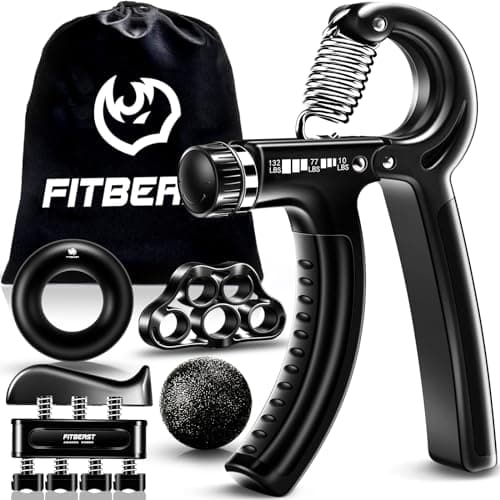
FitBeast — FitBeast Grip Strengthener Kit (5-Pack)
For most readers starting grip work: an adjustable gripper that progresses with you, plus the finger-extensor and forearm tools that keep the joint balanced — the sensible first purchase at the lowest sensible spend.
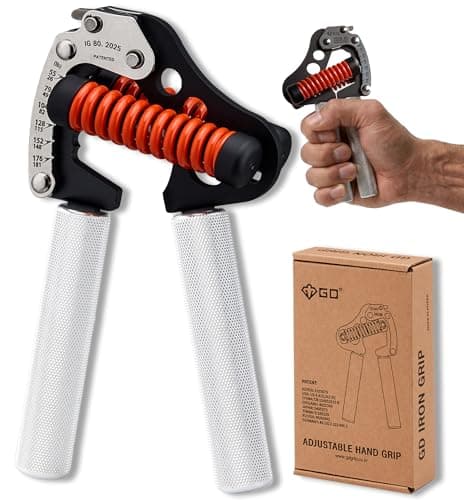
GD Iron Grip — GD Iron Grip 80
For the lifter who is already strong-handed and wants a rated, repeatable fixed resistance to progress through properly rather than a dial they can talk themselves out of.
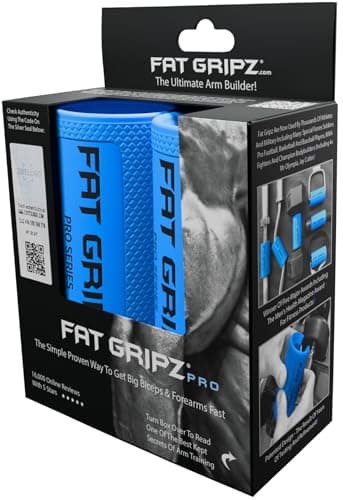
Fat Gripz — Fat Gripz (Original 2.25")
For the reader whose real problem is holding onto a barbell: thick grips make support grip the limiting factor on rows, presses and curls you already do, which is the most efficient grip work there is.
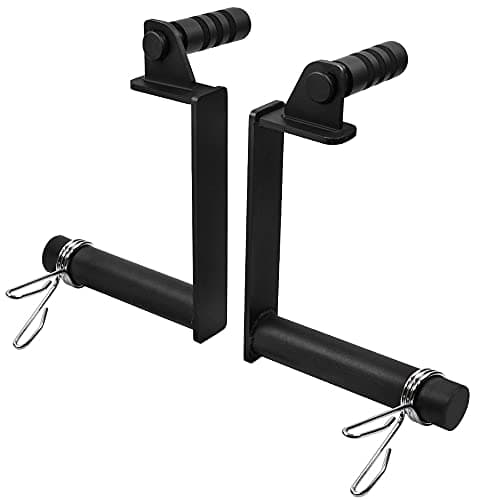
LoGest — LoGest Farmer Walk Handles
For the home-gym lifter who wants the single most effective grip exercise in existence — loaded carries until the hands open — and has the space and plates to do them.
The better tools if your goal is holding onto a barbell
If grip is the limiting factor on your deadlifts, rows and carries, train support grip directly — it is faster and it transfers. Three interventions do most of the work. Heavy carries: pick up two heavy dumbbells or kettlebells, or a pair of loaded farmer's handles, and walk until your hands open. This is the single most effective grip exercise in existence and it also loads your traps, core and conditioning at the same time. Dead hangs: hang from a pull-up bar for time, adding seconds weekly. Thick handles: sliding thick grips over a dumbbell or barbell handle increases the diameter you have to close around, which makes support grip the limiting factor on movements you were already doing — a genuinely efficient way to get grip work for free inside your existing program. Two accessories are worth understanding in this context. Chalk solves a friction problem, not a strength one, and it is the correct fix when your bar is slipping rather than your hand is failing. Lifting straps remove grip from the equation entirely, which is the right call on heavy back work where grip would cut your sets short and the wrong call on every set, because then you never train grip at all. The sensible rule: train grip deliberately on some sets, strap up when the target muscle is the back.
How to actually train with a gripper
Treat it like a lift. Two or three sessions a week, after training rather than before, so you are not going into deadlifts with fatigued hands. A usable template: three to five sets of five to eight hard reps on a resistance you can just complete, with a two-second squeeze at the closed position — the hold is where a lot of the stimulus is, and rushing reps is the most common way people get nothing from a gripper. Add a set of timed closed-holds at the end, thirty to forty-five seconds, which starts bridging toward support grip. When the top end gets easy, increase the resistance rather than the reps; grip responds to load like anything else. Train the openers too: a few sets of finger extensions against a rubber band or the extensor ring in a kit, which balances a joint that otherwise only ever gets trained in flexion. And give it recovery — hands take a beating from lifting already, and the most common gripper injury is a tendon problem from going too hard, too often, too soon. If something sharp develops at the wrist, in a finger, or at the elbow, stop and get it looked at: hand and wrist tendinopathies are slow to settle and much easier to avoid than to fix.
Bottom line
Hand grippers work, for crushing grip, if you program them like training. They are cheap, they load a function almost no program touches, and a stronger hand is genuinely useful. They will not build forearm size, they will not fix a failing deadlift grip, and they are not a medical device for wrist or nerve problems. The complete picture for grip is layered: heavy carries and dead hangs for support grip, thick handles to make existing work harder, chalk for friction, straps for the back work where grip would otherwise be the limiter, and a gripper for crushing strength as the accessory it is. Buy an adjustable gripper if you want one tool that progresses, a rated fixed gripper if you want to train crushing strength seriously, and spend the rest of the money on something to carry.
Frequently asked questions
Yes, for crushing grip specifically. A gripper loads the closing action of the fingers against the thumb, and that function responds to progressive resistance exactly like any other muscle group — heavier springs, more reps, longer holds and negatives all produce measurable gains in crushing strength. That is a real adaptation, it is why grippers have been standard kit in strength training for a century, and it is worth having because almost no training program loads the hand deliberately. The caveat is scope. Crushing grip is one of three grip functions, and improving it transfers only partially to the support grip that fails on a deadlift or the pinch grip that fails carrying a plate. So grippers work at what they do; they just do less than the marketing suggests. Train them like a lift — two or three sessions a week, with a progression plan and a two-second squeeze at the top — and they deliver. Squeeze one absent-mindedly at a desk and they will not.
Related reading
Sources
- Prognostic value of grip strength: findings from the Prospective Urban Rural Epidemiology (PURE) study — The Lancet, 2015
- Grip strength as a biomarker of ageing and health — review of handgrip dynamometry in clinical assessment — Clinical Interventions in Aging, 2019
- Carpal Tunnel Syndrome — Information Page (symptoms, causes, treatment) — National Institute of Neurological Disorders and Stroke (NIH)
- ACSM Position Stand: Progression Models in Resistance Training for Healthy Adults (progressive overload principles) — Medicine & Science in Sports & Exercise (American College of Sports Medicine), 2009
- Product titles, resistance ranges, materials, live prices and availability for the grip tools referenced — retrieved via the Amazon product data layer — Amazon product listing data, 2026
FitBeast — FitBeast Grip Strengthener Kit (5-Pack)
$16.99 · on Amazon