How to Do Farmer's Walks (and Why They Work)
A farmer's walk is exactly what it sounds like — pick up something heavy in each hand and walk with it — and it's one of the highest-return exercises you can do. It builds a vice-like grip, thick traps and upper back, a braced core, and real conditioning all at once, with a movement your body already knows. Warm up, start with a manageable load, and hold tall posture: stand up straight, shoulders set, chest up, core braced, taking short controlled steps. Load for the goal — heavy over short distances for strength and grip, lighter over longer distances for work capacity — and progress by adding weight, distance, or time. Carry handles, dumbbells, kettlebells, or a trap bar; the tool matters far less than holding good posture under a challenging load.
Affiliate disclosure: Trusted Health Gear is an Amazon Associate. If you buy through links on this page, we may earn a commission at no extra cost to you. Commission does not influence our rankings. Full policy.
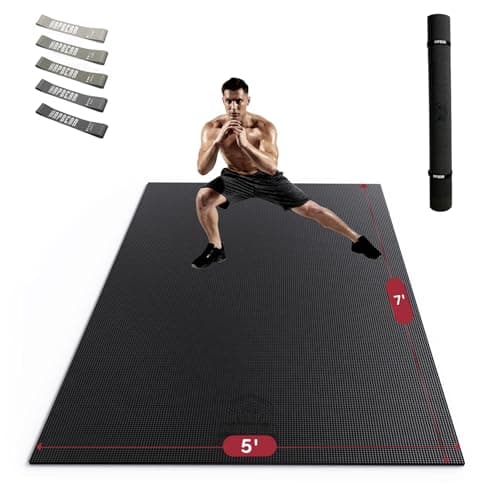
HAPBEAR — HAPBEAR Extra Large Exercise Mat (7ft x 5ft x 8mm)
Best large one-piece mat — a seamless 7-by-5-foot pad for floor work, HIIT, and shoes-on training
Why farmer's walks work
Few exercises train so much at once. The obvious payoff is grip: holding a heavy load for time is pure support-grip work, the exact quality that keeps a deadlift or a heavy carry from slipping out of your hands, and it carries straight over to real life. But carries do far more. The traps and upper back work isometrically to hold the shoulders in place under load, building thickness that direct shrugs rarely match. The core braces hard against the weight trying to pull you down and sideways, training genuine trunk stability without a single crunch. And because you're moving a heavy load over ground, your heart rate climbs fast, so carries double as conditioning and work-capacity training. Add in loaded posture, bone and connective-tissue strength, and obvious carryover to hauling luggage or groceries, and the humble farmer's walk earns its reputation as a near-complete, low-skill strength builder.
Setup and posture
Warm up first with a lighter carry or two, then set up like a deadlift. Stand between or over the implements, hinge at the hips with a flat back, take a solid grip, brace your core, and stand tall by driving through your legs — don't yank the weight up with a rounded back. Once you're up, that's the position you hold the whole way: chest up, shoulders set back and down (not shrugged into your ears), ribs stacked over hips, and eyes forward. Brace your midsection as if bracing for a light punch, and keep the load hanging in straight, quiet arms. Walk with short, controlled steps rather than long strides so the weights don't sway and pull you off balance. Breathe in a steady rhythm on longer carries instead of holding your breath the entire distance. At the end, set the load down under control with a hinge — don't just drop it and slump.
Load and distance guidelines
Two styles cover most goals, so pick one per set. Heavy and short builds maximal strength and grip: load a weight you can hold with clean posture for a short distance of roughly forty to sixty feet, or a timed hold of ten to twenty seconds, and rest fully between efforts. Moderate and long builds conditioning and work capacity: drop the load, extend the distance to a hundred feet or more, or carry for thirty to sixty seconds, keeping rest shorter so it stays a metabolic challenge. Start well within your ability — the load is right when your posture and grip survive the entire distance, and it's too heavy the moment your back rounds, your shoulders round forward, or the bells start swinging. Over time, a strong grip goal is carrying something close to your bodyweight total (about half per hand), but build toward that gradually by adding weight, distance, or time.
What to carry: handles, dumbbells, kettlebells, trap bar
The tool matters less than the load and your posture, so use what you have. Dedicated farmer's handles are the gold standard: a neutral grip, a high pickup point that saves your back, and a frame you load with plates to go genuinely heavy. A trap bar is nearly as good and often more available — the raised handles make it easy to load heavy and start from a strong position, which makes it a top choice for big carries. Dumbbells are the most convenient and perfectly effective, though very heavy ones get bulky and can bang your legs. Kettlebells work too; expect the bells to bump your forearms a little. In a pinch, sandbags, water jugs, or anything heavy and holdable will do. If you want to bias the grip challenge, add thick-bar fat grips to any handle — they turn a moderate carry into serious forearm work.
Variations worth knowing
Once the standard two-hand carry feels solid, a few variations add value. The suitcase carry loads just one side, forcing your core to resist bending sideways — it's one of the best anti-lateral-flexion core exercises there is, and it exposes left-right imbalances fast. A single-arm overhead or front-rack carry shifts the demand to the shoulders and upper back and cranks up the core challenge. A trap-bar carry lets you load the heaviest total weight for pure strength work. You can also vary the implement height and thickness — thicker handles hammer the grip, higher pickups spare the back. Each variation keeps the same rules: brace hard, stand tall, take controlled steps, and don't let the load twist or drag you out of position. Rotating a couple of variations keeps carries interesting and rounds out the core and shoulder work the straight version can miss.
Common mistakes to avoid
A handful of errors show up constantly. Going too light so there's no real stimulus is common — carries should feel genuinely heavy in your hands. The opposite, going too heavy so your posture collapses, is worse: rounding the back, letting the shoulders slump forward, or leaning way back to counterbalance turns a great exercise into a risky one. Taking long, rushed strides lets the weights swing and swings you off balance, so keep steps short and controlled. Holding your breath for an entire long carry leaves you dizzy; breathe in rhythm instead. Picking the load up or setting it down carelessly is where people most often tweak something, so treat the lift and the lower like a deadlift. Finally, reaching for straps too early defeats the grip benefit — save straps for very heavy trap-bar carries where the goal is the traps and legs, and let your grip do the work otherwise.
How to program carries
Farmer's walks slot in easily one to three times a week, usually at the end of a session as a finisher or as dedicated carry work on a lower-body or pulling day. Match the style to the day's goal: heavy, short carries with full rest when you're chasing strength and grip; lighter, longer carries with short rest when you want conditioning. A simple starting dose is three to five sets of a challenging carry, whether measured by distance (forty to a hundred-plus feet) or time (twenty to sixty seconds). Progress the way you would any lift — add a little weight, distance, or time as it gets easier — and count carries toward your weekly grip and upper-back volume so you don't overdo direct forearm work on top. Because they're low-skill and hard to do badly once your posture is set, carries are one of the easiest high-value additions to almost any program.
HAPBEAR — HAPBEAR Extra Large Exercise Mat (7ft x 5ft x 8mm)
Frequently asked questions
A lot at once. The forearms and hands get a heavy dose of support-grip work from holding the load for time. The traps and upper back work isometrically to keep the shoulders in place. The core braces hard against the weight, training real trunk stability. The legs, glutes, and hips do the walking and the pickup, and your cardiovascular system gets taxed too. That full-body, grip-heavy demand is exactly why carries are so efficient.
Related reading
Sources
- How to Do the Farmer's Walk — Technique, Benefits, and Programming — BarBend
- Loaded Carries and Core Stability (anti-lateral-flexion and trunk bracing) — American Council on Exercise
- Essentials of Strength Training and Conditioning (loaded carries, grip, and work capacity) — National Strength and Conditioning Association (NSCA)
- The Case for Loaded Carries in Strength Training — Stronger By Science
HAPBEAR — HAPBEAR Extra Large Exercise Mat (7ft x 5ft x 8mm)
$119.99 · on Amazon