How Much Does a Trap Bar Weigh?
There is no single answer, and that is the whole problem with this question. Unlike a standard Olympic barbell, which is a 20 kg or 45 lb convention almost every manufacturer honours, trap bars have no standard weight at all. They range from roughly 35 lb for a small budget hex bar to over 75 lb for a large open-ended bar with long sleeves and thick steel, and plenty of listings never state it. That spread of forty-odd pounds is larger than a plate on each side, which means two people saying they trap-bar deadlifted 315 lb may have lifted meaningfully different loads. If you track your pulls, your log is wrong by an unknown amount until you find out. So the practical answer is: find the number for your specific model before you log another set. Check the manufacturer's own spec page rather than the marketplace listing, which is where it most often goes missing; if the manufacturer does not publish it, put the bar on a bathroom scale, which is accurate enough for load math. And if you are buying rather than measuring, treat published bar weight as a buying criterion, because a bar that tells you what it weighs is a bar that will not quietly corrupt your training log. Of the bars we review, the CAP Olympic trap bar is the best closed-frame pick and the Bells of Steel open-ended bar is the best open one — both from manufacturers that publish real specifications.
Affiliate disclosure: Trusted Health Gear is an Amazon Associate. If you buy through links on this page, we may earn a commission at no extra cost to you. Commission does not influence our rankings. Full policy.
Why the range is so wide
A barbell is a cylinder, so its weight is almost entirely determined by length and diameter, and the industry converged on a standard decades ago: 20 kg, or 45 lb, for a men's Olympic bar, with 15 kg women's bars and 25 lb to 35 lb technique bars as recognised variants. A trap bar is a welded frame, and a frame has far more variables. Four things drive the weight. Frame size: a bar sized for a big lifter to stand inside with room to spare uses more steel than a compact one. Steel thickness and tube gauge: a bar rated to 1,000 lb is built heavier than one rated to 500 lb, and that mass is real. Sleeve length and diameter: long 2-inch Olympic sleeves that take six plates a side weigh considerably more than short ones. And handle construction: dual-height handles, thick combo grips, rotating collars and a built-in deadlift jack all add material. Stack those up and a 35 lb difference between two bars that look similar in photographs is entirely ordinary. The open versus closed distinction, incidentally, does not predict weight — a large open bar can easily outweigh a small closed hex, and the reverse is also true.
How to find the number for your bar
Work through these in order. First, the manufacturer's own product page, under specifications. Brands that build serious equipment usually publish bar weight, capacity and sleeve dimensions together, and that is the authoritative figure. Second, the printed or stamped marking on the bar itself — some manufacturers stamp weight on the frame or a sleeve collar, and it is worth looking before you assume it is absent. Third, the manual or packaging insert, which sometimes carries specs the marketplace listing omits. Fourth, if none of those produce a number, weigh it. A bathroom scale is accurate enough: stand the bar on end on the scale if it will balance, or set it flat across the scale with one end supported on something at the same height as the scale platform and double the reading, which is a rough but workable method for an awkward frame. Record whatever you find somewhere permanent — written in your training log, or taped to the bar — because the whole point of this exercise is to stop guessing. If you own more than one bar, do it for each: the difference between your hex bar and your straight bar is likely to be ten to thirty pounds.
Trap bars that publish their specs
Every pick below is already reviewed and scored in our roundups — same products, same specs, with live Amazon prices.
| Attribute | CAP Barbell CAP Olympic Trap Bar (Thick Combo Grip, 1,000 lb)Our pick | Bells of Steel Bells of Steel Open-Ended Trap Bar (700 lb) | CAP Barbell CAP Deluxe Open Trap Bar (Dual Grip) |
|---|---|---|---|
| Best for | Best overall — a dual-height, high-capacity closed hex bar that covers deadlifts, shrugs, and carries for most home gyms at a fair price | Best premium / best open bar — rotating sleeves, a built-in deadlift jack, and a walk-in open frame for the serious puller | Best open trap bar on a budget — a walk-in open frame with dual handles for a fraction of the premium bars |
| Who it's for | For most home lifters who only deadlift, shrug and carry. A closed frame rated to 1,000 lb, with both raised and low handles so you can change pull height — the best handle setup we review, and from a brand that publishes real specs. | For the lifter who loads and unloads constantly, or wants lunges and carries. The built-in deadlift jack removes the tilt-the-whole-frame routine, and rotating sleeves make high pulls and cleans viable — the only bar here that does. | For anyone who wants the walk-through open frame on a budget. Dual high and low handles, doubles as a shrug bar, and the open end means you load from the side rather than wrestling the bar onto a block every set. |
| Key specs | Closed hexagonal (hex) frame you step into · thick combo grip with both raised (high) and low handles · black finish · 2-inch Olympic loadable sleeves · rated to 1,000 lb capacity · fixed (non-rotating) sleeves · In Stock on Amazon | Open-ended (open) frame you can walk in and out of · rotating 2-inch Olympic sleeves · built-in deadlift jack to tilt the bar for easy loading · dual handle heights · rated to 700 lb capacity · home/commercial build · In Stock on Amazon | Open (open-ended) frame you can step in and out of · dual grip with high and low handles · doubles as a shrug bar · 2-inch Olympic loadable sleeves · black finish · In Stock on Amazon |
| Our score | 8.5/10 | 8.4/10 | 8.1/10 |
| Where to buy |
Prices pulled from Amazon as of October 18, 2026 and are subject to change. The price shown on Amazon at checkout applies.
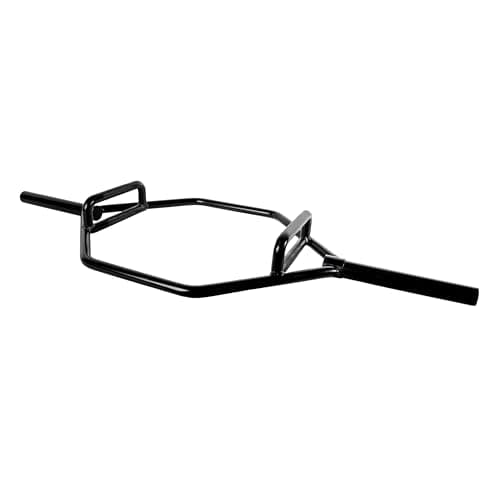
CAP Barbell — CAP Olympic Trap Bar (Thick Combo Grip, 1,000 lb)
For most home lifters who only deadlift, shrug and carry. A closed frame rated to 1,000 lb, with both raised and low handles so you can change pull height — the best handle setup we review, and from a brand that publishes real specs.
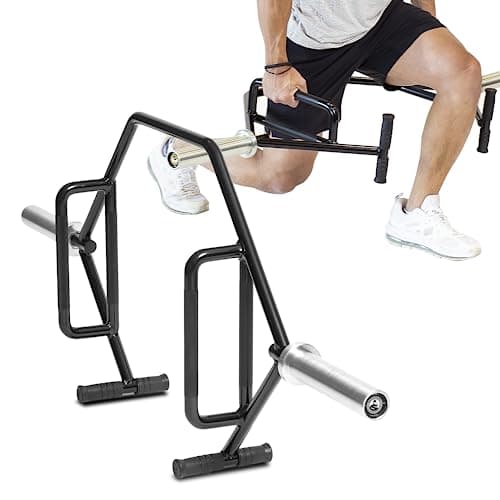
Bells of Steel — Bells of Steel Open-Ended Trap Bar (700 lb)
For the lifter who loads and unloads constantly, or wants lunges and carries. The built-in deadlift jack removes the tilt-the-whole-frame routine, and rotating sleeves make high pulls and cleans viable — the only bar here that does.
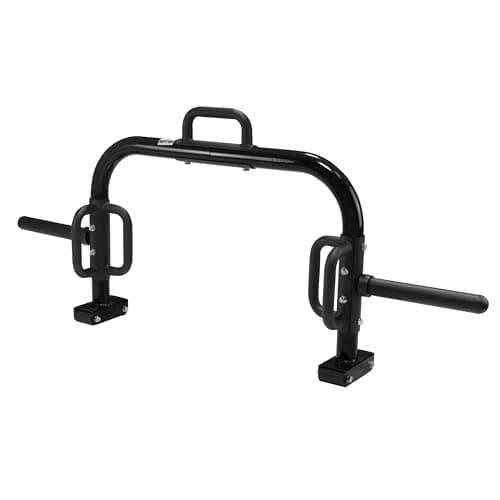
CAP Barbell — CAP Deluxe Open Trap Bar (Dual Grip)
For anyone who wants the walk-through open frame on a budget. Dual high and low handles, doubles as a shrug bar, and the open end means you load from the side rather than wrestling the bar onto a block every set.
Why it matters more than people assume
Three concrete reasons. Progression: if you train on percentages of a one-rep max, an unknown bar weight propagates into every working set for the whole programme, and the error is a fixed offset rather than noise, so it never averages out. Comparison: trap-bar deadlift numbers circulate constantly online, and because trap-bar weight is non-standard, comparing your total to someone else's is meaningless unless both of you know your bars. Programme transfer: if your gym's trap bar is a 75 lb open bar and your home bar is a 40 lb hex, moving a programme between them without adjusting means a 35 lb error, which is enough to turn a technical set into a grind. There is one more that gets overlooked: plate loading at the low end. If you are starting out, a 70 lb bar is already a meaningful load before you put anything on it — enough that a beginner may need to start with the empty bar, and enough that a light bar is actively the better purchase for a new lifter. That is the argument for buying a smaller bar, not a bigger one, if you are not yet strong.
The weights in and around the bar rack, for context
A quick reference, because trap bar weight is usually asked alongside the rest of these. A men's Olympic barbell is 20 kg or 45 lb; a women's Olympic barbell is 15 kg or roughly 33 lb; technique bars run 5 kg to 15 kg. A standard EZ curl bar is commonly in the 15 lb to 25 lb range depending on length and build, and heavy-duty Olympic-sleeve curl bars run higher. A safety squat bar is typically far heavier than a straight bar — often 60 lb to 70 lb or more, because of the camber and the shoulder pad assembly. Standard 1-inch-sleeve bars, the kind that come with cheap home sets, are lighter and much less consistent than Olympic bars. Plates are the one reliably standard thing on the rack: a 45 lb plate is 45 lb whether it is iron or a bumper, which is the entire reason bumpers come in matched diameters. The pattern across all of these is that the straight barbell is the only item with a genuine industry convention, and everything shaped like a frame or a specialty bar has to be looked up individually.
What to look for when you are buying
Treat published bar weight as a short-list criterion, not a detail. A manufacturer that publishes bar weight, rated capacity and sleeve length together is a manufacturer with real specifications behind the product, and the ones that publish none of it are usually rebadging a generic frame. Beyond the number itself, three specs do more for your training than weight does. Handle heights: dual high and low handles let you change the pull height, which is the most useful adjustment on any trap bar. Sleeve type: rotating sleeves matter only if you do cleans, high pulls or jump shrugs, and are irrelevant for straight deadlifts, shrugs and carries. Frame type: an open end lets you walk in and out and load without tilting, and unlocks lunges, split squats and front-rack carries that a closed hex physically cannot do. Then size the bar to yourself. A heavier, bigger bar is not better if you are a lighter lifter who will spend a year training near the empty bar, and a small 35 lb hex bar is a perfectly honest purchase for someone whose working pulls are under 200 lb.
Frequently asked questions
There is no standard, which is why this question has no single answer. Trap bars on the market range from roughly 35 lb for a small budget hex bar to over 75 lb for a large open-ended bar with thick steel and long sleeves, and many listings do not publish the figure at all. The spread is wider than a 45 lb plate, so it genuinely changes your load math. Find the number for your specific model: check the manufacturer's specification page rather than the marketplace listing, look for a stamp on the frame, and if neither gives you a figure, weigh it on a bathroom scale. Then write it down, because every set you log before you know it is wrong by an unknown amount.
Related reading
Sources
- IWF Technical and Competition Rules — barbell specifications (20 kg men's bar, 15 kg women's bar), the convention trap bars have no equivalent of — International Weightlifting Federation
- Bells of Steel open-ended trap bar — published specifications including bar weight, capacity, sleeve type and deadlift jack — Bells of Steel
- Hex bar deadlift biomechanics compared with the straight-bar deadlift (lower peak lumbar moment, more knee contribution) — Journal of Strength and Conditioning Research / PubMed
- Product titles, frame types, handle configurations, sleeve specifications, rated capacities, live prices and availability for the bars referenced — retrieved via the Amazon product data layer — Amazon product listing data, 2026
CAP Barbell — CAP Olympic Trap Bar (Thick Combo Grip, 1,000 lb)
$186.66 · on Amazon