How Many Weight Plates Do You Need?
For a home gym, plan your plates around the lifts you actually do, not a loaded-up showroom rack. A standard Olympic barbell weighs 45 pounds (about 20 kg), and plates come in 45, 35, 25, 10, 5, and 2.5-pound sizes. A sensible beginner-to-intermediate starter set is a pair each of 45s, 25s, 10s, 5s, and 2.5s — and adding a second pair of 45s brings you to roughly 300 pounds on the bar, which covers most people's early squats, deadlifts, presses, and rows. Always buy in matched pairs so the bar loads evenly, add more 45s as your squat and deadlift climb, and grab a set of fractional plates for small, steady increases. Do the simple math: target weight minus the bar, divided by two, is what goes on each side.
Affiliate disclosure: Trusted Health Gear is an Amazon Associate. If you buy through links on this page, we may earn a commission at no extra cost to you. Commission does not influence our rankings. Full policy.
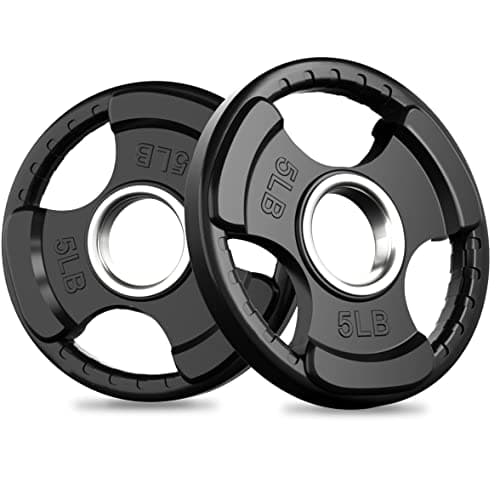
RitFit — RitFit Olympic Rubber Grip Weight Plates (2-inch set)
Best rubber-coated grip-plate alternative — versatile for a mixed home gym (note: grip plates, not true drop bumpers)
Start with the bar: your first 45 pounds
Before you count a single plate, count the bar — because it's the first 45 pounds on every lift. A standard Olympic barbell weighs 45 pounds, or about 20 kilograms; the two numbers are close enough that most people treat 45 lb and 20 kg bars interchangeably, though they're not exactly equal (20 kg is roughly 44 lb). That bar weight matters for planning in two ways. First, it means an empty bar is already a real training load — plenty for learning a squat, press, or deadlift pattern before you add anything. Second, it's the number you subtract when you do plate math: if you want to lift 135 pounds, the bar covers 45 of it, leaving 90 pounds to split across two sides. Some specialty bars differ — many women's Olympic bars are 15 kg (about 33 lb), and technique or training bars can be lighter — so if you're not using a standard 45-pound bar, check its weight and adjust your calculations. Everything below assumes a standard 45-pound Olympic bar with roughly two-inch sleeves that fit Olympic plates.
The standard plate denominations (and what each is for)
In pounds, plates come in a predictable ladder: 45, 35, 25, 10, 5, and 2.5. (Kilogram plates follow a parallel set — 25, 20, 15, 10, 5, 2.5, and 1.25 kg — color-coded in competition, but most U.S. home gyms are in pounds.) Each size has a job. The 45s are your workhorses for heavier squats, deadlifts, and rows; two 45s plus the bar make 135, a common working weight. The 25s and 10s let you build weights between the 45s and make smaller jumps — a pair of 10s adds 20 pounds to the bar, a pair of 5s adds 10. The 5s and 2.5s are your fine-tuning plates for progressing presses and other lifts that climb slowly. The 35s are the odd one out: useful in specific competition math but genuinely optional for a home gym, and most people skip them without missing anything. The takeaway is that you want a spread of sizes, not just big plates — a bar loaded only with 45s jumps in 90-pound steps, which is far too coarse for pressing or steady beginner progress.
A sensible starter set (~300 lb) and what it lifts
For most beginners through early-intermediate lifters, a practical first set is a pair each of 45, 25, 10, 5, and 2.5-pound plates. Add those up: 90 pounds in 45s, 50 in 25s, 20 in 10s, 10 in 5s, and 5 in 2.5s — about 175 pounds of plates, which with the 45-pound bar tops out around 220 pounds. If you want more headroom, going to two pairs of 45s pushes the plate total to roughly 265 pounds and the loaded bar past 300, which genuinely covers most people's squats, deadlifts, presses, and rows for a long time. That range — a loaded bar in the 200-to-300-pound neighborhood — is where the large majority of home lifters actually train for months or years. The honest advice is to buy for the lifts you're doing now plus a realistic year of progress, not for a one-rep max you might hit someday. Plates are easy to add later, they hold their value, and an over-bought rack of 45s you never load is just expensive decoration. Start with a full spread of sizes and a pair or two of 45s, then expand as the bar actually gets heavy.
Why matched pairs matter (and the plate-math method)
Two rules keep loading sane: buy in pairs, and do the math per side. Plates go on both ends of the bar, so they have to be symmetrical — a 45 on one side and a 25 on the other doesn't just look wrong, it makes the bar tip and lift unevenly. That's why plates are sold and counted in pairs, and why a lone plate is nearly useless for barbell work. When you plan a set, think in pairs: a pair of 10s, a pair of 25s, and so on. The loading math is simple once you internalize it. Take your target weight, subtract the bar (45 pounds), then divide what's left by two — that's the load for each side. Want 185? Subtract 45 to get 140, divide by two, and you need 70 pounds per side: a 45 and a 25 on each end. Want 225? That's 180 to split, or 90 per side — two 45s on each end. Keeping this in your head (or taped to the wall) tells you exactly which plates you need to own to hit the weights on your program, and stops you buying sizes you'll never load.
Scaling up: heavy squats, deadlifts, and how many 45s
The plates you add as you get stronger are almost always more 45s, because big lower-body lifts climb into territory the small plates can't reach efficiently. Consider the deadlift: a 405-pound pull needs 360 pounds of plates, or 180 per side — that's four 45s on each end. A 315 squat needs three 45s per side. So the pattern for progressing lifters is to keep the full spread of small plates you already own (you still need 2.5s and 5s to make small jumps) and simply buy additional pairs of 45s as your squat and deadlift demand them. A common home-gym endpoint is three or four pairs of 45s plus the original assortment, which handles loaded bars well past 400 pounds. A practical note for deadlifts specifically: to get the bar to the correct starting height off the floor, the largest plates need to be full-diameter — a standard 45-pound iron plate or a 45-pound bumper both work, but a stack of small plates won't raise the bar high enough. Buy the extra 45s when the weight is genuinely close, not in anticipation of a lift that's a year out.
Bumper vs iron, and fractional plates for real progress
Two more decisions round out a plate set. First, bumper versus iron. Bumper plates are rubber, share one large diameter regardless of weight, and are built to be dropped — the sensible choice if you do Olympic lifts (cleans, snatches) or deadlift and lower the bar hard, because dropped iron plates can crack, chip your floor, and be dangerously loud. Iron plates are thinner, cheaper per pound, and fine for lifts where the bar gets set down under control (racked squats, bench, controlled deadlifts). Many home gyms mix them: a pair of 45-pound bumpers for pulling from the floor, iron for everything else. Second, fractional or micro plates — small plates of 1.25, 1, 0.75, or 0.5 pounds, sold in pairs. Standard jumps go up 5 pounds at a time (a pair of 2.5s), which is a big leap on lifts like the overhead press where beginners stall fast. Fractionals let you add as little as one or two pounds to the bar, keeping a stalling lift progressing when a 5-pound jump would fail. They're inexpensive, take almost no space, and are one of the best small purchases for steady long-term progress.
RitFit — RitFit Olympic Rubber Grip Weight Plates (2-inch set)
Frequently asked questions
For most beginners, a pair each of 45, 25, 10, 5, and 2.5-pound plates is a solid starting set — about 175 pounds of plates, or roughly 220 with the bar. Adding a second pair of 45s pushes the loaded bar past 300 pounds and covers most early squats, deadlifts, and presses for a long time. Buy the full spread of sizes so you can make small jumps, not just a pile of 45s, and add more 45s later as your big lifts climb.
Related reading
Sources
- Best Weight Plates: Iron, Rubber, and Steel (expert-tested) — Garage Gym Reviews, 2026
- The Best Weight Plates (expert reviewed) — BarBend
- Iron Plates vs Bumper Plates: Uses, Benefits and FAQs — SET FOR SET
- Strength training: Get stronger, leaner, healthier — Mayo Clinic
RitFit — RitFit Olympic Rubber Grip Weight Plates (2-inch set)
$29.99 · on Amazon