Home Gym Flooring: How to Protect Your Floor and Joints
For most garage and basement gyms, 3/4-inch (19mm) rubber horse-stall mats are the best-value flooring — dense enough to protect the slab from dropped weights, quiet the room, and give your joints a firmer, more forgiving surface than bare concrete. Buy them from a farm-supply store, not a 'gym flooring' brand, and you'll pay a fraction of the price for the same recycled rubber. Use thinner rubber (8-10mm) under cardio equipment, and reserve thin EVA foam tiles for stretching and bodyweight work only — they crush under barbells. If you deadlift heavy, build a simple plywood-and-mat platform in one spot rather than flooring the whole room thicker.
Affiliate disclosure: Trusted Health Gear is an Amazon Associate. If you buy through links on this page, we may earn a commission at no extra cost to you. Commission does not influence our rankings. Full policy.
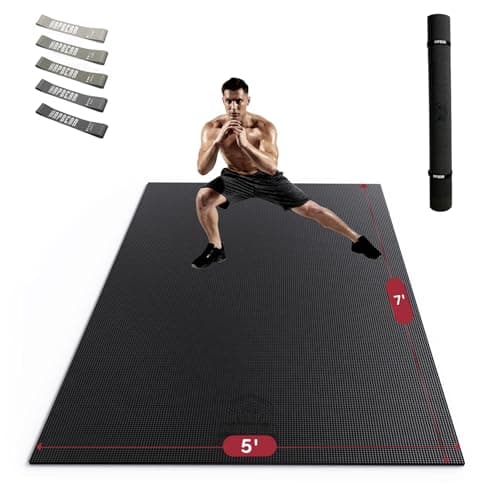
HAPBEAR — HAPBEAR Extra Large Exercise Mat (7ft x 5ft x 8mm)
Best large one-piece mat — a seamless 7-by-5-foot pad for floor work, HIIT, and shoes-on training
Why flooring matters more than people think
Flooring does three jobs. First, it protects the subfloor: a dropped loaded barbell or kettlebell can crack a concrete slab, dent hardwood, or punch through tile, and the damage is expensive and permanent. Second, it protects your gear — bars, bumpers, and dumbbells last longer landing on rubber than on concrete. Third, and most overlooked, it protects you. Standing and jumping on bare concrete for years is hard on knees, hips, and ankles; a firm rubber surface takes the harsh edge off without turning spongy. Flooring also cuts noise and vibration, which matters if there's a bedroom below or neighbors nearby. Skimping here is a false economy: the mats cost less than one slab repair, and far less than a joint problem.
Your options: stall mats, rolls, tiles, and foam
Four common choices. Horse-stall mats are 4x6-foot, 3/4-inch-thick slabs of dense recycled rubber, roughly 80-100lb each — the workhorse of garage gyms and the best value by far. Rubber rolls come in long, thinner sheets (often 1/4-3/8 inch) that cover big areas seamlessly; good for cardio zones and commercial-style finishes, but pricier per square foot. Interlocking rubber tiles puzzle together for easy install and clean edges, at a premium over stall mats. EVA foam tiles — the cheap, colorful puzzle mats — are fine for yoga, stretching, and kids, but they compress and tear under heavy loads and offer little floor protection. As a rule: rubber for weights, foam only for soft, light work.
How thick, based on what you're doing
Match thickness to the load. For cardio machines, bodyweight training, and light dumbbell work, 8-10mm (about 3/8 inch) of rubber is plenty — enough to dampen vibration and protect the floor. For general free-weight training — squats, presses, rows, moderate dumbbell and kettlebell work — 3/4-inch (19mm) stall mats are the standard, and they handle the occasional controlled drop. For heavy deadlifts and dropping loaded bumpers, thickness alone isn't the answer: even thick mats can crack a slab under a hard drop, so you want a dedicated platform (below) or a layered drop zone. Foam's thickness is misleading — a thick foam tile still bottoms out under a barbell. When in doubt for lifting, go denser rather than just thicker.
Where to place it
You rarely need to floor the entire room to the same spec, and doing so wastes money. Think in zones. Put your densest flooring — stall mats or a platform — under the rack and lifting area where weights get loaded and dropped. Run thinner rubber under cardio equipment to catch vibration and sweat. Leave walking or storage areas with the cheapest covering, or none. A common, cost-smart layout is stall mats wall-to-wall in the training footprint (they double as a level, grippy base for a rack) plus a reinforced platform in the single spot where you deadlift. Lay mats tight with staggered seams so they don't creep apart under a rack's feet, and cut them to fit around uprights with a utility knife and a straightedge.
Over concrete, carpet, or a garage slab
The subfloor changes the plan. Concrete is the most common base and the most unforgiving — mats here are about protecting the slab and saving your joints; stall mats sit flat and stable on it. Over a garage slab, watch for slope (garages are pitched for drainage) and cold, damp conditions that make bare concrete miserable and can trap moisture under mats — leave a small gap for airflow or lift mats occasionally to dry. Over carpet, firm stall mats work but can trap heat and moisture, so a low-pile carpet is better than plush, and heavy racks may sink and wobble — a plywood base under the mat steadies them. Never put heavy dropping loads over a suspended wood floor without a platform; joists aren't built for it.
What it costs
Flooring splits into rough price brackets per square foot. Budget: EVA foam puzzle tiles are the cheapest, but they're a stretching-and-yoga solution, not a lifting floor. Best value: horse-stall mats from a farm-supply retailer land far below branded 'gym' rubber for the same material — this is where most home gyms should shop, and buying the mats yourself rather than a labeled gym kit is the single biggest saving. Premium: interlocking rubber tiles and rolled rubber cost several times more, buying you easier installation, cleaner seams, and color options rather than better performance. The pattern here mirrors the rest of a smart home gym — pay for a versatile, durable staple and skip the marked-up branding.
A simple deadlift platform
If you deadlift or drop heavy bumpers, build a platform instead of chasing ever-thicker mats. The classic DIY version is roughly 8x8 feet: two layers of 3/4-inch plywood glued and screwed together for a stiff, load-spreading base, then rubber on top. Cover the two outer 'drop zones' where the plates land with 3/4-inch stall-mat rubber to absorb impact, and leave a firm center strip — a third strip of plywood or hardwood — under your feet so you have a stable base to pull from. A platform spreads the force of a drop across a wide footprint, protects both the slab and your bar, and cuts the noise of a deadlift dramatically. It's a cheap weekend build that outperforms flooring the whole room thicker.
HAPBEAR — HAPBEAR Extra Large Exercise Mat (7ft x 5ft x 8mm)
Frequently asked questions
For most people, 3/4-inch rubber horse-stall mats. They're dense enough to protect the floor from dropped weights, quiet the room, ease the load on your joints, and cost far less than branded gym rubber. Buy them from a farm-supply store rather than a gym-flooring brand.
Related reading
Sources
- Home Gym Flooring — buyer's guide — Garage Gym Reviews
- Best Home Gym Flooring & Rubber Mats — BarBend
- How to Build a Weightlifting Platform — Rogue Fitness
HAPBEAR — HAPBEAR Extra Large Exercise Mat (7ft x 5ft x 8mm)
$119.99 · on Amazon