Vitamin D2 vs Vitamin D3: Which Form Actually Raises Your Levels?
Both forms are vitamin D, both are well absorbed in the gut, and both will cure rickets — the NIH says so plainly, and most steps in their metabolism are identical. The difference is how much they move the number your doctor measures. Vitamin D2 is ergocalciferol, manufactured by UV-irradiating ergosterol in yeast, and it is the vitamin D in mushrooms. Vitamin D3 is cholecalciferol, usually produced by irradiating 7-dehydrocholesterol from lanolin in sheep's wool, and it is the form your own skin makes in sunlight. NIH's position is that most evidence indicates vitamin D3 increases serum 25-hydroxyvitamin D to a greater extent, and maintains those higher levels longer, than vitamin D2. The size of that gap was argued for a decade because the landmark 2012 meta-analysis found D3's advantage clearly in bolus dosing but not in daily dosing — and a 2023 meta-analysis of 20 comparative studies closed the argument by finding D3 superior even when the analysis was limited to daily dosing, with D2 producing a change in total 25(OH)D about 10.4 nmol/L — roughly 40% — lower. So: buy D3. The practical exceptions are narrow and worth knowing. If you are vegan, animal-free D3 from lichen exists and is the better choice over D2. If your doctor prescribed 50,000 IU capsules, those are ergocalciferol — prescription vitamin D in the US is D2 — and that is a dosing decision made for you, not a mistake to correct on your own.
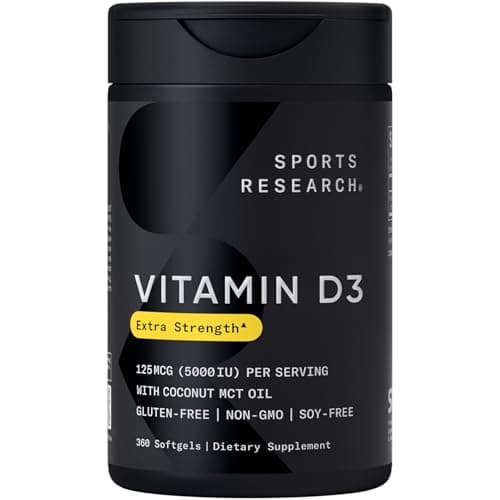
Sports Research — Sports Research Vitamin D3 with Coconut Oil
The verdict
Buy vitamin D3. It raises and holds serum 25(OH)D better than D2, it is the form your skin makes, it costs the same or less, and it is what nearly every third-party-tested supplement on the shelf already contains. If you avoid animal products, buy lichen-derived D3 rather than settling for D2 — it is widely available and it gives you the better form without the lanolin. Three things matter more than the D2-versus-D3 question once you have the right form. Take it with a meal that contains some fat, because absorption is passive diffusion and dietary fat helps. Pick a sane dose: the RDA is 600 IU a day up to age 70 and 800 IU after, the upper limit for adults is 4,000 IU, and the 10,000 IU softgels on the shelf are not a better buy. And get a blood test rather than guessing, because the only thing that tells you whether your dose is working is your serum 25(OH)D — sufficient for most people is 20 ng/mL (50 nmol/L) or more, below 12 ng/mL (30 nmol/L) is where deficiency risk climbs, and above 50 ng/mL (125 nmol/L) is where the Food and Nutrition Board starts flagging possible harm. Sunlight and food first, a modest supplement to close the winter gap second.
Side-by-side
| Attribute | Vitamin D2 (Ergocalciferol) | Vitamin D3 (Cholecalciferol) |
|---|---|---|
| Chemical name | Ergocalciferol | Cholecalciferol |
| How it's made | UV irradiation of ergosterol in yeast | UV irradiation of 7-dehydrocholesterol from lanolin (sheep's wool); lichen for animal-free versions |
| Food sources | Mushrooms (variable), UV-treated mushrooms and mushroom powder | Fatty fish, cod liver oil, egg yolks, beef liver, fortified dairy |
| Made by your own skin? | No | Yes — this is the form sunlight produces |
| Absorption in the gut | Well absorbed by passive diffusion | Well absorbed by passive diffusion |
| Effect on total serum 25(OH)D | Lower — about 10.4 nmol/L (~40%) less than D3 in daily-dose trials | Higher, and maintained longer |
| Bolus / weekly dosing | Clearly inferior to D3 in meta-analysis | Significantly better — the largest gap between the two forms |
| Vegan-friendly | Yes | Only the lichen-derived versions |
| US prescription form | Yes — 50,000 IU capsules are ergocalciferol | No — D3 is sold as a dietary supplement |
| Our call | Only if prescribed | Buy this |
| Where to buy |
Prices pulled from Amazon as of October 18, 2026 and are subject to change. The price shown on Amazon at checkout applies.
Who should pick which
Pick Vitamin D2 (Ergocalciferol)
- Anyone whose doctor prescribed 50,000 IU capsules for a diagnosed deficiency — US prescription vitamin D is ergocalciferol, and that is a clinical decision, not a labeling error.
- People getting vitamin D from UV-exposed mushrooms as part of a whole-food diet, where the D2 you eat is a real contribution rather than a choice between bottles.
Pick Vitamin D3 (Cholecalciferol)
- Essentially everyone buying vitamin D off the shelf — D3 raises serum 25(OH)D more and holds it longer at the same intake.
- Anyone taking a once-weekly or less-frequent dose, where D3's advantage over D2 is largest and most consistent.
- Vegans and vegetarians — choose lichen-sourced D3, which is animal-free and still the better-performing form.
- People retesting their blood levels after a few months, who want the dose and the number to track together predictably.
What the two forms actually are
Vitamin D is not one molecule. In foods and supplements it comes in two main forms, D2 and D3, which differ chemically only in their side-chain structures, and both are well absorbed in the small intestine by passive diffusion plus a carrier-protein mechanism. Where they part company is origin. Vitamin D2 — ergocalciferol — is manufactured by UV-irradiating ergosterol in yeast, and it is the form found in mushrooms, which provide variable amounts naturally; some mushrooms sold in stores have been deliberately UV-treated to raise their D2 content, and the FDA has approved UV-treated mushroom powder as a food additive. Vitamin D3 — cholecalciferol — is typically produced by irradiating 7-dehydrocholesterol taken from lanolin in sheep's wool, which is also, not coincidentally, essentially what your own skin does when sunlight hits it. Dietary D3 comes from fatty fish and cod liver oil above all, with smaller amounts in egg yolks, beef liver and cheese. An animal-free version of D3 sourced from lichen is also available, which matters because it means vegans no longer have to accept the weaker form to avoid animal products. Once either form is in your bloodstream it is hydroxylated in the liver to 25-hydroxyvitamin D — 25(OH)D — which is the metabolite your blood test measures and the one used to define deficiency. Most steps in the metabolism and actions of D2 and D3 are identical, and NIH notes they appear to have equivalent ability to cure rickets. The question is not whether D2 is real vitamin D. It is how far a given dose moves your 25(OH)D.
The evidence that D3 wins, and the decade-long argument about daily dosing
NIH's summary is the right starting point: most evidence indicates that vitamin D3 increases serum 25(OH)D levels to a greater extent and maintains those higher levels longer than vitamin D2, even though both forms are well absorbed. The paper that put numbers on it was the 2012 systematic review and meta-analysis by Tripkovic and colleagues in the American Journal of Clinical Nutrition, which pooled randomized trials directly comparing the two and found D3 significantly better at raising 25(OH)D (P = 0.001). But it also found the nuance that kept the debate alive for ten years: the advantage was clear when the vitamin was given as a bolus dose, and the effect was lost when the comparison was restricted to daily supplementation. That left a reasonable position available — that for the way most people actually take vitamin D, one a day, the form might not matter. A 2023 systematic review and meta-analysis took that question on directly, pooling 20 comparative studies of daily or once-to-twice-weekly dosing and controlling for how 25(OH)D was measured. It found D3 superior to D2 even inside the daily-dose subset. Across 12 daily-dosed comparisons analyzed by liquid chromatography-tandem mass spectrometry, the weighted mean difference in change in total 25(OH)D was 10.39 nmol/L lower for D2 than D3 — about 40% less — with a 95% confidence interval of −14.62 to −6.16. Two findings from that paper are worth carrying with you. First, each form raises its own hydroxylated metabolite perfectly well: D2 reliably lifts 25(OH)D2 and D3 lifts 25(OH)D3, and the gap appears in the total. Second, body mass index turned out to be the strongest response modifier, reducing heterogeneity between studies to zero when accounted for — and in people with a BMI above 25, the difference between the forms lost statistical significance. Vitamin D response is individual, and body size is part of why.
Where D2 still legitimately shows up
Two places, and neither is a reason to buy a D2 supplement off the shelf. The first is your prescription. In the United States, high-dose prescription vitamin D is ergocalciferol: the 50,000 IU capsule is 1.25 mg of ergocalciferol USP in an edible vegetable oil, labeled for conditions including hypoparathyroidism, vitamin D-resistant rickets and familial hypophosphatemia, and it is routinely prescribed weekly for diagnosed deficiency. If that is what you were given, take what you were given — the dose is doing the work there, the follow-up blood test will tell your doctor whether it worked, and swapping to an over-the-counter D3 on your own initiative is not an upgrade, it is a change to a treatment plan. The second is food. Mushrooms are the only common whole food that contributes meaningful D2, and UV-exposed mushrooms contribute considerably more. If you eat them, that is a genuine dietary contribution and exactly the kind of thing this site prefers to a capsule. What we would not do is choose a D2 supplement over a D3 one for ethical reasons, because that trade-off no longer exists: lichen-derived D3 is animal-free and performs like D3. If you are vegan, read the source line on the bottle rather than the form line.
Dose, absorption, and the number that actually tells you something
Form is the easy decision; the dose and the follow-up are where people go wrong. The RDA for vitamin D is 15 mcg (600 IU) a day from age 1 through 70, rising to 20 mcg (800 IU) from 71, and the tolerable upper intake level for adults is 100 mcg (4,000 IU) a day. That ceiling is the reason to be skeptical of the 10,000 IU softgels sold beside the 1,000 IU ones: more is not better here, and excess vitamin D is genuinely toxic rather than just wasteful. Because vitamin D increases calcium absorption, toxicity produces marked hypercalcemia and hypercalciuria, with serum 25(OH)D typically above 375 nmol/L (150 ng/mL), and in extreme cases renal failure, soft-tissue calcification, cardiac arrhythmias and death — almost always from supplements, not from sun or food. On the interpretation side, the Food and Nutrition Board considers 50 nmol/L (20 ng/mL) or more sufficient for most people, flags rising deficiency risk below 30 nmol/L (12 ng/mL), treats 30-50 nmol/L (12-20 ng/mL) as potential inadequacy, and notes that concentrations above 125 nmol/L (50 ng/mL) can be associated with adverse effects. Two practical notes. Take it with food containing some fat: absorption happens by passive diffusion and concurrent fat in the gut enhances it, so a vitamin D softgel with your eggs beats one with black coffee. And test rather than guess — your own 25(OH)D after a few months on a given dose is the only readout that tells you whether your supplement is doing anything, and it is also how you find out you never needed 5,000 IU in the first place.
What we'd actually buy
A plain D3 softgel, third-party tested, at 1,000-2,000 IU for routine use, taken with a meal — and sunlight and fatty fish doing as much of the work as your latitude and diet allow. That is the entire recommendation, and it is why every pick in our vitamin D roundup is a D3 product. Look for USP Verified, NSF Certified for Sport or an equivalent mark, because vitamin D content in supplements has historically varied from label claim and certification is the only cheap way to check. Softgels in oil are a sensible default given that absorption improves with fat; sprays and gummies are legitimate if a softgel is the reason you stop taking it, with the caveat that gummies tend to come with added sugar and more variable dosing. One note on what you will actually see listed: 5,000 IU softgels are everywhere, and that dose sits above the 4,000 IU adult upper limit, which makes it a correct-a-tested-deficiency product rather than a daily default — buy it on the back of a blood test and a conversation with your doctor, not because it was the biggest number per dollar. If you avoid animal products, buy the lichen-sourced D3 and ignore the D2 shelf entirely. D3 plus K2 combinations are popular and the better products are perfectly reasonable buys, but treat the K2 as a bonus rather than the reason to pay more. And keep the whole thing in proportion: vitamin D is one of the few supplements where a real, measurable deficiency is common in winter at northern latitudes, which makes it worth taking seriously — and also one where the dose-response question is settled enough that there is no case for megadosing. Correct the gap, verify with a test, and spend the rest of your attention on protein, training and sleep.
Frequently asked questions
Yes, for raising and holding your blood level. NIH's position is that most evidence indicates vitamin D3 increases serum 25(OH)D to a greater extent and maintains those higher levels longer than D2, even though both forms are well absorbed in the gut and both cure rickets. The 2012 meta-analysis that established this found D3 significantly better overall (P = 0.001) but could not show the advantage within daily-dosing trials specifically, which kept the question open for years. A 2023 meta-analysis of 20 comparative studies settled it: D3 was superior even when the analysis was restricted to daily dosing, with D2 producing a change in total 25(OH)D about 10.4 nmol/L — roughly 40% — lower across 12 daily comparisons measured by mass spectrometry. Interestingly, each form raises its own metabolite normally; the shortfall shows up in total 25(OH)D. Body mass index was the strongest modifier of the response, and above a BMI of 25 the difference between the two forms lost statistical significance.
Related reading
Sources
- Vitamin D — Health Professional Fact Sheet ('most evidence indicates that vitamin D3 increases serum 25(OH)D levels to a greater extent and maintains these higher levels longer than vitamin D2'; D2 made by UV irradiation of ergosterol in yeast and D3 from 7-dehydrocholesterol in lanolin, with lichen-sourced D3 available; RDA 600 IU to age 70 and 800 IU after; UL 4,000 IU for adults; sufficiency at 50 nmol/L (20 ng/mL); deficiency risk below 30 nmol/L (12 ng/mL); adverse effects possible above 125 nmol/L (50 ng/mL); toxicity typically above 375 nmol/L (150 ng/mL); dietary fat enhances absorption; mushrooms provide variable D2) — NIH Office of Dietary Supplements, 2026
- Comparison of vitamin D2 and vitamin D3 supplementation in raising serum 25-hydroxyvitamin D status: a systematic review and meta-analysis (D3 significantly more effective than D2 overall, P = 0.001; advantage present with bolus dosing and lost with daily dosing) — American Journal of Clinical Nutrition (Tripkovic et al.), 95(6):1357-1364, 2012
- Comparison of the effect of daily vitamin D2 and vitamin D3 supplementation on serum 25-hydroxyvitamin D concentration and importance of body mass index: a systematic review and meta-analysis (20 comparative studies; D3 superior even limited to daily dosing; weighted mean difference 10.39 nmol/L — about 40% — lower for D2 across 12 daily LC-MS/MS comparisons, 95% CI −14.62 to −6.16, I² = 64%; each form raises its own hydroxylated metabolite similarly; BMI the strongest response modifier) — Advances in Nutrition, 2023
- DRISDOL (ergocalciferol) capsules, liquid filled — FDA label (each softgel contains ergocalciferol USP 1.25 mg, equivalent to 50,000 USP units of vitamin D, in edible vegetable oil; indicated for hypoparathyroidism, vitamin D-resistant rickets and familial hypophosphatemia) — DailyMed, National Library of Medicine, 2026
Sports Research — Sports Research Vitamin D3 with Coconut Oil
$18.95 · on Amazon