The Best Dip Stations & Dip Bars for Home (2026)
A dip station is the most efficient way to add heavy vertical pressing to a home gym without a bench or a rack: dips build the chest, front delts, and triceps through a long range the bench press never reaches, and the same bars double as a base for L-sits, leg raises, and elevated push-ups. The hardware that matters is boring but decisive. You want a frame that doesn't rock or walk across the floor when you're at the bottom of a rep, a steel gauge and weld quality that comfortably clears your bodyweight plus a loaded dip belt, and a footprint you can actually store. We ranked these on stability, build and weight capacity, adjustability, footprint, and value — and we'll say plainly where a single welded frame beats a two-piece adjustable stand, and where a pair of independent bars earns its keep, so you don't buy more (or wobblier) hardware than your training needs.
Top pick
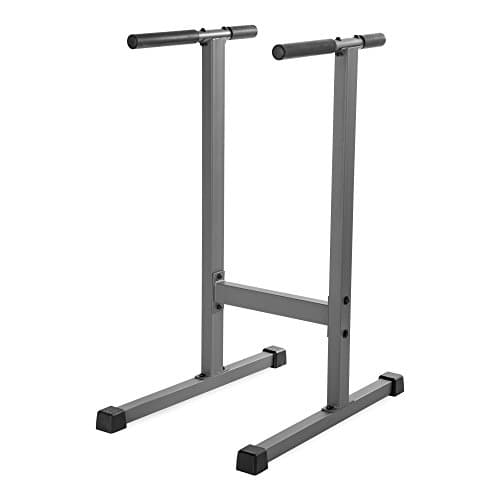
XMARK — XMARK Dip Station (500 lb Capacity)
Welded single H-frame (not a two-piece stand) · 500 lb rated capacity · fixed-height dip bars with padded grips · wide, low floor base for stability · dedicated dip station that does not break down for storage · steel construction
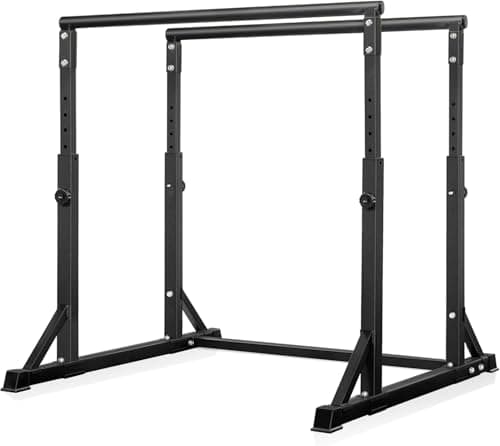
Bongkim — Bongkim Dip Bar (7 Height Levels, 800 lb)
At a glance
Tap a row to check price · tap a header to sort| # | Best for | Price | ||
|---|---|---|---|---|
| 1 | | Best overall | 8.5/10 | Check price |
| 2 | | Best heavy-duty adjustable | 8.2/10 | $125.99$139.99 |
| 3 | 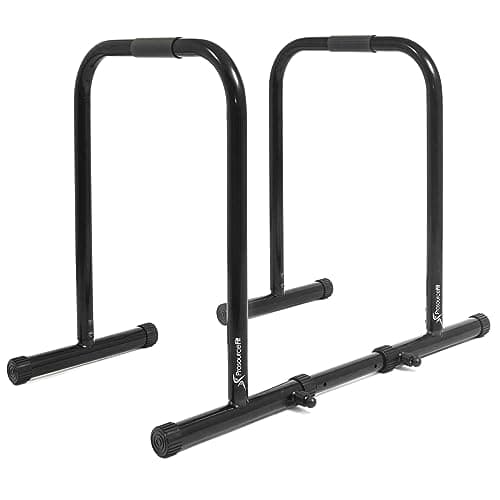 | Best A-frame value | 7.9/10 | $69.98$89.99 |
| 4 | 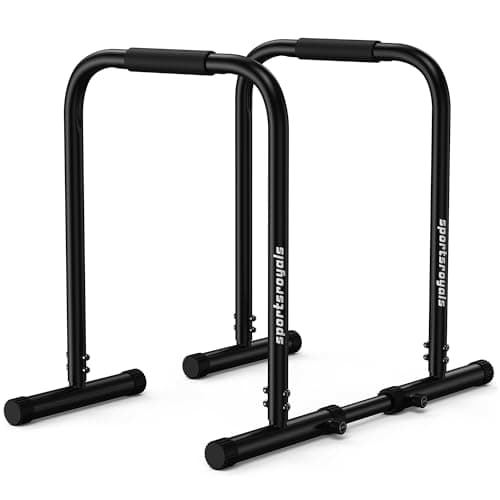 | Best adjustable for progressions | 7.7/10 | $59.99 |
| 5 | 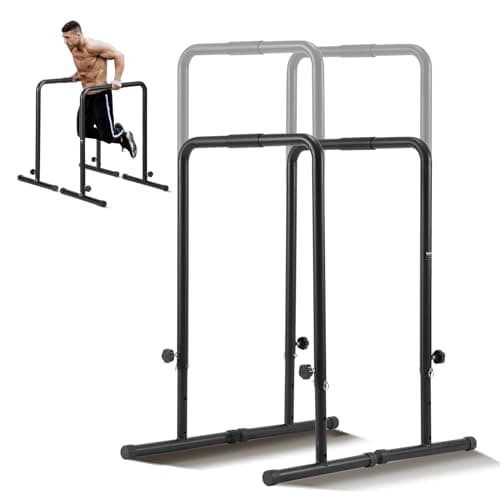 | Best budget adjustable | 7.3/10 | $55.90 |
| 6 | 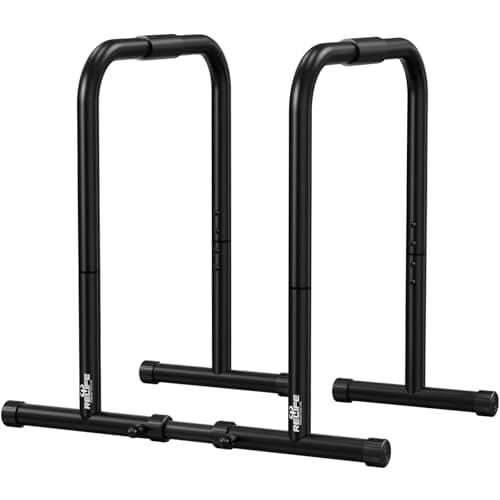 | Best ultra-budget compact | 7/10 | $58.99$69.99 |
Prices pulled from Amazon as of Sep 16, 2026 and are subject to change. The price shown on Amazon at checkout applies.
How we scored
Every product below is scored on six metrics, 0-10 each, with the weighting described on how we review. The criteria specific to this category:
- Stability — the single most important spec: a wide base and low center of gravity keep the stand from rocking or tipping at the bottom of a dip, where a welded single frame is the most planted and a two-piece stand relies on a connector bar or your bodyweight to stay put.
- Build and weight capacity — the rated capacity should clear your bodyweight plus any added load from a dip belt with a wide margin, and you should weigh steel gauge and weld quality over the headline number, since cheap tubing flexes long before it fails.
- Adjustability — adjustable-height (and sometimes width) bars let you set a comfortable grip and progress from bench-style dips to full reps, but every extra pin and joint is another potential wobble point.
- Footprint and storage — a dedicated welded stand lives on the floor permanently, while two-piece and parallette-style bars break down or nest for small and shared spaces at the price of some stability.
- Grip width and handle comfort — bars roughly shoulder-width apart suit most lifters, because too wide stresses the shoulder joint and too narrow crowds the elbows, and foam or textured grips affect comfort on long sets.
- Value — stability and durability per dollar, factoring whether you want a buy-once dedicated stand or a cheap, packable set for bodyweight dips and push-up variations.
What to know before buying
- Single frame vs two-piece vs independent bars: a welded single-frame station (like the XMARK) is the most stable format and the best base for weighted dips, but it doesn't break down and takes permanent floor space. Two-piece A-frame stands with a connector bar store smaller and cost less with only a little stability lost. Fully independent bars are the most versatile and packable but the least idiot-proof — they can slide apart under load if the floor is slick.
- Capacity headroom matters more than the headline number. A 400 lb rating sounds generous until you hang a dip belt with 90 lb off your waist and add the dynamic load of driving out of the bottom. Buy a capacity that clears your bodyweight plus your heaviest planned added load with real margin, and treat the cheapest no-name ratings with a healthy dose of skepticism.
- Watch the grip width. Bars that are too wide throw extra stress on the shoulder joint and can aggravate cranky shoulders; too narrow crowds the elbows and turns the movement into a triceps-only press. Most lifters do best with bars roughly shoulder-width apart, which is why adjustable-width or slightly angled bars are worth a small premium if your shoulders are picky.
- Independent (two separate bases) bars are the most versatile but need babysitting. You can set them to any width and use them as parallettes for push-ups, L-sits, and handstand work — but because they aren't joined, they can slide apart under load when the feet slip or the floor is smooth. Put them on a mat and check the width every few sets.
- Match the stand to your bodyweight and goals. If you're heavy, train weighted dips, or want one stand for life, pay up for a wide welded frame with a high capacity. If you're lighter, tight on space, or mostly doing bodyweight volume and push-up variations, a packable two-piece or adjustable set does the job for a fraction of the price.
Our picks
XMARK — XMARK Dip Station (500 lb Capacity)
Key specs: Welded single H-frame (not a two-piece stand) · 500 lb rated capacity · fixed-height dip bars with padded grips · wide, low floor base for stability · dedicated dip station that does not break down for storage · steel construction
Pros
- Welded single-frame design is the most stable format here — no connector bar to loosen and nothing to slide apart, so it stays planted at the bottom of a rep and under a loaded dip belt
- 500 lb rated capacity leaves real headroom for bodyweight plus a heavily loaded dip belt, which is exactly where cheaper stands start to feel sketchy
- Wide floor base and low center of gravity resist the forward rock that plagues tall, narrow stands during the eccentric
- Padded grips and a simple, rigid build make it a genuine lifetime piece rather than a disposable budget stand
Cons
- Fixed height and width — no way to dial in grip spacing or scale down to bench-style dips
- Does not break down, so it occupies permanent floor space and isn't the pick for a shared or tiny room
- The heaviest and priciest option here; overkill if you only do light bodyweight volume
XMARK — XMARK Dip Station (500 lb Capacity)
- Stability9/10
- Build / capacity9/10
- Adjustability4/10
- Footprint / storage5/10
- Value7/10
Bongkim — Bongkim Dip Bar (7 Height Levels, 800 lb)
Key specs: Two independent adjustable bases · 7 height levels · 800 lb rated capacity · matte-black steel · works for dips, L-sits, push-ups, and calisthenics · height-adjustable for bench-to-full-dip progressions · rated for indoor and outdoor use
Pros
- 800 lb rated capacity is the highest on this list — ample margin for bigger lifters and heavy weighted dips
- Seven height levels let you set a comfortable bar height, progress from partial to full dips, and accommodate taller frames
- The two independent bases double as parallettes for push-ups, L-sits, and handstand work, so it trains more than just dips
- Heavy-gauge matte-black steel feels noticeably more rigid than the sub-$50 adjustable stands
Cons
- As two separate bases, the bars can drift apart under load if the feet slip — they need a grippy floor or a mat and a width check between sets
- Height adjustment relies on pins and joints, which add a small amount of play a welded frame doesn't have
- Pricier than the budget adjustable stands and heavier to move around than a packable set
Bongkim — Bongkim Dip Bar (7 Height Levels, 800 lb)
- Stability7/10
- Build / capacity9/10
- Adjustability9/10
- Footprint / storage7/10
- Value8/10
ProsourceFit — ProsourceFit Heavy Duty Dip Station (Parallel Bars, 400 lb)
Key specs: Two triangular A-frame bases joined by a safety connector bar · 400 lb rated capacity · foam-padded grips · breaks into two pieces for storage · steel frame with non-slip feet · fixed grip width
Pros
- The safety connector bar ties the two A-frame bases together, so it resists the slide-apart problem of fully independent bars while still breaking down for storage
- Wide triangular bases sit low and stable — a genuinely solid platform for bodyweight and moderately weighted dips
- 400 lb rated capacity covers most lifters' bodyweight with room for a modest dip belt
- Foam grips and a proven, widely owned design at a mid-budget price make it an easy first dip stand
Cons
- Fixed grip width won't suit lifters who need a narrower or wider setting for shoulder comfort
- The 400 lb rating is adequate but not generous once you add heavy belt weight
- Foam grips wear and can spin over time; the finish is workmanlike, not premium
ProsourceFit — ProsourceFit Heavy Duty Dip Station (Parallel Bars, 400 lb)
- Stability8/10
- Build / capacity7/10
- Adjustability5/10
- Footprint / storage8/10
- Value9/10
Sportsroyals — Sportsroyals Adjustable Dip Bar (400 lb)
Key specs: Two independent bases · adjustable height and width · 400 lb rated capacity · calisthenics-focused design · doubles as parallettes for push-ups and L-sits · non-slip feet · compact footprint
Pros
- Adjustable in both height and width, so you can set shoulder-friendly grip spacing and progress from low bench-style dips to full reps
- The independent bases work as parallettes for push-ups, L-sits, and handstand practice — versatile for calisthenics
- Compact and easy to reposition or move aside, unlike a welded frame
- A popular, well-reviewed budget option that covers most lifters' bodyweight at a low price
Cons
- Independent bars can slide apart under load without a grippy surface — they need a mat and a periodic width check
- The 400 lb rating leaves modest headroom once you add belt weight; not a heavy weighted-dip platform
- More pins and joints than a welded stand means a bit more play and setup fiddling
Sportsroyals — Sportsroyals Adjustable Dip Bar (400 lb)
- Stability7/10
- Build / capacity7/10
- Adjustability9/10
- Footprint / storage8/10
- Value8/10
VEVOR — VEVOR Dip Bars (440 lb, Adjustable Height)
Key specs: Two independent bases · adjustable height · 440 lb rated capacity · doubles as a parallette push-up stand · steel frame with non-slip feet · compact, packable footprint
Pros
- Among the cheapest adjustable stands here while still quoting a 440 lb capacity
- Height-adjustable and usable as parallettes for push-ups and L-sits, so it earns its keep beyond dips
- Small footprint and light enough to move aside or store between sessions
- Widely stocked and easy to restock through VEVOR's Amazon storefront
Cons
- Budget steel and hardware flex more than the heavier stands — treat the 440 lb rating conservatively
- The independent bases can drift under load; they need grippy footing and a width check
- No width adjustment and basic grips — a functional budget tool, not a refined one
VEVOR — VEVOR Dip Bars (440 lb, Adjustable Height)
- Stability6/10
- Build / capacity6/10
- Adjustability8/10
- Footprint / storage8/10
- Value9/10
RELIFE — RELIFE Rebuild Your Life Dip Station
Key specs: Two A-frame bases in a parallette / push-up-stand style · foam-padded grips · compact and breaks down for storage · steel frame with non-slip feet · fixed grip width · one of the most widely owned budget dip stands
Pros
- One of the lowest prices here for a two-piece dip stand that also works as a parallette for push-ups and L-sits
- Compact A-frame bases break down and tuck away easily for small or shared spaces
- Foam-padded grips are comfortable for bodyweight volume work
- Enormously popular and easy to restock, with a long track record for light-to-moderate use
Cons
- No published high capacity and a lighter build — best kept to bodyweight and light added load, not heavy weighted dips
- The two independent bases can slip apart on smooth floors without a mat
- Fixed grip width and basic hardware; the foam can wear or spin over time
RELIFE — RELIFE Rebuild Your Life Dip Station
- Stability6/10
- Build / capacity5/10
- Adjustability5/10
- Footprint / storage9/10
- Value9/10
Frequently asked questions
It depends entirely on the format. A welded single-frame station like the XMARK is the most stable and the right choice if you belt on real weight — there's no connector to loosen and nothing to slide apart. A two-piece A-frame stand with a safety connector bar (like the ProsourceFit) is the next best thing and stays planted for most lifters. Fully independent bars are the least stable under heavy load because the two bases can drift apart; they're fine for bodyweight work but need a grippy floor or a mat. Whatever you buy, make sure the rated capacity clears your bodyweight plus your belt load with margin to spare.
Sources
- Triceps Dip — technique, muscles worked, and common form errors — American Council on Exercise (ACE), 2026
- Bodyweight and resistance training guidelines for upper-body pushing strength — National Strength and Conditioning Association (NSCA), 2026
- Best Dip Stations and Dip Bars — buying criteria (stability, capacity, footprint) — BarBend, 2026
- ACSM Guidelines for resistance and bodyweight training programming — American College of Sports Medicine (ACSM), 2026
Last verified: August 1, 2026. See our editorial policy and how we review for details on scoring and update cadence. Canonical URL: https://trustedhealthgear.com/reviews/best-dip-station.
XMARK — XMARK Dip Station (500 lb Capacity)
on Amazon