Resistance Band Exercises: A Full-Body Routine That Actually Builds Strength
Yes — a well-structured resistance band routine genuinely builds strength and muscle, especially for beginners and intermediates training at home. The key is progressive overload: as a band gets easier, you slow the tempo, add reps, take less rest, or move to a thicker band. Bands provide ascending resistance (hardest at full stretch), which is great for pressing and pulling lockouts but means you have to choose tension that challenges the weakest point of the movement too. Below is a balanced full-body routine covering push, pull, lower body, and core, plus how to anchor safely and how to progress. Pair it with adequate protein and whole foods, and you have a complete home strength program.
Affiliate disclosure: Trusted Health Gear is an Amazon Associate. If you buy through links on this page, we may earn a commission at no extra cost to you. Commission does not influence our rankings. Full policy.
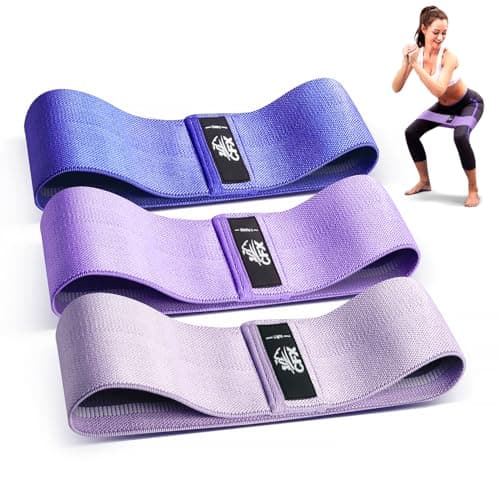
CFX — CFX Booty Bands (3-Level Set)
Most versatile budget set — a low-cost non-slip fabric kit that covers glutes plus Pilates and full-body home work
A balanced full-body routine
Train the whole body 2-3 times per week with a day of rest between sessions. A simple, balanced template: one push, one pull, one squat-pattern, one hinge-pattern, and one core movement per session. For example — banded chest press, banded row, banded squat, banded RDL (Romanian deadlift), and a Pallof press. Do 2-4 sets of 10-20 reps each. Because bands are forgiving on the joints and easy to scale, you can train them more frequently than heavy barbell work, but still leave a day between hard sessions for recovery. Warm up first with band pull-aparts and a few light bodyweight squats.
Push: chest press, overhead press, pushdowns
Chest press — anchor the band behind you at chest height (or loop it across your upper back), hold a handle in each hand, and press forward until your arms are straight, squeezing the chest. Overhead press — stand on the middle of the band with feet shoulder-width, start with handles at shoulder height, and press straight overhead; the resistance increases as you lock out, which trains the top of the press hard. Triceps pushdowns — anchor the band high (over a door or pull-up bar), keep your elbows pinned to your sides, and extend down until your arms are straight. Control the return on all three; don't let the band snap you back.
Pull: rows, pull-aparts, lat pulldowns
Seated/standing row — anchor the band at chest height (or sit and loop it around your feet), pull the handles toward your ribs while squeezing your shoulder blades together, and control the return. Band pull-aparts — hold the band in front of you at shoulder height with straight arms and pull it apart until it touches your chest; this is one of the best movements for posture and rear-delt/upper-back health. Lat pulldowns — anchor the band high overhead, kneel or stand, and pull the handles down toward your shoulders, driving your elbows down and back. Pulling volume matters: aim for at least as much pulling as pressing to keep the shoulders balanced.
Lower body: squats, RDLs, glute bridges, lateral walks
Squats — stand on the band with feet shoulder-width, run the handles up to your shoulders, and squat to depth while keeping your chest up. Romanian deadlifts (RDLs) — stand on the band, hinge at the hips with a soft knee bend and a flat back, feeling the stretch in your hamstrings, then drive your hips forward to stand tall. Glute bridges — loop the band over your hips (anchored to the floor or held), lie on your back, and drive your hips up, squeezing your glutes at the top. Lateral band walks — place a loop band around your thighs or ankles, sink into a quarter-squat, and step sideways to fire up the glute medius (great for hip stability and knee health). Lower-body muscles are strong, so you'll likely need a thicker band here than for upper-body work.
Core
Pallof press — anchor the band at chest height to your side, hold the handle with both hands at your chest, and press straight out while resisting the band's pull to rotate you; this anti-rotation work builds a stable, functional midsection. Banded woodchoppers — anchor low or high and pull diagonally across your body for rotational strength. You can also add standing band crunches (anchor high, kneel, and crunch down against the resistance). Core trains best with control and tension, not speed — move deliberately and keep your ribs down.
How to anchor safely
A secure anchor is the single most important safety factor with bands. Use a proper door anchor (a strap with a foam ball that closes inside a door at the hinge side) rather than wrapping a band around a thin handle or sharp edge. Inspect bands before every session for nicks, cracks, or fraying — a band under tension that snaps can cause serious eye or face injury. Never stretch a band more than about 2.5x its resting length, and never point a stretched band toward your face. Stand on tube bands with a stable, flat foot so they can't slip out. If you're anchoring to furniture, make sure it can't tip or slide toward you.
Progression: sets, reps, and overload
Strength comes from progressive overload, and bands give you several levers. Within a workout, aim for 2-4 sets of 8-20 reps, stopping 1-3 reps shy of failure on most sets. To make a movement harder over time, in order of preference: (1) move farther from the anchor or shorten your grip to increase starting tension, (2) slow the lowering phase to 3-4 seconds, (3) add reps or sets, (4) reduce rest between sets, and (5) step up to a thicker band once you can hit the top of your rep range with good form. Track your sessions so you know when to progress. A set of stackable bands (light/medium/heavy) gives you the range to keep challenging every muscle as you get stronger.
Frequently asked questions
Yes. Multiple studies show resistance-band training produces strength and muscle gains comparable to free weights when effort and progression are matched. The deciding factor is progressive overload — you have to keep making the movements harder over time, not the type of equipment.
Related reading
Sources
- Resistance training using elastic bands vs conventional resistance training: a systematic review and meta-analysis — SAGE Open Medicine, 2019
- Physical Activity Guidelines for Americans, 2nd edition (muscle-strengthening guidance) — U.S. Department of Health and Human Services, 2018
- Progression Models in Resistance Training for Healthy Adults (Position Stand) — American College of Sports Medicine — Medicine & Science in Sports & Exercise, 2009
- Resistance Band Training (exercise guidance and safety) — American Council on Exercise
CFX — CFX Booty Bands (3-Level Set)
$12.90 · on Amazon