Resistance Bands vs Free Weights: Which Should You Pick?
When the resistance is high enough to take a set near failure, randomized trials show elastic bands can build muscle comparably to free weights. Where free weights pull ahead is maximal strength and heavy loading: a barbell lets you add weight in precise, near-unlimited increments and trains the high-load, low-rep end that bands struggle to reach. Bands win on portability, cost, joint-friendly variable resistance, and accommodating tension for explosive work. For most home and travel training, bands cover hypertrophy well; for powerlifting, Olympic lifting, and max-strength CrossFit work, free weights remain the standard. The best setup for serious lifters is usually both — a barbell or dumbbells for the heavy compound work and bands for accessory, warm-up, and accommodating resistance.
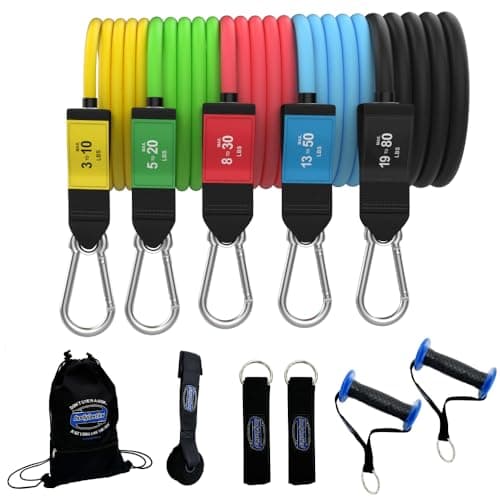
Bodylastics — Resistance Bands Set with Handles, Door Anchor & Ankle Straps
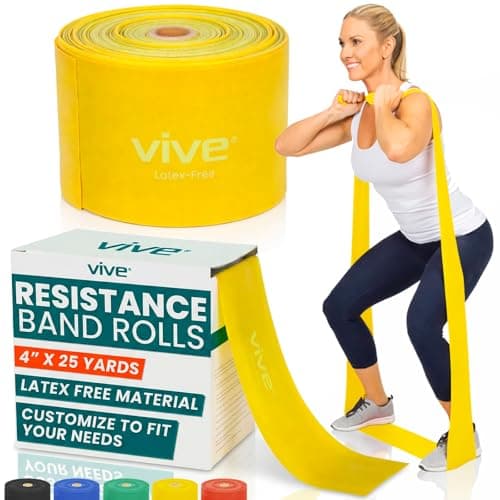
Vive Health — Latex-Free Exercise Bands (Therapy Roll / Pre-Cut Set)
The verdict
Pick resistance bands if you train at home or travel, want low-cost joint-friendly muscle building, and train mostly in the 8-20 rep hypertrophy range. Pick free weights if max strength, heavy compound lifting, precise progressive overload, or competitive powerlifting/Olympic lifting/CrossFit is the goal. If you can, own both: free weights for heavy strength, bands for accessories, warm-ups, and accommodating resistance.
Side-by-side
| Attribute | Resistance bands | Free weights |
|---|---|---|
| Hypertrophy evidence | Comparable to free weights when sets reach near failure (RCT/meta-analysis support) | Strong, well-established evidence base; the long-standing reference standard |
| Maximal strength gains | Builds strength, but harder to test/express 1RM; weaker for true max loading | Superior for max strength and 1RM development; precise heavy loading |
| Loadable resistance | Variable; capped by band stack and stretch — hard to reach very high loads | Near-unlimited; add plates in small precise increments |
| Joint stress / resistance curve | Ascending/variable — lightest in stretched (often weakest) position; joint-friendly | Constant gravitational load; can spike stress at the bottom of a movement |
| Portability | Excellent — fits in a bag, weighs ounces | Poor — heavy, bulky, rack/bench often required |
| Cost | Low — a full band set is a fraction of a barbell setup | Higher upfront — barbell, plates, rack/bench add up |
| Space required | Minimal — a doorway anchor and floor space | Significant — rack, bench, plate storage, lifting platform |
| Progression / progressive overload | Step-jumps between bands or doubling up; less granular | Fine-grained — micro-plates allow 0.5-1 kg jumps |
| Where to buy |
Prices pulled from Amazon as of Sep 24, 2026 and are subject to change. The price shown on Amazon at checkout applies.
Who should pick which
Pick Resistance bands
- Home and travel trainers who need a compact, packable full-body setup.
- People with cranky joints — variable resistance is lightest at the most vulnerable stretched position.
- Beginners and budget buyers who want to build muscle without a rack or heavy plates.
Pick Free weights
- Lifters chasing maximal strength, a bigger squat/bench/deadlift, or competitive powerlifting.
- CrossFit, Olympic-lifting, and heavy-compound athletes who need precise, near-unlimited loading.
What the hypertrophy research actually shows
This is the headline most people get wrong. A 2019 systematic review in SAGE Open Medicine concluded that elastic resistance training produces strength gains similar to conventional resistance training (machines/free weights). More recent randomized trials and a 2022 meta-analysis comparing elastic versus conventional resistance found no significant difference in muscle hypertrophy when training variables — effort, volume, and proximity to failure — are matched. The mechanism makes sense: muscle growth is driven primarily by mechanical tension and taking sets close to failure, not by whether the tension comes from gravity or a stretched band. The practical catch is that you need enough band resistance to make the last reps genuinely hard. A light band you can do 40 reps with won't grow much — same as a 5 lb dumbbell wouldn't.
Why free weights still win for max strength
Maximal strength is the honest weak point for bands. To train and express a true one-rep max you need to handle near-maximal loads in a measurable, repeatable way, and the resistance curve of a band makes that awkward: tension is lowest where you're stretched and you simply can't stack enough bands to replicate a heavy barbell squat or deadlift. Free weights let you load in precise increments essentially without ceiling, which is exactly what max-strength and powerlifting progress requires. If your goal is a bigger squat, bench, or deadlift — or you compete in powerlifting, Olympic lifting, or strength-biased CrossFit — free weights are the right tool. Bands can supplement (see accommodating resistance below) but won't replace the barbell here.
Resistance curves, joints, and accommodating resistance
Bands provide ascending (variable) resistance: tension increases as the band stretches, so the load is lightest at the start of the range and heaviest at lockout. That can be joint-friendly — the most vulnerable, deeply-stretched positions see the least load. Free weights deliver constant gravitational load that can spike joint stress at the bottom of a lift. The two combine well: in the lab and in elite gyms, adding bands to a barbell ('accommodating resistance') is a documented way to train explosive force and improve the force-velocity profile, because you accelerate against rising tension. Westside-style banded squats and bench are a real, evidence-supported method — not gimmickry.
Portability, cost, space, and progression
On logistics, bands win decisively. A full band set weighs a few ounces, costs a fraction of a barbell-and-plates setup, and needs only a doorway anchor and floor space — ideal for apartments, travel, and minimal home gyms. The trade-off is progression granularity: free weights let you add micro-plates for 0.5-1 kg jumps, while bands force step-changes between thicknesses or doubling up, which is coarser. For hypertrophy that coarseness rarely matters (you progress reps and proximity to failure instead). For squeezing out the last few percent of max strength, the fine increments of free weights matter a lot.
Our take: whole-foods-first, train hard, use the right tool
Muscle is built by hard training plus enough protein and recovery — the implement is secondary once the resistance is sufficient. If you eat enough whole-food protein, sleep, and take your working sets close to failure, bands will build real muscle. We recommend bands as a primary tool only for home/travel hypertrophy and rehab-adjacent, joint-friendly work. For anyone chasing maximal strength or competing in heavy-lifting sports, free weights are the foundation and bands are a smart supplement. Owning both is the strongest setup, and it's still cheaper and more compact than most people assume.
Frequently asked questions
Yes. Randomized trials and meta-analyses comparing elastic resistance to free weights show comparable muscle and strength gains when effort, volume, and proximity to failure are matched. The key is using enough band resistance that your last reps are genuinely hard — a band you can rep 40+ times won't grow much, just like a too-light dumbbell wouldn't.
Related reading
Sources
- Effects of elastic resistance exercise on muscle strength and function: a systematic review and meta-analysis — SAGE Open Medicine, 2019
- Resistance training with elastic bands versus conventional resistance training: a meta-analysis of muscle strength and hypertrophy — Frontiers in Physiology, 2022
- Resistance training to momentary muscular failure improves muscular strength and hypertrophy: a meta-analysis — Sports Medicine, 2021
- The use of variable resistance (bands and chains) and its effects on strength and power: a review — Journal of Strength and Conditioning Research, 2016
- Mechanisms of muscle hypertrophy and their application to resistance training — Journal of Strength and Conditioning Research, 2010
Bodylastics — Resistance Bands Set with Handles, Door Anchor & Ankle Straps
$49.97 · on Amazon