Resistance Band Weight Guide: What Strength Should You Get?
Most people are best served by a set that spans light, medium, and heavy rather than a single band, because the right resistance changes by exercise and by how strong you already are. As a rough starting point: light bands (roughly 5-15 lb equivalent) suit upper-body accessory work, rehab, and warm-ups; medium bands (15-35 lb) cover most full-body training; heavy bands (35 lb and up) suit glutes, legs, and assisted pull-ups. Treat every printed lb rating as approximate — it describes force at a specific stretch length, and it varies by brand, band age, and how far you pull. If you're buying one thing, buy a graduated set so you can scale load the way you'd add plates.
Affiliate disclosure: Trusted Health Gear is an Amazon Associate. If you buy through links on this page, we may earn a commission at no extra cost to you. Commission does not influence our rankings. Full policy.
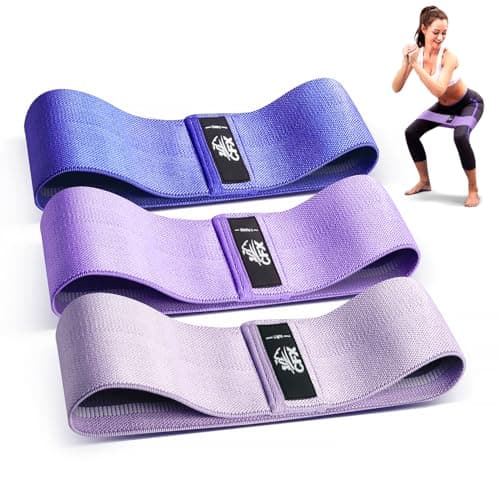
CFX — CFX Booty Bands (3-Level Set)
Most versatile budget set — a low-cost non-slip fabric kit that covers glutes plus Pilates and full-body home work
How band resistance is actually rated
Unlike a dumbbell, a band has no fixed weight. The force it produces depends on how far you stretch it: pull a band to twice its length and it pushes back harder than at 1.5x. So a printed '30 lb' rating is really a snapshot — the force measured at one specific elongation the manufacturer chose, often around 100-200% stretch. Stretch it less and you get less than the rating; stretch it more and you get more. This is why two bands labeled the same number can feel different, and why the same band feels heavier at the top of a curl than at the bottom. Think of the number as a ballpark, not a calibrated weight.
The color-coding myth
There is no industry-wide standard tying a color to a resistance level. Yellow might be the lightest band in one brand's set and a mid-tier band in another's. Therapy-band brands, loop-band brands, and tube-set brands all pick their own color order. Always read the lb (or kg) rating and the stretch range printed on the package or listing — never assume 'green = medium' carries over between brands. If you add bands later from a different maker, re-test them against your existing set rather than trusting the color.
Which to buy by goal: glutes and lower body
Glute and leg work tolerates and benefits from heavier resistance, because these are large, strong muscle groups. For hip thrusts, banded squats, lateral walks, and kickbacks, lean toward medium-heavy and heavy bands. Fabric (cloth) loop bands are popular here because they don't roll up or pinch the skin the way thin latex loops do during walks and abductions. If glutes are your main goal, prioritize a set with at least one genuinely heavy band rather than three light ones.
Which to buy by goal: upper body and full-body
Upper-body pressing and pulling (chest press, rows, face pulls, lateral raises, triceps pushdowns) usually needs lighter-to-medium resistance than legs, because the muscles are smaller and the leverage is less favorable. A tube set with handles and a door anchor covers most of this. For full-body and CrossFit-style accessory work — banded good mornings, pull-aparts, overhead carries, assistance work — a graduated long-loop (pull-up style) set gives you the widest range from one purchase, since you can loop, double, or anchor them in many configurations.
Which to buy by goal: rehab and assisted pull-ups
For rehab, prehab, and shoulder/rotator-cuff work, you want light, smooth resistance and fine control — flat therapy bands or light tubes in the 2-15 lb range. The goal is high reps with clean form, not maximal load. For assisted pull-ups it's the opposite: you need a thick long-loop band that takes a large fraction of your bodyweight, so look at the heaviest bands in a long-loop set (often rated 50-175 lb equivalent across a range). Pick the band that lets you complete clean reps, then step down to a lighter one as you get stronger.
Single band vs a set, and tube vs loop
Buy a set if you can. A single band locks you into one resistance, and because band force is non-linear, you'll quickly outgrow it on some lifts while it stays too hard on others. A graduated set lets you scale load and combine bands. On format: tube bands with handles and a door anchor mimic cable machines well and are great for presses, rows, and curls; flat loop / mini-bands are best for glute and hip activation; long continuous loops (the thick pull-up bands) are the most versatile for full-body, assisted pull-ups, and adding resistance to barbell lifts. Fabric loops resist rolling and last longer for floor work; latex loops are cheaper and pack smaller.
How band 'lbs' compare to dumbbell lbs, and how to progress
Band lbs and dumbbell lbs are not interchangeable. A dumbbell applies constant force through the whole rep; a band applies the least force at the start and the most at full stretch (ascending resistance). So a band rated '20 lb' will feel easier than a 20 lb dumbbell at the bottom of a movement and potentially harder at the top. Use the rating to pick a starting band, then judge by reps in reserve, not by matching the number to a dumbbell. To progress: add reps, slow the tempo, increase range of motion (stand farther from the anchor), combine two bands, or step up to the next band in the set. That's your equivalent of adding plates.
Frequently asked questions
A medium band in roughly the 15-35 lb range is the most generally useful single choice, because you can stand closer to the anchor for less force or farther for more. But a graduated set is a better buy — it costs little more and covers far more exercises.
Related reading
Sources
- Resistance bands: Tips to help you stay strong — Harvard Health Publishing
- A comparison of free weight squat to Smith machine squat using electromyography — Journal of Strength and Conditioning Research, 2009
- Effects of resistance training using elastic bands on muscle strength: a systematic review with meta-analysis — Biology of Sport, 2022
CFX — CFX Booty Bands (3-Level Set)
$12.90 · on Amazon