How to Choose Knee Sleeves for Lifting
For most lifters, a pair of 5mm neoprene knee sleeves, sized snug using the brand's own measurement chart, is the right choice — they give warmth and compression across a whole session without limiting mobility. Go 7mm if you want maximum support for heavy powerlifting-style squats, or 3mm if you mostly want warmth for higher-rep and general training with full range of motion. Buy them as a pair, check the stitching and material for durability, and remember that sleeves are not wraps: sleeves provide steady warmth and compression the whole time you train, while wraps cinch tight for a rebound effect on maximal single squats. Knee sleeves are gym gear, not a medical device — if you have a knee injury, see a qualified professional before relying on them.
Affiliate disclosure: Trusted Health Gear is an Amazon Associate. If you buy through links on this page, we may earn a commission at no extra cost to you. Commission does not influence our rankings. Full policy.
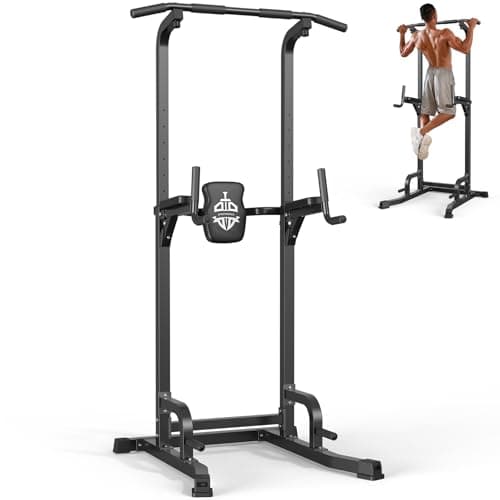
Sportsroyals — Sportsroyals Power Tower Pull-Up and Dip Station
Best freestanding option — no drilling, with pull-up, dip, and knee-raise stations in one frame
What knee sleeves actually do
Let's be clear about the job knee sleeves are built for, because it's easy to overstate. A knee sleeve is a tube of neoprene that slides over the knee and provides two main things: warmth and compression. The warmth keeps the joint and surrounding tissue at a consistent temperature through your session, which many lifters find makes the knee feel better during heavy squatting. The compression offers a snug, supportive feel and some proprioceptive feedback — a sense of where the joint is — plus a bit of elastic support out of the bottom of a squat. What sleeves are not is a brace or a fix for an injured knee; they don't hold the joint together or treat a problem. They're a comfort-and-support tool that helps a healthy knee feel warm, secure, and a little more supported under load. That's a genuinely useful thing for people who squat regularly, but it's worth setting the expectation honestly: sleeves make training more comfortable, they don't repair anything, and they're not a substitute for good technique or medical care.
Thickness: 3mm vs 5mm vs 7mm
Neoprene sleeves come in a few standard thicknesses, and the number describes the material, which drives the support-versus-mobility trade-off. 3mm sleeves are thin and light: mostly warmth and a little compression, with almost no restriction, so they suit higher-rep training, general fitness, and anyone who mainly wants a warm joint and full range of motion. 5mm is the popular all-rounder: a noticeable snugness and supportive feel with only mild restriction, which works well for a mix of strength training and moderate-to-heavy squats — this is the thickness most lifters should start with. 7mm sleeves are the thickest common option: stiffer, more compressive, and offering the most supportive 'rebound' feel out of the hole, which is why they're favored for heavy, low-rep powerlifting-style squats — but they're warm, tighter, and can feel like too much for light or high-rep work. The rule of thumb: thicker means more support and warmth but less mobility and comfort at high reps. Pick the thickness that matches how you train most often, not the heaviest thing you'll ever do.
Sizing: snug, not strangling
Sizing is where people go wrong most, and it matters more than the brand. Knee sleeves are meant to be snug — that's the point of the compression — but sizing is not standardized, so you must measure yourself and use the specific brand's own size chart rather than assuming your usual 'medium.' Most charts ask you to measure the circumference of your leg a set distance below the kneecap (or around the mid-patella), then match that number to their sizing. Getting it right means a sleeve that's firm and supportive but that you can still get on with effort and wear for a full session without your lower leg going numb or your foot tingling. Too loose and you lose the warmth and support that justify buying them; too tight and you cut off circulation, which is uncomfortable and counterproductive. If you're between sizes, consider how you'll use them — tighter for maximal support on heavy singles, slightly looser for long training sessions and higher reps. Always check the chart for the exact pair you're buying, because a 'large' from one brand can differ from another.
Material, stitching, and durability
Because a sleeve is a simple product, build quality is mostly about the neoprene and the seams — and it's what separates a pair that lasts years from one that stretches out or splits in months. Look for good-quality neoprene that holds its shape and compression over time rather than going slack after a few weeks. The stitching is the usual failure point: reinforced, flat, or double-stitched seams resist the repeated stretching of pulling sleeves on and off and squatting in them, whereas thin single seams can pop under that stress. A little reinforcement at the top and bottom hems helps them keep their edge. Fit and shape matter too — some sleeves are pre-curved or contoured to the bent knee, which can feel more comfortable under a heavy squat than a straight tube. Finally, plan to care for them: neoprene traps sweat and can get funky, so sleeves that tolerate regular washing and air-drying will last longer and smell better. You don't need the most expensive pair, but paying a little for solid stitching and dense neoprene pays off in durability.
Single sleeve or a pair?
Almost everyone should buy a pair, and most reputable knee sleeves are sold that way by default. Squatting, lunging, and most lower-body training load both knees roughly equally, so it makes sense to have matching warmth and support on each side — training with a sleeve on only one knee creates an odd asymmetry in feel and support. The main reason someone buys a single sleeve is a specific, one-sided situation, and even then that's usually a medical or rehab context that a professional should guide, not a general training choice. For normal strength training and squatting, get the pair, size both to the same measurement (your knees are usually close enough), and use them together. If you happen to have a meaningful difference between legs, follow the brand's chart for each side. But the default, boring answer is the right one: buy a pair, wear both, keep it simple.
Sleeves vs wraps: don't confuse them
Knee sleeves and knee wraps look related but do different jobs, and mixing them up leads to the wrong purchase. A sleeve is a slip-on neoprene tube that stays at a consistent, moderate compression the entire time you wear it — it's about warmth, comfort, and steady support across a whole training session, and you can leave it on between sets and even during warm-ups. A wrap is a long elastic strip you wind tightly around the knee just before a heavy attempt; it's cinched to a much higher tension to store elastic energy and give a strong rebound out of the bottom of a maximal squat, then you unwrap it between attempts because it's too tight to leave on. In short: sleeves for warmth and all-session comfort, wraps for a cinch-tight rebound on heavy, low-rep or one-rep-max squats — mostly a competitive powerlifting tool. Most home and general lifters are better served by sleeves; wraps are a specialized piece for maximal work. This is gym gear, not medical equipment: if you're dealing with a knee injury or pain, see a qualified professional rather than trying to sleeve or wrap your way around it.
Sportsroyals — Sportsroyals Power Tower Pull-Up and Dip Station
Frequently asked questions
5mm is the best all-round starting point for most lifters — enough compression and warmth for strength training and moderate-to-heavy squats without much restriction. Choose 7mm if you want maximum support for heavy, low-rep powerlifting-style squats, accepting that they're tighter and warmer. Choose 3mm if you mainly want warmth and full mobility for higher-rep training and general fitness. Match the thickness to how you train most often, not the single heaviest thing you'll ever do.
Sources
- Knee Sleeves Buying Guide: Thickness, Sizing, and Use — Garage Gym Reviews
- Knee Sleeves vs Knee Wraps: What's the Difference? — BarBend
- Should You Use Knee Sleeves? Evidence and Practice — Stronger By Science
- ACE: Strength Training and Joint Support Resources — American Council on Exercise
Sportsroyals — Sportsroyals Power Tower Pull-Up and Dip Station
$139.99 · on Amazon