How to Choose Adjustable Dumbbells
Choose adjustable dumbbells by matching four things to how you actually train: the weight range and increment size, the adjustment mechanism, the top-end max weight, and the handle feel. For most people a dial or selector pair running from about 5 to 50-52.5 lb per hand in small jumps covers years of training in the footprint of a shoebox. If you're already strong, or you plan to press and row heavy, look at 70-90 lb models or plate-loaded designs that expand. Prioritize 2.5 lb increments at the low end, a handle that isn't uncomfortably fat or long, and a stable cradle. Cheap spin-lock sets are the value pick but slow to change; dial systems cost more and reward you on every set.
Affiliate disclosure: Trusted Health Gear is an Amazon Associate. If you buy through links on this page, we may earn a commission at no extra cost to you. Commission does not influence our rankings. Full policy.
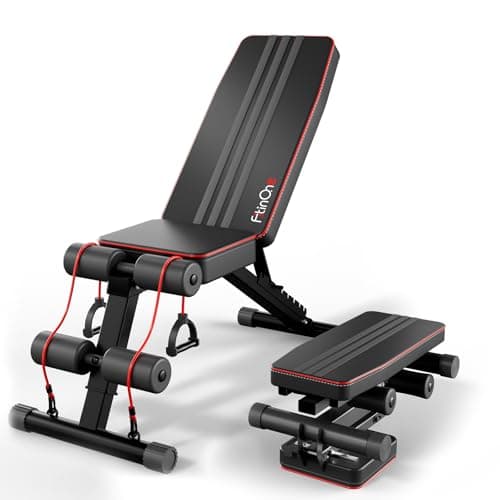
FitinOne — FitinOne Adjustable Weight Bench
Best budget — a fast-folding incline/decline bench for building out a starter home gym cheaply
Weight range and increments (2.5 vs 5 lb jumps)
Range is the headline number, but increment size is what you'll feel every workout. A pair that spans 5-50 lb sounds generous, yet if it only moves in 5 lb steps, the jump from 15 to 20 lb on a lateral raise or a strict press is a 33% increase — too big to progress cleanly on small-muscle or single-arm work. Look for 2.5 lb increments through at least the bottom half of the range; the best dial systems give you 2.5 lb steps up to 25 lb per hand, then 5 lb after that. For compound lifts like rows and goblet squats, 5 lb jumps are fine because you're strong there. The honest rule: fine increments matter most for pressing and isolation, and that's exactly where cheap sets with coarse jumps stall your progress.
Adjustment mechanism: dial, selector, or plate-loaded
Three mechanisms dominate. Dial systems (turn a knob at each end) and selector pins let you change weight in a few seconds without leaving the bench — ideal for drop sets and supersets, but the most expensive and the most reliant on plastic housings. Spin-lock and plate-loaded handles use a threaded collar or a locking sleeve you load with small plates; they're cheap, nearly indestructible, and expandable, but changing weight takes 20-40 seconds of unscrewing and reloading per hand. Be honest about your patience: if a slow change means you'll skip warm-up sets or avoid drop sets, a dial pays for itself in adherence. If you mostly do straight sets and want durability for the money, plate-loaded is the value-conscious, anti-gimmick pick.
Max weight and expandability
Most standard dial sets top out around 50-52.5 lb per hand, which is plenty for pressing, curls, and lateral work for a long time — but it caps out for heavy rows, goblet squats, and lunges surprisingly fast if you're already trained. Before buying, look at your current dumbbell lifts and ask where you'll be in a year. Deconditioned beginners rarely outgrow 50 lb quickly; intermediate lifters often do on rows and squats. If that's you, consider 70-90 lb selector models, or a plate-loaded handle you can keep feeding plates into. Expandability is the quiet advantage of plate systems: you're never trapped by a fixed ceiling, and add-on plates cost far less than buying a whole new heavier pair.
Handle diameter, length, and feel
This is the spec buyers ignore and then regret. Adjustable dumbbells are usually longer and fatter than a fixed dumbbell of the same weight, because the mechanism and plate stack have to live somewhere. A long handle can bang your forearms on curls and clang together on chest presses; a thick handle taxes your grip before the target muscle is done. If you have smaller hands, check the grip diameter and knurl. The weight balance matters too — some dial models feel plate-heavy at the ends, which is fine for pressing but awkward for get-ups or overhead work. If you can, hold a pair before buying; feel beats spec sheets here, and an uncomfortable handle is the most common reason a set gets abandoned.
Build quality: plastic vs metal and durability
The durability question is really a materials question. Dial and selector systems rely on plastic housings, trays, and selection plates; drop them or bang them on the floor and something cracks — and a cracked selector plate can jam a dumbbell at a weight you can't change. Metal-on-metal plate-loaded and spin-lock handles shrug off abuse and outlast most dial systems by years, which is why they're the pragmatic pick for anyone who trains hard or trains outdoors. If you buy a dial system, treat it gently: set it down, don't drop it, and store it on its cradle. Read the reviews for the failure mode, not the marketing — look specifically for reports of plates not re-seating and selection knobs slipping under load.
Footprint, the cradle, and drop-safety
The whole point of adjustable dumbbells is that one pair replaces a rack of fixed ones, so footprint is the feature — a single set lives in about two square feet. But most systems only adjust while seated in their cradle or tray, so you need floor or shelf space for that base within arm's reach of your bench. Factor the cradle into your layout, not just the dumbbells. Drop-safety is the flip side: unlike a solid fixed dumbbell, most adjustables are not built to be dropped, and dumping a dial set at the top of a heavy press can shatter it and void the warranty. If you train to failure and expect to bail reps, that's a real strike against fragile dial systems and a point for tougher plate-loaded handles.
Warranty and matching the pair to your goals and budget
Because the moving parts can fail, warranty length is a genuine signal — a longer warranty usually means the maker trusts the mechanism, and it protects a pricey purchase. Now match it all to you. Budget-first or hard-training minimalist: a spin-lock or plate-loaded pair is cheap, expandable, and nearly unbreakable, at the cost of slow changes. Convenience-first or short-on-time: a 2.5 lb-increment dial set in the mid-price bracket is worth it if you'll actually use the fast swaps. Already strong: skip the 50 lb dials and go straight to a 70-90 lb or plate-loaded system so you don't buy twice. In every case, buy the versatile staple that fits your real strength and patience — not the flashiest gadget on the page.
Frequently asked questions
For most people, roughly 5-50 lb per hand covers pressing, curls, and isolation work for years. If you already row or goblet squat heavy, look at 70-90 lb selector models or a plate-loaded handle you can keep adding weight to, so you don't outgrow the pair in a year.
Related reading
Sources
- How to Choose Adjustable Dumbbells — Garage Gym Reviews
- Best Adjustable Dumbbells — testing and buying criteria — BarBend
- Resistance Training and Progression Guidelines — National Strength and Conditioning Association
- Dumbbell Training and Load Progression for Beginners — American Council on Exercise
FitinOne — FitinOne Adjustable Weight Bench
$59.98 · on Amazon