Are Adjustable Dumbbells Worth It for a Home Gym?
For most home and garage gyms, yes — a single pair of adjustable dumbbells replaces a full rack and costs a fraction of buying that many fixed dumbbells, while taking up roughly the footprint of one pair. That makes them a genuinely good buy if you're short on space, budget, or both. The caveats are real, though: the handles are longer and bulkier, swapping weights is slower than grabbing a fixed dumbbell off a rack, and the adjustment mechanism is a moving part that can fail or get damaged if you drop the weights. If you train heavy, do fast drop sets, or have the room and money for a fixed set, fixed dumbbells are still the more durable and convenient option. For everyone else, adjustables are usually worth it.
Affiliate disclosure: Trusted Health Gear is an Amazon Associate. If you buy through links on this page, we may earn a commission at no extra cost to you. Commission does not influence our rankings. Full policy.
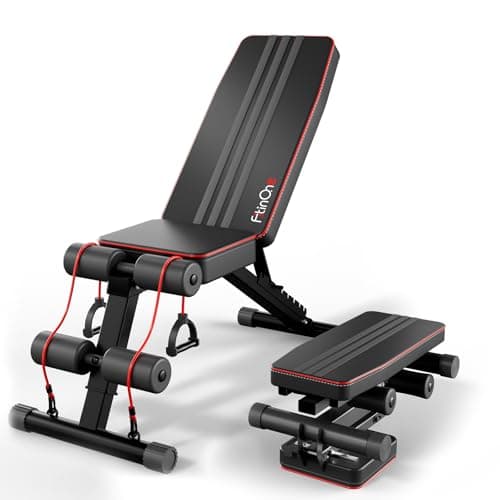
FitinOne — FitinOne Adjustable Weight Bench
Best budget — a fast-folding incline/decline bench for building out a starter home gym cheaply
The space and cost math vs a full fixed set
This is the core argument for adjustables. A common adjustable pair covers roughly 5 to 50 or 5 to 90 lb per hand in small increments. To match that range with fixed dumbbells you'd need somewhere between 10 and 17 separate pairs — which is a lot of iron and a dedicated rack. Buying that many fixed pairs runs well into four figures and eats a wall of floor space. One adjustable pair occupies about the footprint of a single fixed pair plus a small stand. So the trade is straightforward: you pay more per pound of iron with adjustables, but far less in total because you're not buying 15 redundant handles, and you reclaim most of the floor. For a one-room or garage setup, that math usually wins.
Where adjustables genuinely shine
Small spaces and apartments, where a full rack simply doesn't fit. Beginners and general fitness lifters who use a moderate weight range and don't need every increment instantly. Anyone doing full-body or circuit-style training where having 5 to 50 lb on tap in one pair covers nearly every movement. They're also great for households where one set serves multiple people at different strength levels. If your training is varied and your weights are moderate, a single adjustable pair does the job of a whole rack and you'll rarely feel the compromise.
The honest downsides
Adjustables are not a free lunch. The handle is longer than a fixed dumbbell because it has to house the full weight range, so the loaded plates sit farther from your hand — this changes the balance and can feel awkward on exercises that bring the dumbbell close to your body, like certain presses or curls near the chest. Changing weight takes a few seconds (set it in the cradle, turn a dial or move pins, lift it back out) versus instantly grabbing a fixed dumbbell. They also do not tolerate dropping: most adjustable systems are explicitly not built to be dropped, and a hard drop can crack housings or jam the mechanism. And because re-racking is part of every weight change, fast heavy drop sets — where you'd normally peel a dumbbell off a rack and keep moving — are clunky with a single adjustable pair.
Dial vs selector-pin reliability
Most adjustables use one of two mechanisms. Dial systems use a twist dial at each end that engages the number of plates you want; they're fast and intuitive but have more internal parts, and a dropped or mis-seated dial unit is the most common failure point people report. Selector-pin systems use a pin or lever to lock plates; they tend to have fewer fiddly internals and some users find them more robust, though they can be slightly slower to set. Neither is bulletproof. The practical takeaways: always seat the dumbbell fully in its cradle before adjusting, never change weight while the dumbbell is lifted, and don't drop either type. Build quality varies more between brands than between mechanism types, so read durability-focused reviews for the specific model.
Who should buy fixed instead
Fixed dumbbells make more sense for a few groups. Strength-focused lifters who train heavy and want a tool that shrugs off drops and abuse. Anyone who programs fast drop sets or supersets across several weights and needs to grab and go without re-racking. People with the floor space and budget for a full rack, who'll appreciate the instant access and longer service life. And rough-use environments — commercial-style garage gyms, multiple users, frequent dropping — where the simplicity and toughness of a solid hex or rubber dumbbell is worth the space. If durability and grab-and-go speed matter more to you than footprint, fixed wins.
Bottom line
Adjustable dumbbells are worth it for the majority of home gyms, specifically because they solve the space and cost problem that stops most people from owning a full dumbbell range at all. Buy them if you're space- or budget-constrained, train at moderate weights, and can be disciplined about not dropping them. Lean toward fixed dumbbells if you lift heavy, do a lot of fast drop sets, drop weights regularly, or have the room and money for a rack. There's no single right answer — it comes down to how much space you have, how heavy and how fast you train, and how careful you'll be with the mechanism.
Frequently asked questions
Usually yes. Beginners work through a range of weights as they progress, and a single adjustable pair covers that whole climb in one purchase without a rack. Just handle them carefully — most aren't built to be dropped — and start light to get used to the longer handle.
Related reading
Sources
- Physical Activity Guidelines for Americans, 2nd edition (muscle-strengthening recommendations) — U.S. Department of Health and Human Services, 2018
- Progression Models in Resistance Training for Healthy Adults (position stand) — American College of Sports Medicine / Medicine & Science in Sports & Exercise, 2009
- Strength training: Get stronger, leaner, healthier — Mayo Clinic
FitinOne — FitinOne Adjustable Weight Bench
$59.98 · on Amazon