How to Choose a Weight Bench for a Home Gym
Choose a weight bench by matching four things to how you actually train: bench type (a simple flat bench if you only ever bench and row, an adjustable flat-to-incline bench for most people, or a full FID bench with decline if you want the widest range), a weight-capacity rating that comfortably clears your bodyweight plus the heaviest load you will lift, a firm pad that is wide and thick enough to support you without going soft, and a stable, low-wobble frame. Then sort the details: how the backrest adjusts (a ladder or pop-pin system with plenty of angle stops), how big the gap is between the seat and backrest on incline, the pad material's durability, and whether it needs to fold away to save space. Get the type and the capacity right first — everything else is refinement.
Affiliate disclosure: Trusted Health Gear is an Amazon Associate. If you buy through links on this page, we may earn a commission at no extra cost to you. Commission does not influence our rankings. Full policy.
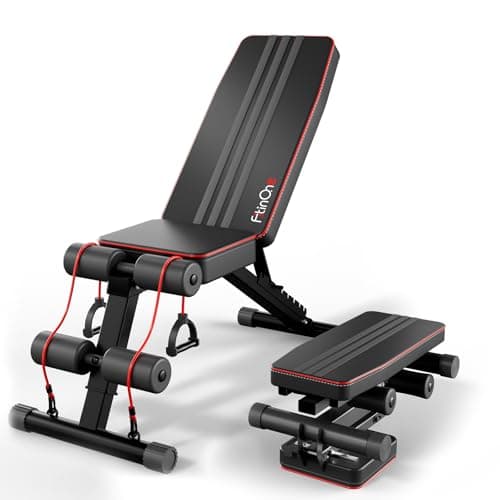
FitinOne — FitinOne Adjustable Weight Bench
Best budget — a fast-folding incline/decline bench for building out a starter home gym cheaply
Flat vs adjustable vs FID: pick the type first
The first decision is bench type, because it sets everything else. A flat bench is a fixed horizontal pad — cheap, rock-solid, and low to the ground, which makes it the most stable choice for heavy flat pressing and rows. Its limit is obvious: it only does flat. An adjustable bench moves the backrest from flat up through a range of incline angles (usually to around 85 degrees, near vertical for shoulder work), which covers the overwhelming majority of what home lifters do — flat and incline presses, rows, and seated overhead work. A FID bench adds a decline position (flat, incline, and decline) plus, usually, an adjustable seat, giving you the widest exercise range including decline presses and better support at steep incline angles. For most people an adjustable bench is the sweet spot. Buy a flat-only bench if you want maximum stability for pressing and never plan to incline; buy a FID if you specifically want decline work and the most versatility, and can accept a bigger footprint and price.
Weight capacity: rate it for you plus the bar
Weight capacity is the spec people underestimate, and it is a safety issue, not a nice-to-have. The rating has to cover your bodyweight plus the heaviest load you will ever have on the bench at once — the loaded barbell or the pair of dumbbells — with a real safety margin on top. A common rule of thumb is bodyweight plus your top load, multiplied by about 1.2 for a buffer. In practice, most home lifters are well served by a bench rated for at least 600 to 1,000 pounds total, which comfortably covers a person plus heavy dumbbells or a loaded barbell with room for future strength gains. Be a little skeptical of the headline number on the cheapest benches; capacity claims are sometimes optimistic, so treat frame quality and steel gauge (11 to 12 gauge is sturdy) as corroborating evidence. Under-rating the bench to save money is the one corner you should never cut.
The pad: width, thickness, and firmness
You lie on the pad for every rep, so its width, thickness, and firmness matter more than the spec sheet suggests. Width is a trade-off: a pad around 10 to 12 inches wide supports most backs while still letting your shoulder blades retract and your arms move freely on presses; too narrow feels unstable, too wide blocks your shoulders. Thickness and firmness go together — you want a pad thick enough (roughly 2 to 3 inches of dense foam) that you do not feel the plywood board underneath, but firm enough that you do not sink in and lose a stable pressing base. Soft, squishy pads feel comfortable in the store and terrible under a heavy press, because your body rocks on the foam. High-density foam that stays firm under load is what you are looking for. A good pad is stable, supportive, and does not compress to nothing when you are heaviest.
Mind the incline butt-gap
The gap between the seat pad and the backrest pad — the so-called butt-gap — is a real, often-overlooked flaw on adjustable benches. When you set the backrest to an incline, some benches leave an awkward gap where the two pads meet, so your lower back or backside has no support right where you need it during an incline press. A well-designed bench closes or minimizes this gap across its incline range, or uses a design where the pads meet cleanly. Before you buy, look at photos of the bench set to a 30 to 45 degree incline and check how the pads line up; in reviews, this is one of the most common complaints about budget adjustable benches. A large gap does not just feel odd — it can leave your spine unsupported under load. It is worth prioritizing a bench known for a small, clean pad transition.
Adjustment mechanism: ladder vs pop-pin
How the backrest changes angle affects both convenience and how solid the bench feels. Two systems dominate. A ladder (or bracket) adjustment uses a notched arm that drops into slots — it is simple, tough, and has fewer parts to fail, but you often have to lift and reposition the backrest to change angles, and the number of preset positions is fixed. A detent or pop-pin system uses a spring-loaded pin you pull to slide the backrest along a rail, which is faster and usually offers more angle stops, but adds a moving part and, on cheap benches, a little more play. Either can be excellent; what matters is the number of usable incline positions (more is better for dialing in the exact angle) and that, once set, the backrest locks with no rattle or slop. Test or read closely for wobble at the joint — a mechanism that feels loose new will only get worse.
Frame stability, steel gauge, and wobble
A bench that wobbles under a heavy press is unusable and unsafe, so frame quality is non-negotiable. The things that drive stability are the steel gauge (11 to 12 gauge tubing is sturdy; higher gauge numbers mean thinner, flexier steel), the width and design of the base (a wider stance and, ideally, a tripod or H-frame base resists tipping and rocking), and the quality of the welds and hardware. Heavier benches are generally more stable — mass is your friend here — which is one reason a rock-solid flat bench often outperforms a flimsy adjustable one for pure pressing. Rubber feet keep it from sliding and protect your floor. When you set it up, the bench should sit flat with no rocking, and there should be no lateral sway when you push against it. If a bench feels tippy or springy empty, it will feel far worse loaded and mid-rep.
Footprint, foldability, and pad durability
Finally, fit the bench to your space and your patience for teardown. A flat bench has the smallest footprint and simply slides under a rack or against a wall. Adjustable and FID benches take more room and often more height. If you train in a shared or tight space, a folding bench that stows upright in a closet is worth real consideration — just accept that folding mechanisms add a hinge and usually a little more flex than a fixed frame, so do not buy a folding bench if you chase maximum stability for heavy pressing. On durability, the pad cover is what wears first: look for thick, tear-resistant vinyl with double or reinforced stitching, since thin covers crack and split at the seams within a year or two of sweat and use. A quality cover wipes clean and survives years; a cheap one is the first thing you will replace.
Frequently asked questions
Enough to cover your bodyweight plus the heaviest load you will ever have on the bench at once, with a safety margin. A useful rule of thumb is bodyweight plus top load times about 1.2. In practice, most home lifters are well served by a bench rated for at least 600 to 1,000 pounds total, which comfortably handles a person plus heavy dumbbells or a loaded barbell with headroom for getting stronger. Do not cut this corner to save money, and treat sturdy 11 to 12 gauge steel as a sign the rating is real.
Related reading
Sources
- 13 Best Weight Benches (capacity, pad width, pad gap, frame gauge — specs that matter) — Garage Gym Lab
- How to Choose a Workout Bench: Flat vs Adjustable vs FID — RitFit
- Weight Bench Buying Guide and Home Gym Equipment Standards — Garage Gym Reviews
- Basics of Strength and Conditioning (equipment and safe training setup) — National Strength and Conditioning Association (NSCA)
FitinOne — FitinOne Adjustable Weight Bench
$59.98 · on Amazon