How to Choose a Pull-Up Bar
The right pull-up bar depends mostly on one question: are you willing to drill? If yes, a wall- or ceiling-mounted bar bolted into studs or joists is by far the most solid option and the only doorway-free way to kip safely, so that's the honest recommendation for anyone who trains hard. If you can't drill — a rental, a finished wall you won't touch — you have two doorway styles, and the difference matters for your safety. A leverage (hook-mount) bar hangs over the top of the door trim and uses your bodyweight to press itself in place; it's the safest doorway design. A telescoping pressure-fit bar wedges between the frame by twist-tension and is genuinely convenient, but it can slip, so never mount one over stairs or a hard floor. If drilling is off the table entirely and you want zero doorway risk, a free-standing power tower is the no-compromise no-drill answer. Then check doorframe width and molding depth, weight capacity, grip options, and ceiling clearance before you buy.
Affiliate disclosure: Trusted Health Gear is an Amazon Associate. If you buy through links on this page, we may earn a commission at no extra cost to you. Commission does not influence our rankings. Full policy.
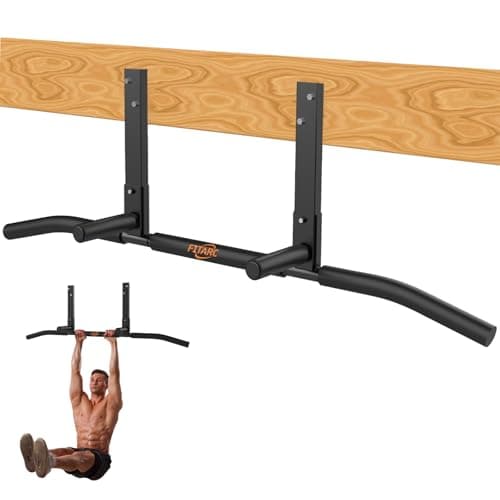
Fitarc — Fitarc Joist-Mount Pull-Up Bar
Best budget permanent mount — a simple, sturdy joist- or wall-mount bar rated to 440 lb
Doorway bars: leverage vs telescoping vs screw-in
Most people start with a doorway bar, and there are three distinct types with very different safety profiles — don't lump them together. A leverage or hook-mount bar is shaped so the long arm rests on top of the door trim while the padded portion braces against the far side of the wall; your bodyweight actually levers it more firmly into place as you hang, which makes it the safest doorway option and the one most reviewers recommend. A telescoping pressure-fit bar is a single expanding tube you twist to wedge between the two sides of the frame using friction alone. It's the most convenient — it pops in and out in seconds and leaves no marks — but friction is the only thing holding it, and it can and does slip. A screw-in bar mounts permanently by screwing brackets into the doorframe or joist, which is more secure than pressure-fit but leaves holes and demands solid wood to bite into. For most renters the leverage bar is the sweet spot; the pressure-fit is a convenience buy you accept the caveats on.
The pressure-fit safety caveat you can't skip
The telescoping pressure-fit bar deserves its own warning because its failure mode is the dangerous one. It stays up purely by friction against the doorframe, and that grip depends on how tightly you twisted it, how smooth or painted the frame is, and whether your movement stays vertical. Add any dynamic load — a kip, a swing, an explosive pull, or simply repositioning your grip mid-set — and the horizontal force can break the friction hold and drop the bar with you on it. That's why the standing rule is simple: never install a pressure-fit bar over a staircase, over a hard floor, or anywhere a fall would hurt. Set it low enough that you can bail to your feet, mount it on a clean unpainted frame, re-tighten it before every session, and treat any wobble as a stop sign. None of this makes a pressure-fit bar unusable — plenty of people train on them for years — but it makes them the wrong choice for kipping, for heavy or explosive work, or for any spot where a slip has real consequences. If those describe you, mount instead.
Wall- and ceiling-mounted bars: the most solid choice
If you're serious and can put holes in something, a mounted bar is the clear winner. A wall-mounted bar bolts through the drywall into the studs and cantilevers out far enough to clear the wall, while a ceiling- or joist-mounted bar bolts up into the overhead framing. Both anchor into structural lumber rather than relying on friction or trim, which makes them dramatically more stable and rated for far more than a doorway bar — and critically, they're the only home options that let you kip, swing, and do explosive gymnastics work without the whole thing shifting. The install is real, though: use a stud finder to locate the framing (studs are usually 16" on center), mount into the wood and not just drywall anchors, and drive proper lag bolts to the manufacturer's spec. Confirm you're hitting solid framing before you trust it with your bodyweight. A wall bar also frees up your doorways and gives you a permanent, predictable station. For anyone doing pull-up volume, muscle-ups, or CrossFit-style work at home, this is the setup worth the drilling.
The no-drill option: a free-standing power tower
Not everyone can drill and not everyone trusts a doorway, and for those people a free-standing power tower is the honest answer. A power tower is a weighted steel frame that stands on the floor and typically combines a pull-up bar up top with dip handles, a vertical knee-raise station, and sometimes push-up grips — no holes, no doorframe, no friction fit. Because it's a full standalone structure, a good one is far more stable than any pressure-fit bar and lets you do controlled pull-ups, chin-ups, and dips without worrying about a slip, though a very tall or aggressively kipping athlete can make a lighter tower rock and should look for a heavier, wider-based model. It takes up real floor space and it isn't cheap, but it's the only way to get a solid pull-up station in a rental with zero modifications. If you've ruled out both drilling and doorway bars, this is where to look — see our roundup of the best power towers for the free-standing, no-drilling picks.
Doorframe fit: width and molding depth
Before you buy any doorway bar, measure — this is the step people skip and regret. Every doorway bar has a supported width range, usually somewhere around 24" to 36", and if your frame is wider or narrower than the bar's range it simply won't fit or won't seat securely. Measure the inside width of the doorway at the exact height you'd mount the bar. Just as important for leverage bars is the molding, or trim: a hook-mount bar drapes over the top casing, so it needs the trim to project far enough from the wall for the hook to grab, and if your doorway has minimal or flush molding the bar can't get a purchase. Check the required molding depth and door-trim thickness against your actual doorway, and note that some bars ship with mounting cups or a bracket to improve the fit on shallow trim. Confirm the door itself isn't so tight to the frame that the bar interferes with it closing. Two minutes with a tape measure saves you a return and a bar that never felt safe.
Weight capacity, steel, and welds
The rated weight capacity is the number to sanity-check first, and you want real margin over your bodyweight — not because a lean adult is near the limit of most bars, but because pull-ups aren't static. You load the bar dynamically at the bottom of each rep, and if you add a weight belt, a dip belt, or a child hanging on for fun, that number climbs fast. Look for a capacity comfortably above your loaded bodyweight, then look at how that rating is achieved. Solid, thick-walled steel tubing beats thin stamped metal, and the joints matter as much as the tube: clean, continuous welds at the stress points and the grips are what keep a bar from failing where the leverage is highest. Be wary of very cheap bars where the arms are held by a few small screws or spot welds. For mounted bars, the bracket-to-wall connection and the quality of the included hardware matter as much as the bar itself — a strong bar on undersized lag bolts is only as strong as the bolts. Buy the sturdier bar; this is the one piece of gear you hang your whole weight from.
Grip options and ceiling clearance
Two comfort-and-fit details decide how much you'll actually use the bar. First, grips: many bars offer more than a straight bar, adding wide grips for a stretched lat-focused pull, neutral (palms-facing) handles that are easier on the shoulders and elbows, and angled or multi-grip options that let you vary the movement and hit different muscles. A multi-grip bar is genuinely useful if your shoulders dislike a fixed wide pronated grip. On the surface itself, foam sleeves are comfortable for bare-handed reps but compress and tear over time and can slip when sweaty, while knurled steel gives a far more secure hold for heavy or high-volume work at the cost of some hand comfort — chalk or gloves bridge the gap. Second, clearance: a mounted or doorway bar needs enough room above it for your head at the top of the rep and enough below for a full dead hang with straight arms, which matters for tall lifters and anyone kipping. Measure your ceiling and your reach before committing to a mount height, and leave margin so you're not clipping the ceiling on every rep or tucking your knees to clear the floor.
Frequently asked questions
The leverage (hook-mount) bar is safer, and it's the doorway design most reviewers recommend. It hangs over the top of the door trim so your bodyweight levers it more firmly into place as you hang — the load actually helps hold it. A telescoping pressure-fit bar stays up only by friction against the doorframe, and that grip can break under a swing, a kip, or a grip change, dropping the bar with you on it. Pressure-fit bars are more convenient and leave no marks, but if you want the more secure doorway option, choose leverage — and if you're doing anything dynamic, mount a bar into studs or joists instead.
Related reading
Sources
- Best Pull-Up Bars, Tested (doorway leverage vs pressure-fit, wall- and ceiling-mounted, capacity, grips) — Garage Gym Reviews, 2026
- The Best Pull-Up Bars (mounting types, weight capacity, grip options) — BarBend, 2026
- Essentials of Strength Training and Conditioning (facility and equipment safety considerations) — National Strength and Conditioning Association (NSCA)
- Pull-Up Bar Buying Guide (doorway fit, molding depth, mounting hardware) — REP Fitness
Fitarc — Fitarc Joist-Mount Pull-Up Bar
$39.99 · on Amazon