Are Push-Up Bars Worth It?
Short answer: yes for two specific reasons, no for the reasons they are usually sold. Push-up bars are worth it if your wrists hurt doing push-ups on a flat floor, or if you want more range of motion out of an exercise you already do — and our pick for most people is the Perfect Pushup Elite rotating handles, because the sealed-bearing rotation is the feature that actually addresses the wrist complaint rather than just elevating your hands. They are not worth it if you are expecting a different exercise, a dramatically bigger chest, or a shortcut. A push-up bar does not change what a push-up trains; it changes the joint position you do it in and how deep you can go. That second part is a real, if modest, benefit: research on push-up variations notes that the greater muscle activation seen in some versions relates to going through a greater range of motion than a floor-based push-up allows. Elevating your hands by a few inches lets your chest drop below your hands, which is exactly that. Whether it is worth paying for depends on which of three readers you are, and the rest of this page sorts that out — including the case for spending the money on parallettes or rings instead, and the case for spending nothing at all.
Affiliate disclosure: Trusted Health Gear is an Amazon Associate. If you buy through links on this page, we may earn a commission at no extra cost to you. Commission does not influence our rankings. Full policy.
What push-up bars actually change
Strip away the marketing and a push-up bar does three concrete things. First, it changes your wrist angle. A floor push-up holds the wrist in extension — palm flat, forearm angled over the top of it — and sustained loaded extension is the single most common reason people stop doing push-ups. A bar puts the hand in a neutral grip, the way a dumbbell press would, which removes that position entirely. Second, it raises your hands a few inches off the floor, which lets your chest travel below hand level at the bottom. That is additional range, and research on push-up variations attributes the greater muscle activation seen in some versions partly to exactly this increase in range compared with the floor. Third, on rotating models, it lets the hand turn through the rep instead of being pinned in one orientation, which changes how the elbow and shoulder track. What a push-up bar does not do is make the exercise fundamentally harder, recruit a different set of muscles, or substitute for any of the things a home gym actually lacks. It makes a movement you already own more comfortable and slightly more productive.
Who should buy them — and who should not
There are three readers here and the answer differs for each. The first has wrist pain or stiffness doing floor push-ups. For you they are genuinely worth it, and they may be the difference between doing push-ups and not doing them — a neutral grip removes the loaded wrist extension that is causing the problem, and that is the clearest case on this page. The second does a lot of push-up volume and wants more out of it. For you they are a small, cheap upgrade: more range per rep, slightly better bottom-position stimulus, no learning curve. Worth it, but do not expect to feel transformed. The third has no wrist complaints and does push-ups occasionally. For you, honestly, no — the floor is free, and the better upgrade is making the push-up harder rather than more comfortable. Slow the tempo down, pause at the bottom, elevate your feet, move your hands into a narrower position, or work toward single-arm variations. Those cost nothing and change the stimulus far more than a few inches of elevation. There is also a fourth case worth naming: if your wrists hurt in handstand or planche work rather than push-ups, parallettes are the better purchase, because they get your hands properly below shoulder level and give you a frame to balance on.
Rotating handles versus fixed stands versus parallettes
The three formats solve overlapping but distinct problems, and the price differences follow the function. Rotating handles sit on sealed bearings so the hand turns as you descend, which is the most direct answer to wrist and elbow discomfort — and the small base means they take almost no space. Fixed stands are simpler and cheaper: a static frame, a neutral grip, a little elevation, no moving parts to collect grit. They are the sensible buy if your only goal is the neutral wrist position and you do not care about rotation. Parallettes are the different animal: taller, wider, and designed for L-sits, tuck planches, deeper dips and handstand work as much as for push-ups. They cost more and do more, and they are the right pick if your training is heading toward floor skills rather than just push-up volume. One real consideration across all three: stability. Narrow bases on hard floors can slide, and a handle that moves under load is worse than no handle at all, so look for a wide base with genuine non-slip treads and a stated weight rating rather than a slim stand with a star rating.
What to look for if you buy a pair
Four specs decide whether a set of push-up bars is any good, and none of them is the number of exercises on the box. Base width and grip come first: a wide base with textured, non-slip treads is what stops the handle sliding out from under you on hardwood or tile, and a narrow base is the single most common failure in cheap sets. Stated weight rating second — the better products publish one, and the ones that just say heavy-duty usually have a reason not to. Build material third: steel frames with a solid handle survive years, where thin plastic with a foam sleeve compresses and eventually cracks, and foam is also the part that absorbs sweat and starts to smell. Rotation mechanism fourth, if you are buying rotating handles: sealed bearings spin smoothly for years and unsealed ones get gritty, which turns a smooth rotation into a notchy one. Ergonomics round it out — a contoured grip at a diameter your hand can close around comfortably, and a handle that is not so tall it makes the exercise awkward. Skip the accessory charts, the resistance-band attachment points and the colour options; none of those change anything.
The three we'd actually buy
Every pick below is already reviewed and scored in our roundups — same products, same specs, with live Amazon prices.
| Attribute | Perfect Fitness Perfect Pushup Elite Rotating HandlesOur pick | Perfect Fitness Perfect Fitness Pushup Stands | RELIFE RELIFE Steel Parallette Push-Up Bars (14 in) |
|---|---|---|---|
| Best for | Best overall and best for cranky wrists — rotating handles on sealed bearings let the joints track naturally on every rep | Best value stands — a compact, stable handle from a trusted brand for deeper range without the premium price | Best parallette-style and most versatile — tall steel bars that do deep push-ups, L-sits, dips, and planche progressions |
| Who it's for | For the reader whose wrists or elbows are the problem: sealed-bearing rotation lets the hand turn through the rep instead of being pinned flat, which is the most direct fix for loaded wrist extension. | For the reader who just wants a neutral grip and a few inches of extra depth without paying for a rotation mechanism — a simple fixed stand with nothing to wear out. | For the reader heading toward calisthenics rather than push-up volume: a steel parallette-style bar that handles deeper pressing and basic floor skills, not just push-ups. |
| Key specs | Rotating handles on sealed steel ball bearings for smooth spin · ergonomic contoured grips · roughly 8-inch stable base with textured, non-slip bottom treads · rated to support up to 400 lb · sold as a pair · from the established Perfect Fitness / Perfect Pushup line | Compact push-up stands · contoured molded grip · wide, low base with non-slip footing · low profile that stays planted at the bottom of a rep · sold as a pair · the budget-friendly entry point in the Perfect Fitness line, positioned below the rotating Elite · broadly stocked on Amazon | Welded steel parallette-style bars standing about 14 inches tall · foam-sleeve grips · wide feet for stability under bodyweight loads · built for L-sits, tuck and planche work, dips, and deficit push-ups · sold as a pair · calisthenics-oriented dip-station design |
| Our score | 8.6/10 | 8.2/10 | 8.1/10 |
| Where to buy |
Prices pulled from Amazon as of October 18, 2026 and are subject to change. The price shown on Amazon at checkout applies.
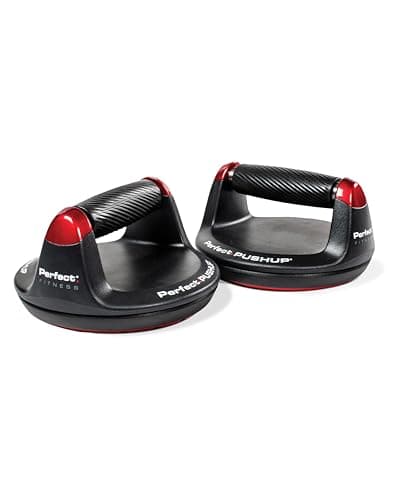
Perfect Fitness — Perfect Pushup Elite Rotating Handles
For the reader whose wrists or elbows are the problem: sealed-bearing rotation lets the hand turn through the rep instead of being pinned flat, which is the most direct fix for loaded wrist extension.
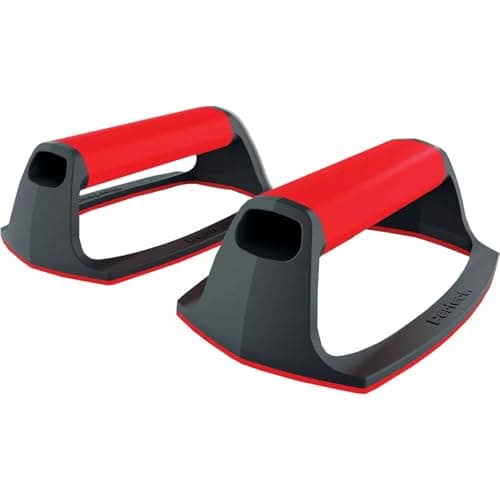
Perfect Fitness — Perfect Fitness Pushup Stands
For the reader who just wants a neutral grip and a few inches of extra depth without paying for a rotation mechanism — a simple fixed stand with nothing to wear out.
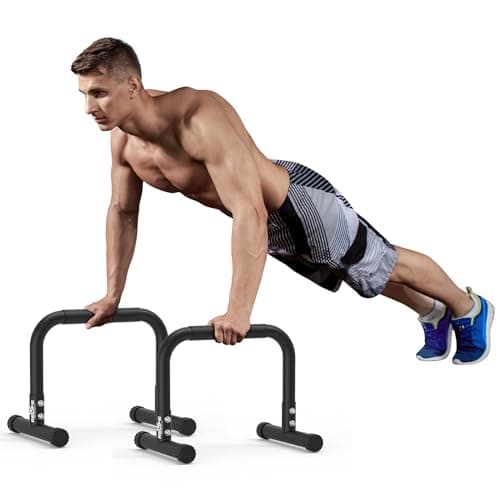
RELIFE — RELIFE Steel Parallette Push-Up Bars (14 in)
For the reader heading toward calisthenics rather than push-up volume: a steel parallette-style bar that handles deeper pressing and basic floor skills, not just push-ups.
What the evidence actually says about push-up variations
The honest summary is that the research supports the range-of-motion argument and does not support the marketing. A scoping review of push-up variations set out to catalogue common versions and describe their muscle activation levels, and the pattern that emerges is that activation differences between variations are real but modest, and are often explained by mechanical factors rather than by anything special about the equipment. Hand position matters measurably: a narrow-base hand position elicits greater triceps brachii and pectoralis major activation than a wide-base position, which means you can change the stimulus for free by moving your hands. And greater EMG activity in certain variations is attributed in part to subjects going through a greater range of motion than a floor-based push-up permits — which is the mechanism a push-up bar actually provides. None of this amounts to a bar being dramatically superior to a floor. It amounts to a few inches of extra depth being worth a small amount of extra stimulus, and a neutral wrist being worth a lot to the people whose wrists hurt. That is the real, modest case, and it is the case we would make if you were standing in front of us.
The cheaper and free alternatives
Before you spend anything, know what the free versions are, because for some readers they are the right answer. For wrist comfort: make a fist and do push-ups on your knuckles on a mat, which gives a neutral wrist with no equipment — it is less comfortable on the hands but it is free and it works. Or push up with your hands on two sturdy objects you already own: a pair of dumbbells on their ends, the edge of a step, two stacked books, the arms of a solid chair. For range of motion: push-ups between two low, stable objects give you the same depth that elevated handles do, and feet-elevated push-ups add stimulus without any hand equipment at all. For more difficulty: tempo, pauses, narrower hands, archer push-ups, and eventually one-arm work. The honest hierarchy is that if your wrists are fine, technique and progression beat equipment; if your wrists are not fine, a $20-40 pair of handles is one of the better small purchases in a home gym; and if you are building toward calisthenics skills, skip straight to parallettes or rings and treat push-up handles as the thing you did not need.
Frequently asked questions
Worth it for wrist comfort and extra range; not worth it as a shortcut. If floor push-ups bother your wrists, a neutral grip removes the loaded extension causing it, and that alone can be the difference between training the movement and avoiding it — that is the strongest case and the reason our top pick is a rotating-handle model. If you do a lot of push-up volume, the few inches of elevation let your chest drop below hand level, and research on push-up variations attributes some of the greater activation in certain versions to exactly that extra range. If your wrists are fine and you do push-ups occasionally, skip them: tempo, pauses, narrower hand placement and feet-elevated push-ups change the stimulus more, for free.
Related reading
Sources
- Push-up variations and shoulder-girdle stability — scoping review cataloguing common push-up variations and their muscle activation levels — PubMed Central
- Muscle activation of the triceps brachii and pectoralis major in narrow-base versus wide-base push-up hand positions (narrow base elicited greater activation of both) — PubMed Central
- Physical Activity Guidelines for Americans, 2nd edition — muscle-strengthening activity on 2 or more days per week — U.S. Department of Health and Human Services, 2018
- Product titles, base dimensions, stated weight capacities, materials, live prices and availability for the push-up bars referenced — retrieved via the Amazon product data layer — Amazon product listing data, 2026
Perfect Fitness — Perfect Pushup Elite Rotating Handles
$39.99 · on Amazon