Magnesium Oxide vs Magnesium Glycinate: Which One Should You Actually Buy?
These two forms sit at opposite ends of the same trade-off. Magnesium oxide is the densest common form of the mineral — MgO is one magnesium atom bonded to one oxygen, so about 60% of the compound's weight is magnesium itself, which is why the cheapest bottle on the drugstore shelf can promise a big number on a small tablet. The catch is that it barely dissolves, and magnesium you cannot dissolve is magnesium you mostly do not absorb: the standard reference study on US commercial preparations put fractional absorption from oxide at roughly 4%, against 9-11% for chloride, lactate and aspartate. The NIH Office of Dietary Supplements says the same thing in plainer language — forms that dissolve well in liquid are absorbed more completely than less soluble ones, and oxide and sulfate specifically sit on the wrong side of that line. Magnesium glycinate is the opposite build: each magnesium atom is chelated to two glycine molecules, which drops the mineral content to about 14% by weight but makes it far more soluble and considerably gentler on the gut. What glycinate does not have is the pile of head-to-head absorption data its marketing implies. The NIH professional fact sheet does not even mention glycinate when it lists the better-absorbed forms, and in a 2024 crossover study that measured plasma magnesium after single doses, oxide produced a significant rise at one hour while bisglycinate produced no significant rise at all. Our call: for topping up daily intake, buy glycinate or citrate and pay attention to elemental dose and tolerance, not the label story. Buy oxide on purpose only if what you actually want is an osmotic laxative, which is a job it does well and has real trials behind it.
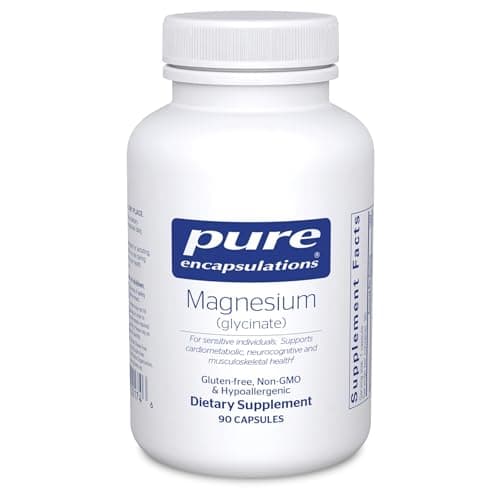
Pure Encapsulations — Magnesium Glycinate (Capsules)
The verdict
For daily supplementation, buy magnesium glycinate — or citrate, which is cheaper and has better absorption data behind it than glycinate does. Glycinate's case is that it dissolves, it is well tolerated at doses that would send oxide straight through you, and glycine itself is harmless and mildly useful. That is enough to make it the sensible default, and it is why the glycinate and bisglycinate products are the ones at the top of our magnesium roundup. But be clear about what you are buying: glycinate is the form with the best tolerance record, not the form with the deepest evidence base, and anyone selling it as dramatically superior absorption is going beyond what has actually been measured. Magnesium oxide is not a scam either — it is real magnesium, it is the cheapest elemental magnesium you can buy, and for chronic constipation it has placebo-controlled trials showing roughly a 68-70% response rate against 12-25% on placebo. That is a legitimate use. Using it as your daily magnesium top-up is the mistake: you are relying on about 4% absorption and accepting the loose stools that come from the 96% that stays in your gut. And before either bottle: magnesium is abundant in leafy greens, legumes, nuts, seeds and whole grains, you absorb 30-40% of what you eat, and food should be doing most of this work.
Side-by-side
| Attribute | Magnesium Oxide | Magnesium Glycinate |
|---|---|---|
| What it is | Magnesium bonded to oxygen (MgO) — an inorganic magnesium salt | Magnesium chelated to two glycine molecules (magnesium bisglycinate) |
| Magnesium by weight | ~60% (MgO is 40.3 g/mol, magnesium is 24.3 of it) | ~14% (magnesium diglycinate is 172.4 g/mol) |
| Solubility in water | Very poor | Good — chelation is what buys the solubility |
| Measured fractional absorption | ~4% in the standard US commercial-preparations study | No equivalent published figure; chelates are assumed better but under-measured |
| Named by NIH as better absorbed? | No — named as one of the poorly absorbed forms, with sulfate | Not named at all; NIH lists aspartate, citrate, lactate and chloride |
| GI tolerance | Poor — one of the forms most commonly reported to cause diarrhea | Good — the usual reason people switch to it and stay on it |
| Best-supported use | Osmotic laxative for constipation (68-70% response vs 12-25% placebo) | Daily intake top-up; one RCT shows a small insomnia-severity benefit |
| Typical cost | Cheapest magnesium per elemental milligram on the shelf | Several times more per elemental milligram |
| Pills to hit a given dose | Fewest — the dense form | More, or larger capsules, because the chelate is mostly glycine |
| Our call | Buy for constipation, not for daily magnesium | Buy this (or citrate) for daily magnesium |
| Where to buy |
Prices pulled from Amazon as of October 18, 2026 and are subject to change. The price shown on Amazon at checkout applies.
Who should pick which
Pick Magnesium Oxide
- Anyone whose actual goal is an osmotic laxative for constipation — oxide is cheap, it works by the mechanism you want, and it has randomized placebo-controlled trials supporting that use.
- Budget buyers who tolerate it fine and are honest with themselves that they are buying 4%-absorbed magnesium cheaply rather than buying the better form.
Pick Magnesium Glycinate
- Anyone taking magnesium daily to close a dietary gap — glycinate is soluble, well tolerated, and the form you can actually stay on for months.
- People who tried a cheap magnesium and got diarrhea. That is the classic oxide experience, and switching form usually fixes it without lowering the dose.
- Anyone taking magnesium in the evening as part of a sleep routine — the one decent bisglycinate RCT is a sleep trial, and glycinate's tolerability is what makes a nightly dose sustainable.
- Readers who want a clean, minimal label: magnesium, glycine, nothing else, with the elemental dose stated on the panel.
The trade-off in one line: density versus solubility
Every magnesium supplement is a magnesium atom plus whatever is carrying it, and the carrier decides both how much mineral you get per pill and how much of it you absorb. Magnesium oxide is the most efficient carrier imaginable on paper: PubChem lists MgO at 40.3 g/mol, and magnesium accounts for 24.3 of that, so roughly 60% of the compound's weight is the mineral you want. Magnesium bisglycinate wraps each magnesium atom in two glycine molecules, giving a molecular weight of 172.4 g/mol and dropping the magnesium content to about 14%. Magnesium citrate sits between them at 451.1 g/mol for three magnesium atoms, or about 16%. That is why a drugstore oxide tablet can be small and still claim a large number while a glycinate serving is often two or three capsules. It is also why oxide is cheapest per milligram of elemental magnesium, and that is a real advantage, not a marketing trick. The problem is the second half of the equation. Oxide is barely soluble in water, and absorption in the gut depends on the mineral being in solution. The NIH Office of Dietary Supplements puts it directly: forms of magnesium that dissolve well in liquid are more completely absorbed in the gut than less soluble forms, and small studies have found the aspartate, citrate, lactate and chloride forms absorbed more completely and more bioavailably than magnesium oxide and magnesium sulfate. A dense form you do not absorb loses to a dilute form you do.
How bad is oxide absorption, really?
The number everyone quotes traces to one study, and it is worth knowing what it actually did. Firoz and Graber tested four US commercial preparations in 16 healthy adults — eight men and eight women — giving each roughly 21 mEq of magnesium as oxide, chloride, lactate or aspartate and measuring urinary excretion to estimate absorption. Fractional absorption from magnesium oxide averaged about 4%, while chloride, lactate and aspartate came in around 9-11% and were statistically indistinguishable from each other. The authors' conclusion was that magnesium oxide has relatively poor bioavailability while the other three are greater and equivalent. Two honest caveats, because one small study carrying this much weight deserves them. Sixteen subjects is not a large trial, and urinary excretion is an indirect proxy for absorption. More importantly, 4% of a large dose is not zero: in a 2024 double-blind crossover study in 40 adults that sampled plasma magnesium before and after single doses, magnesium oxide produced a statistically significant rise at one hour — while magnesium bisglycinate, in the same study, produced no significant rise at any timepoint. That study was funded by the maker of a competing microencapsulated ingredient, and single-dose plasma magnesium is a crude measure of what a daily supplement does to body stores, so do not read it as proof that oxide beats glycinate. Read it as evidence that the popular claim 'oxide does nothing' is overstated, and that glycinate's absorption advantage is assumed more often than it is measured.
What glycinate's evidence actually looks like
Glycinate is the form the internet recommends, and we recommend it too — but for tolerance rather than for a stack of absorption studies, because that stack does not exist. Notice what is missing from the NIH professional fact sheet: when it names the better-absorbed forms, it lists aspartate, citrate, lactate and chloride. Glycinate is not in that sentence, and the document does not discuss it anywhere. The best direct clinical evidence for the form is a 2025 randomized, double-blind, placebo-controlled trial in 155 adults aged 18-65 with self-reported poor sleep, which gave 250 mg of elemental magnesium as bisglycinate daily and tracked the Insomnia Severity Index. The supplement group improved more than placebo — a reduction of 3.9 points versus 2.3 — and the difference was statistically significant at p = 0.049, with a small effect size of d = 0.2. The authors noted that improvements looked larger in participants with lower baseline dietary magnesium, which is exactly what you would expect if you are correcting a shortfall rather than drugging a system. That is a real, honest result: a modest benefit in a decent-sized trial, concentrated in the people who were probably low to begin with. It is not the transformation the category sells. What glycinate unambiguously has over oxide is the tolerance profile. The forms most commonly reported to cause diarrhea, per NIH, include carbonate, chloride, gluconate and oxide — and the mechanism is simply osmotic: unabsorbed magnesium salt sitting in the intestine pulls water in. Less unabsorbed magnesium, less of that. If you have ever abandoned a magnesium supplement after four days, this is usually why, and this is what you are paying extra to avoid.
Oxide's real job: it is a laxative, and a good one
The most common mistake in this comparison is treating magnesium oxide as a failed daily supplement rather than a successful drug for a different indication. The same osmotic effect that makes it a poor daily top-up makes it an effective treatment for constipation, and unlike most of this category, that use has placebo-controlled randomized trials. A double-blind placebo-controlled trial in 34 women with chronic constipation found the primary endpoint met by 70.6% of the magnesium oxide group versus 25.0% on placebo, with significant improvements in Bristol stool form and in colonic transit time. A larger 2021 trial randomized 90 patients with chronic idiopathic constipation — mean symptom duration nearly ten years — to senna, magnesium oxide or placebo, and reported overall improvement in 68.3% of the oxide group and 69.2% of the senna group against 11.7% on placebo. Magnesium's laxative role is also why it shows up in over-the-counter products at doses far above the supplemental upper limit: NIH notes that a tablespoon of Phillips' Milk of Magnesia delivers 500 mg of elemental magnesium as the hydroxide, with directions allowing up to four tablespoons a day, and that much of that magnesium is never absorbed precisely because of the laxative effect. So if your problem is constipation, oxide is cheap, evidence-backed and the right tool. If your problem is that your diet runs low on magnesium, using oxide means depending on about 4% absorption and tolerating the consequences of the rest — which is backwards.
The numbers that should actually drive your purchase
Three figures matter more than the form on the front of the bottle. First, the elemental dose. Supplement panels in the US are required to state the amount of magnesium, not the amount of compound, so read the line that says 'Magnesium (as magnesium bisglycinate) 200 mg' and ignore any larger number printed on the front — and check the serving size, because glycinate servings are frequently two or three capsules. Second, your target. The RDA is 400-420 mg a day for adult men and 310-320 mg for adult women, and that is total intake, food included; you absorb 30-40% of the magnesium in food, and leafy greens, legumes, nuts, seeds and whole grains are dense in it. Most people are closing a modest gap, not replacing an entire requirement. Third, the upper limit on the supplemental side: 350 mg a day of magnesium from supplements and medications for adults. That ceiling exists specifically because higher supplemental doses cause diarrhea, nausea and abdominal cramping, which is why a 500 mg 'high potency' capsule is not a better buy than a 200 mg one. Very high intakes can go further than discomfort — NIH lists hypotension, vomiting, difficulty breathing, irregular heartbeat and cardiac arrest among the signs of magnesium toxicity, with a few fatal cases of hypermagnesemia reported. Those are not risks you run from a sensible supplement, but they are the reason the 350 mg number exists and the reason to respect it. If you have kidney disease or take prescription medications, the dose question goes to your doctor rather than to a label.
What we'd actually buy
A glycinate or bisglycinate from a brand that does third-party testing, with the elemental dose on the panel, bought in a quantity you will finish — and food doing the heavy lifting underneath it. Our magnesium roundup's top picks are bisglycinate and glycinate products for exactly the reasons above: they dissolve, they are tolerable at a dose that matters, and their labels are honest about elemental content. Citrate is a completely defensible cheaper alternative with better published absorption data than glycinate, and it is slightly laxative, which some people want and some do not — that trade-off is what our glycinate versus citrate comparison is for. Skip the proprietary 'magnesium complex' blends that list five forms and no individual amounts, because the only way they make sense as a purchase is if you cannot see what you are getting. Skip buying oxide as a daily supplement; buy it if you want a laxative. And do not buy magnesium at all expecting it to fix energy, mood or sleep on its own if you are eating almost no greens, legumes, nuts or seeds. Magnesium is a mineral you are supposed to get from food, a supplement is for closing the remaining gap, and no form of it — however well chelated — substitutes for the diet, the training and the sleep schedule.
Frequently asked questions
For daily supplementation, yes — mainly on solubility and tolerance rather than on a decisive pile of absorption trials. Magnesium oxide is about 60% magnesium by weight but barely dissolves, and the standard study of US commercial preparations put fractional absorption from oxide at roughly 4% against 9-11% for chloride, lactate and aspartate. The NIH Office of Dietary Supplements names oxide and sulfate as the less completely absorbed forms. Oxide is also one of the forms most commonly reported to cause diarrhea, because unabsorbed magnesium salt pulls water into the intestine. Glycinate is about 14% magnesium by weight, dissolves well, and is far easier to stay on for months. Be aware of what is thin, though: NIH does not list glycinate among the better-absorbed forms at all, and a 2024 crossover study found a significant plasma magnesium rise after oxide but not after bisglycinate. Glycinate is the better daily choice; it is not the dramatic absorption upgrade the marketing suggests.
Related reading
- → Best magnesium supplements (our scored glycinate and citrate picks)
- → Magnesium glycinate vs citrate (choosing between the two good forms)
- → Best magnesium for sleep
- → When to take magnesium (timing, food, and splitting the dose)
- → Magnesium glycinate benefits, honestly assessed
- → How to read a supplement label (elemental dose vs compound weight)
Sources
- Magnesium — Health Professional Fact Sheet (forms that dissolve well in liquid are more completely absorbed; aspartate, citrate, lactate and chloride absorbed more completely than oxide and sulfate; 30-40% of dietary magnesium absorbed; RDA 400-420 mg men and 310-320 mg women; tolerable upper intake level 350 mg from supplements; carbonate, chloride, gluconate and oxide most commonly reported to cause diarrhea; magnesium in laxatives and antacids) — NIH Office of Dietary Supplements, 2026
- Bioavailability of US commercial magnesium preparations (16 healthy adults; ~21 mEq doses; fractional absorption ~4% for magnesium oxide vs 9-11% for chloride, lactate and aspartate; 'relatively poor bioavailability of magnesium oxide') — Magnesium Research (Firoz M, Graber M), 14(4):257-262, 2001
- Comparative clinical study on magnesium absorption and side effects after oral intake of microencapsulated magnesium versus other magnesium sources (double-blind randomized crossover, 40 adults; significant plasma magnesium rise after magnesium oxide at 1 h; no significant rise after magnesium bisglycinate at any timepoint; study funded by Lubrizol Life Science) — Nutrients, 2024
- Magnesium bisglycinate supplementation in healthy adults reporting poor sleep: a randomized, placebo-controlled trial (155 adults, 250 mg elemental magnesium daily; Insomnia Severity Index −3.9 vs −2.3 for placebo, p = 0.049; small effect size d = 0.2; larger improvements in those with lower baseline dietary magnesium) — Nature and Science of Sleep, 2025
- Senna versus magnesium oxide for the treatment of chronic constipation: a randomized, placebo-controlled trial (90 patients; overall improvement 68.3% magnesium oxide, 69.2% senna, 11.7% placebo, P < 0.0001) — American Journal of Gastroenterology, 2021
- A randomized double-blind placebo-controlled trial on the effect of magnesium oxide in patients with chronic constipation (34 patients; primary endpoint met by 70.6% vs 25.0% placebo, P = 0.015; improved Bristol stool form and colonic transit time) — Journal of Neurogastroenterology and Motility, 2019
- Compound records for magnesium oxide (MgO, 40.305 g/mol), magnesium diglycinate (C4H8MgN2O4, 172.42 g/mol) and magnesium citrate (C12H10Mg3O14, 451.12 g/mol) — used to calculate elemental magnesium by weight — PubChem, National Library of Medicine, 2026
Pure Encapsulations — Magnesium Glycinate (Capsules)
$27.00 · on Amazon