How to Choose a Jump Rope
Picking a jump rope comes down to matching the rope to your goal and then sizing it correctly, and most people get the second part wrong. First, the type: a thin speed/PVC rope is for fast cardio and double-unders; a weighted rope builds conditioning and helps you feel the rhythm while learning; a beaded or segmented rope shrugs off rough outdoor ground; a cloth or licorice rope is slower and forgiving for beginners; and a coated-cable rope splits the difference for durable everyday use. Then size it: stand on the middle of the rope and the handle tops should reach somewhere between your chest and armpit — beginners go longer, advanced jumpers go shorter, and an adjustable rope lets you tune it. Handle and bearing quality decide how smoothly it spins, with ball bearings clearly beating bushings for double-unders. Jump on a smooth flat surface in cushioned shoes, mind your ceiling height indoors, and buy for the goal you actually train, not the one on the box.
Affiliate disclosure: Trusted Health Gear is an Amazon Associate. If you buy through links on this page, we may earn a commission at no extra cost to you. Commission does not influence our rankings. Full policy.
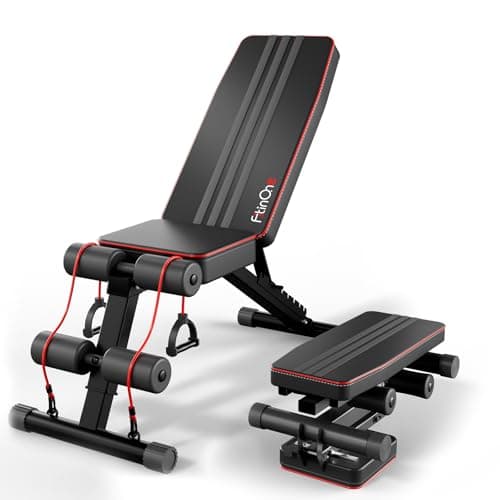
FitinOne — FitinOne Adjustable Weight Bench
Best budget — a fast-folding incline/decline bench for building out a starter home gym cheaply
Rope types: speed, weighted, beaded, cloth, and coated cable
The rope material and build change how it feels and what it's good for, so pick with your goal in mind. A speed rope — a thin PVC cord or bare cable — spins fast with almost no drag, which makes it the standard for cardio intervals and double-unders, though its lightness means it whips and stings when you miss and gives little feedback while learning. A weighted rope adds mass in the cord or handles; the extra load builds shoulder and forearm conditioning and, usefully, the drag makes the rope's position easy to feel, which helps beginners find their rhythm — see our weighted jump rope roundup for those picks. A beaded or segmented rope threads plastic beads over a cord; it's heavier and slower but extremely durable and the best choice for jumping outdoors on rough concrete or asphalt that would shred a bare cable. A cloth or licorice rope is soft, slow, and forgiving, which makes it friendly for absolute beginners and kids but too draggy for speed work. A coated-cable rope wraps the wire in PVC for durability and a moderate speed — a solid, versatile everyday pick. Match the type to the job before anything else.
Sizing: stand on the midpoint and check the handles
Length is the single most important fit variable, and a badly sized rope makes everything harder — too long drags and trips you, too short clips your head and forces you to hunch. The reliable way to check is to stand with one or both feet on the middle of the rope and pull the handles straight up alongside your body: the tops of the handles should reach somewhere between the middle of your chest and your armpits. That range is deliberate, because the right length depends on your skill. Beginners should size toward the longer end (handle tops nearer the armpit), because a longer rope is more forgiving of an inconsistent turn and gives you more margin for error. Advanced jumpers chasing speed and double-unders size shorter (handle tops nearer the mid-chest), because a shorter rope moves faster and demands tighter, more efficient mechanics. Your ceiling and your body height factor in too — taller jumpers need a longer rope. When in doubt, an adjustable-length rope lets you dial it in yourself, which is why they're the safest first purchase.
Adjustable ropes and why they're a smart first buy
If you're not certain of your ideal length — and if you're new, you're not — an adjustable rope solves the problem. Most adjustable ropes work by feeding excess cord through the handle and locking it with a screw or clamp, letting you trim or extend the working length in minutes and, on the better ones, cut and re-crimp the cable to a permanent custom length once you've settled on it. That flexibility matters more than it sounds. Your ideal length shifts as your skill improves: you'll likely start long and forgiving, then shorten the rope as your timing tightens and you move toward speed work and double-unders. A fixed-length rope locks you into one guess, and if that guess is wrong you're either fighting the rope or buying another. An adjustable rope also covers more than one user in a household, which fixed ropes can't. The trade-off is usually a slightly bulkier handle or a small amount of added complexity, but for most buyers — especially beginners and anyone whose training is still evolving — that's a fair price for getting the fit right.
Handles and bearings: ball bearings vs bushings
How smoothly a rope spins is decided at the handle, where the cord attaches to the grip through either a bushing or a bearing — and for anything fast, the difference is real. A bushing is a simple sleeve the cable pivots against; it's cheap and works, but it has more friction, can develop play, and tends to spin less freely over time. A ball-bearing mechanism lets the cable rotate on actual bearings, which spin faster, smoother, and more consistently, and that matters enormously for double-unders and high-speed intervals where the rope has to whip around cleanly twice per jump. If double-unders are a goal, prioritize ball bearings. Handle length and material matter too: a slightly longer handle gives leverage and control, and a grippy, sweat-resistant surface keeps the handle from twisting in your hand mid-set — foam and textured aluminum both work, but bare slick plastic gets slippery fast. Look at the swivel where the cable meets the handle as well, since a smooth 360-degree swivel prevents the tangling and kinking that a rigid attachment causes. Cheap handles are usually where a bargain rope quietly falls apart.
Surface and footwear: protect the rope and your joints
Where and in what you jump affects both your body and your rope's lifespan, so don't overlook it. The ideal surface is smooth, flat, and firm with a little give — a wood or rubberized gym floor, a mat, or a smooth garage slab — which spares your joints and doesn't chew up the cable. Rough concrete and asphalt are the enemy of thin speed and coated-cable ropes: every miss drags the cord across the abrasive surface and shreds the coating, which is exactly why beaded and segmented ropes exist for outdoor use. If you must jump on rough ground, use a beaded rope or a mat. Footwear matters just as much as the floor. Jumping rope is repetitive impact through the balls of your feet, so wear cushioned athletic shoes with real forefoot support rather than going barefoot or in flat minimalist shoes, especially when you're building volume — your calves, Achilles, and shins will thank you. A cheap mat under your jumping spot both protects the rope and softens the landing, a small purchase that pays off on both fronts.
Ceiling height and space indoors
Jumping rope indoors adds one constraint people forget until they've smacked the ceiling: overhead clearance. When the rope passes over your head it rises well above your reach, so you need enough room that the rope clears the ceiling on every rotation without you ducking or shortening your jump. As a rough guide, add roughly a couple of feet above your standing overhead reach and make sure the ceiling is higher than that — a standard 8-foot residential ceiling is fine for most adults but can be tight for tall jumpers or anyone using a longer rope, and a low basement ceiling with pipes or fixtures is a real hazard. Check side-to-side and front-to-back clearance too, since the rope arcs out around you; you want a clear radius free of light fixtures, furniture, and ceiling fans. If your indoor space is genuinely too cramped, that's a reason to jump outdoors on a suitable surface with a beaded rope, or to size a shorter rope that keeps the arc tighter. Measure the room before you assume it works.
Match the rope to your goal
Everything above resolves into one decision: what are you actually training for? If the goal is fat loss and general cardio conditioning, a light coated-cable or PVC rope of the right length is all you need — it spins fast enough for steady intervals and won't wear out your shoulders, and consistency matters far more than the rope. If the goal is skill and double-unders, prioritize a fast, thin speed rope with quality ball bearings and size it on the shorter end, because that combination is what makes clean, fast rotations possible; a draggy or oversized rope will hold you back no matter how hard you work. If the goal is conditioning and strength endurance — building shoulders, forearms, and grip while getting your heart rate up — a weighted rope delivers that extra stimulus and doubles as a rhythm teacher for newer jumpers. Plenty of people end up owning two: a weighted or forgiving rope for learning and conditioning, and a light speed rope for skill and intervals. Buy for the training you'll actually do, not the flashiest rope on the shelf.
Frequently asked questions
Stand with one or both feet on the middle of the rope and pull the handles straight up alongside your body — the tops of the handles should reach somewhere between the middle of your chest and your armpits. Where in that range depends on your skill: beginners should size toward the longer end (handle tops nearer the armpit) for a more forgiving turn, while advanced jumpers chasing speed and double-unders size shorter (nearer mid-chest) for faster, tighter rotations. Taller jumpers need more length. If you're unsure, an adjustable-length rope lets you tune the fit yourself, which is why it's the safest first purchase.
Sources
- Best Jump Ropes, Tested (speed vs weighted vs beaded, sizing, bearings, surfaces) — Garage Gym Reviews, 2026
- The Best Jump Ropes (rope types, handle and bearing quality, sizing for double-unders) — BarBend, 2026
- Jumping Rope: Benefits, Technique, and Getting Started (impact, footwear, surface) — Cleveland Clinic
- Essentials of Strength Training and Conditioning (conditioning, plyometric loading, surfaces and footwear) — National Strength and Conditioning Association (NSCA)
FitinOne — FitinOne Adjustable Weight Bench
$59.98 · on Amazon