Does Beta-Alanine Work?
Yes — beta-alanine is one of the better-evidenced sports supplements, but its benefit is real and modest rather than dramatic, and it only shows up for a specific kind of effort. It works by raising the level of carnosine stored in your muscles, and carnosine acts as a buffer that soaks up the hydrogen ions (acid) that build up when you train hard. That buffering helps most during high-intensity work lasting roughly one to four minutes — think a rowing piece, a 400-to-800-meter run, a brutal high-rep set, or sustained interval-style training — where the research points to something like a 2-3% improvement in performance. It does very little for a one-rep-max lift, a single short sprint under a minute, or long steady-state endurance. It also isn't a pre-workout "hit": beta-alanine works by chronic loading, meaning you take about 3.2 to 6.4 grams a day for several weeks to saturate your muscle carnosine. Total daily intake and consistency are what matter, not the timing of any single dose. The famous tingling on your skin is harmless and dose-related, and it's easy to blunt by splitting the dose. Bottom line: beta-alanine is a legitimate, well-studied edge for the right training — but a small one, and worthless if your training, protein, and sleep aren't already handled.
Affiliate disclosure: Trusted Health Gear is an Amazon Associate. If you buy through links on this page, we may earn a commission at no extra cost to you. Commission does not influence our rankings. Full policy.
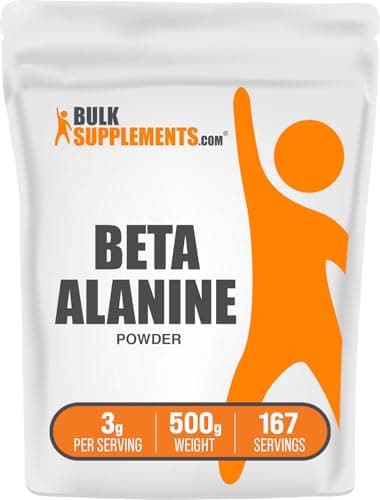
BulkSupplements — BulkSupplements Beta-Alanine Powder
Best pure-bulk option — lab-tested single ingredient in flexible sizes
How beta-alanine actually works: carnosine and acid buffering
Beta-alanine is an amino acid, but you don't take it for its own sake — you take it because it's the rate-limiting building block for making carnosine inside your muscle cells. Carnosine is a dipeptide (beta-alanine bonded to histidine) that sits in the muscle and acts as an intracellular buffer. When you train hard, your working muscles produce hydrogen ions and the fluid inside the cell becomes more acidic; that drop in pH is one of the things that makes a hard set start to burn and fail. Carnosine mops up some of those hydrogen ions, blunting the acidity and letting you sustain a high output a little longer before you have to stop. Your body's supply of beta-alanine is normally the limiting factor in how much carnosine you can store, which is exactly why supplementing it works: give the muscle more beta-alanine, consistently, and it builds more carnosine, raising its buffering capacity. This is a well-characterized mechanism, and it's a big part of why beta-alanine has better evidence behind it than most supplements on the shelf. The International Society of Sports Nutrition's position stand recognizes it as an effective ergogenic aid for the right kind of exercise.
Where it helps: high-intensity efforts of about 1 to 4 minutes
The benefit of beta-alanine is not general — it maps directly onto the type of exercise where acid buffering matters most. That's high-intensity work sustained for roughly one to four minutes, where you're going hard enough and long enough for hydrogen ions to accumulate and limit you. Practical examples: a 400-to-800-meter run, a 500-to-2,000-meter row, a hard cycling interval, a set of 15-20 reps taken near failure, repeated sprints with short rest, and a lot of CrossFit-style conditioning that keeps you in that punishing middle zone. Across the research, the improvement is modest but real — on the order of a couple of percent — which won't be obvious rep to rep but can be the difference between finishing a set or a piece and stalling just short. If your sport or your training regularly parks you in that one-to-four-minute pain cave, beta-alanine is one of the few supplements with genuine evidence to help you hold the line a little longer.
Where it doesn't help much: max strength, short sprints, long endurance
It's just as important to know where beta-alanine won't do much, because that's where it gets oversold. It offers little for a one-rep-max or heavy low-rep strength work: those efforts are over in seconds and are limited by force production and the phosphocreatine system, not by accumulated acid — that's creatine's territory, not beta-alanine's. It also does little for a single short sprint under about 60 seconds, where you again haven't built up enough acidosis for buffering to matter. And it's largely unhelpful for long, steady-state endurance — a marathon, a long easy ride — where the intensity is low enough that acid buildup isn't the bottleneck. The pattern is consistent: beta-alanine helps in the metabolic middle, where efforts are long enough to become acidic but short enough to be truly high-intensity. Outside that window, expect little to nothing, and don't let a label imply otherwise.
Dosing: it's about chronic loading, not a pre-workout hit
This is the most misunderstood thing about beta-alanine, and getting it right is the difference between benefit and waste. Beta-alanine does not work acutely — taking a scoop right before you train does nothing on the spot except possibly make you tingle. It works by slowly saturating muscle carnosine over time, so you have to load it chronically. The evidence-based approach is to take roughly 3.2 to 6.4 grams per day, every day, for several weeks (often quoted as around 4-6 weeks to meaningfully raise carnosine, with higher and longer intakes pushing stores higher still). Because it's the total accumulated intake that builds carnosine, the timing within the day genuinely does not matter — you can take it morning or night, with or without a workout, and split it however you like. What matters is hitting your daily total consistently, day after day, including on rest days. This is also why beta-alanine belongs in a pre-workout formula only as a long-game ingredient, not because it does anything in the moments before you lift. If you skip days, you're just draining the tank you spent weeks filling.
The tingles (paresthesia): harmless, and easy to manage
If you've ever taken a big scoop of pre-workout and felt a prickling, flushing, pins-and-needles sensation across your face, neck, hands, or scalp, that was almost certainly beta-alanine. The sensation is called paresthesia, it's dose-related (bigger single doses cause more of it), and — importantly — it is harmless. It's a temporary nerve-tingling effect, not a sign of an allergy, danger, or that the supplement is "working" in the moment; it typically fades within 15 to 30 minutes and has no known lasting effect. Some people actually enjoy it as a pre-workout cue, while others find it uncomfortable. If you want to minimize it, you have two easy options: split your daily total into smaller doses (for example, a couple of 1.5-2 gram servings rather than one big one), or use a sustained-release beta-alanine formula designed to release it more slowly. Both reduce the peak blood concentration that triggers the tingle without changing how much carnosine you ultimately build, since — again — it's the daily total that counts.
Safety and stacking: pairs logically with creatine
Beta-alanine is one of the better-tolerated ergogenic aids in the research, with the harmless paresthesia being the main and essentially only common side effect at standard doses. It stacks especially logically with creatine, and the two are natural partners precisely because they cover different gaps: creatine fuels short, maximal, high-force efforts through the phosphocreatine system, while beta-alanine buffers acid during the longer, high-intensity efforts where creatine's contribution has faded. Between them they cover much of the high-intensity spectrum, and taking both is a reasonable, evidence-supported combination for someone who trains hard across those zones. As with any supplement, this is general information and not medical advice: if you're pregnant or nursing, have a medical condition, or take medications, talk to your doctor before starting beta-alanine, and don't use it to self-treat any health problem. It's an ergogenic aid for performance, not a treatment for anything.
The honest bottom line
Beta-alanine is a rare thing in the supplement aisle: an ingredient with a clear mechanism, real evidence, and a legitimate — if small — performance benefit. It raises muscle carnosine, buffers acid, and can nudge high-intensity performance in the one-to-four-minute range by a couple of percent, provided you load it chronically at 3.2-6.4 grams a day for weeks and keep taking it. That's the whole story, and it's worth being honest about both halves of it. The benefit is real, which is why it's one of the few supplements worth considering. But it's also modest, narrow, and entirely secondary to the basics. If your training program is inconsistent, your protein intake is low, or you're sleeping five hours a night, no amount of beta-alanine will rescue your progress — those fundamentals move the needle far more than any powder. Treat beta-alanine as a small, well-earned refinement for the specific efforts it helps, layered on top of good training and nutrition, and you'll have the right expectations. Buy it expecting a miracle and you'll be disappointed; buy it as a 2% edge in the right training window and it delivers exactly what the evidence promises.
Frequently asked questions
Weeks, not minutes. Beta-alanine works by gradually saturating the carnosine stored in your muscles, so a single dose does nothing on the spot except possibly make you tingle. Taking roughly 3.2 to 6.4 grams a day, every day, meaningfully raises muscle carnosine over about four to six weeks, and continued use pushes stores higher still. Because it's the accumulated daily intake that matters, consistency is everything — including on rest days. If you're expecting a same-session boost like caffeine, that's not how beta-alanine works; think of it as slowly filling a tank that then stays topped up as long as you keep taking it.
Related reading
Sources
- International Society of Sports Nutrition position stand: Beta-Alanine (Trexler et al.) — mechanism, carnosine, dosing, performance in ~1-4 min efforts, paresthesia — Journal of the International Society of Sports Nutrition (JISSN), 2015
- Beta-Alanine — evidence summary on carnosine, high-intensity performance, dosing and loading — Examine.com
- Dietary Supplements for Exercise and Athletic Performance — beta-alanine efficacy, dose, and safety — NIH Office of Dietary Supplements (ODS)
- Effects of beta-alanine supplementation on exercise performance: a meta-analysis (Hobson et al.) — Amino Acids (Springer), 2012
BulkSupplements — BulkSupplements Beta-Alanine Powder
$21.97 · on Amazon