Creatine vs Pre-Workout: Which Should You Take (or Both)?
This isn't really a versus — creatine and pre-workout do two different jobs, and for a lot of lifters the right answer is both. Creatine monohydrate is a daily, non-stimulant supplement that slowly raises the amount of phosphocreatine in your muscles, which lets you do a rep or two more on heavy sets and, over weeks, adds real strength, power, and lean mass. It's the most-studied and most-proven sports supplement there is, and you feel nothing acute from it — the benefit shows up in your training log, not in the first ten minutes. Pre-workout is the opposite: an acute, mostly stimulant-driven hit — caffeine plus, usually, beta-alanine, citrulline, and other extras — that you take 20 to 45 minutes before a session to feel more energetic, focused, and 'pumped' for that one workout. It does little for long-term muscle on its own; it makes the session in front of you feel better. If you have to choose one for building a better body over months, it's creatine. If you want a jolt for a specific hard session, that's pre-workout. They stack fine — and many pre-workouts already include creatine, which is the source of most of the confusion.
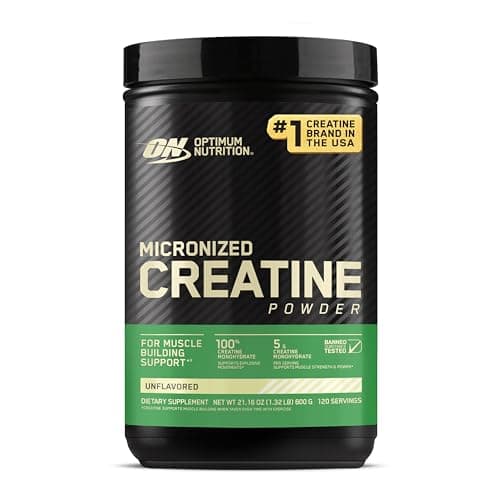
Optimum Nutrition — Creatine Monohydrate Powder (Micronized)
The verdict
Take creatine if you care about long-term strength, power, and muscle — it's cheap, non-stimulant, and the best-evidenced supplement in the category, and almost every lifter should be on it. Reach for pre-workout when you want an acute energy and focus boost for a hard or early session, and you tolerate stimulants. They aren't competitors: the smart setup is daily creatine as your foundation plus pre-workout used strategically before the sessions that need it. Just don't double up on creatine by accident if your pre-workout already contains it, and don't lean on stimulants so often that they stop working or wreck your sleep.
Side-by-side
| Attribute | Creatine | Pre-Workout |
|---|---|---|
| What it is | A daily, non-stimulant supplement taken every day | An acute, mostly stimulant-based pre-session boost |
| Main job | Builds strength, power, and lean mass over weeks | Ups energy, focus, and pump for one workout |
| Key mechanism | Refills muscle phosphocreatine to regenerate ATP for hard efforts | Caffeine stimulates the CNS; extras like citrulline aid blood flow, beta-alanine buffers fatigue |
| When you feel it | Nothing acute — the benefit builds and shows in your training over weeks | Within about 20-45 minutes, lasting the session |
| Stimulant | None | Usually yes — often 150-350 mg caffeine per serving |
| Evidence | The most-studied, most-proven sports supplement (ISSN position stand) | Caffeine is well-proven; other blend ingredients vary widely in support |
| Typical dose | 3-5 g creatine monohydrate daily, any time | One serving 20-45 min pre-workout, per the label |
| Main downsides | Small water-weight gain; requires daily consistency | Stimulant tolerance, sleep disruption, beta-alanine tingles, proprietary blends |
Who should pick which
Pick Creatine
- Anyone whose main goal is long-term strength, power, and muscle — creatine is the highest-value, best-proven pick and should be the default.
- People who train in the evening, are caffeine-sensitive, or simply don't want stimulants but still want a performance edge.
- Budget-focused lifters — plain creatine monohydrate costs pennies per day and does more for physique than any pre-workout.
Pick Pre-Workout
- Lifters who need acute energy and focus for early-morning, fasted, or unusually demanding sessions and tolerate caffeine well.
- People chasing the subjective 'pump,' alertness, and drive that make a hard workout feel better in the moment.
Creatine: the daily foundation that builds strength over weeks
Creatine monohydrate is the closest thing the supplement aisle has to a sure thing. Your muscles store it as phosphocreatine and use it to rapidly regenerate ATP — the fuel for short, intense efforts like a heavy set or a sprint. Supplementing raises those stores, which lets you squeeze out an extra rep or two on hard sets, and those extra reps, accumulated over weeks and months, add up to measurable gains in strength, power, and lean muscle. The International Society of Sports Nutrition's position stand calls it the most effective nutritional supplement available for increasing high-intensity exercise capacity and lean body mass during training. The catch is that it works by accumulation, not by acute effect: take it today and you feel nothing, because the payoff is in your saturated muscles and your training log over time. That's exactly why it's non-negotiable for a physique or strength goal and useless as a same-day 'boost.'
Pre-workout: an acute hit for the session in front of you
Pre-workout is built to change how one workout feels, right now. The workhorse ingredient is caffeine — a genuinely effective, well-evidenced stimulant that increases alertness, drive, and perceived energy and can modestly improve performance. Around it, most formulas add citrulline (or citrulline malate) to support blood flow and the 'pump,' beta-alanine to buffer the acid that builds up in longer sets (and to produce that harmless skin tingle people either love or hate), and sometimes tyrosine, taurine, or extra stimulants. Unlike creatine, you feel pre-workout: it kicks in within 20 to 45 minutes and lasts the session. But it does little for long-term muscle on its own — it helps you train harder in the moment, and the training is what builds you, not the powder. It's a tool for the hard, early, or fasted sessions that need a lift, not a daily requirement.
The honest problems with pre-workout: stimulants, blends, and tingles
Pre-workout is where this site's skepticism earns its keep. First, stimulant tolerance is real — lean on caffeine before every session and it works less well and creeps upward in dose, and taken too late in the day it wrecks the sleep that drives your recovery. Second, proprietary blends: many labels hide doses inside a single 'blend' number, so you can't tell whether the citrulline is at the researched 6-8 g or a sprinkle for the label. Buy formulas that disclose every dose. Third, the beta-alanine tingle (paresthesia) is harmless but startles people who don't expect it, and beta-alanine only does anything if dosed consistently at ~3.2 g/day over weeks, which a single pre-workout serving usually doesn't deliver. None of this makes pre-workout bad — a well-dosed, transparent formula is a legitimate tool. It just means most of the 'proprietary-blend fairy dust' is exactly that, and caffeine plus a couple of properly dosed ingredients is doing the real work.
They stack — and many pre-workouts already contain creatine
Because they do different jobs, creatine and pre-workout combine cleanly, and there's no reason to pick only one if you want both effects. The standard smart setup is daily creatine (3-5 g, any time — timing barely matters since it works by saturation) as your permanent foundation, plus a pre-workout used before the sessions that actually need a lift. The one thing to watch: a lot of pre-workouts already include creatine, sometimes at a token dose. If yours does, you don't need to fear 'too much' — extra creatine isn't harmful at normal intakes — but you also shouldn't count on a pre-workout's small, inconsistent creatine dose (which you only take on training days) to keep your muscles saturated. Take your full daily creatine separately every day, and treat any creatine in your pre-workout as a bonus, not your source.
How to choose (and how to run both well)
If you can only add one supplement and your goal is a stronger, more muscular body, take creatine — it's cheaper, better proven, stimulant-free, and works for essentially everyone who trains hard. Add pre-workout when you specifically want acute energy and focus for tough or early sessions and you tolerate caffeine. Running both, a sane protocol looks like this: 3-5 g creatine monohydrate every day, on training and rest days alike; a transparent, fully dosed pre-workout taken 20-45 minutes before hard sessions only, not every workout; caffeine kept away from within about 8-10 hours of bedtime; and at least a couple of stimulant-free training days a week to keep your caffeine response sharp. Skip proprietary blends, skip 'super-creatine' forms sold at a premium (plain monohydrate is the most studied and cheapest), and remember the whole-food, sleep, and training basics do more than any tub.
Frequently asked questions
Take creatine. For long-term strength, power, and muscle it's the best-evidenced, cheapest, and most reliable supplement there is, and it works for almost everyone who trains hard — no stimulant required. Pre-workout only changes how a single session feels; it doesn't build you the way consistent training plus creatine does. If your goal is a better body over months, creatine wins easily. Pre-workout is the thing you add later for acute energy on demanding days, not the foundation.
Related reading
Sources
- International Society of Sports Nutrition position stand: safety and efficacy of creatine supplementation (creatine monohydrate is the most effective ergogenic supplement for high-intensity capacity and lean mass; 3-5 g/day maintenance or 0.3 g/kg/day loading; safe up to 30 g/day over 5 years) — Journal of the International Society of Sports Nutrition (Kreider et al.), 2017
- Dietary Supplements for Exercise and Athletic Performance — Fact Sheet for Health Professionals (creatine, caffeine, beta-alanine, and citrulline: mechanisms, effective doses, and evidence) — NIH Office of Dietary Supplements, 2023
- Creatine — research summary on efficacy, dosing, and safety — Examine.com
- Caffeine and pre-workout ingredients — evidence on ergogenic effects and dosing — Examine.com
Optimum Nutrition — Creatine Monohydrate Powder (Micronized)
$27.99 · on Amazon