Smith Machine vs Power Rack: Which Should Anchor Your Home Gym?
The Smith machine and the power rack both let you squat and press heavy at home, but they build strength in fundamentally different ways. A Smith machine fixes the bar to a guided vertical (or slightly angled) track with hooks you rotate to rack anywhere in the range — that makes it beginner-friendly, forgiving to train alone, and quick to set up, at the cost of a locked bar path and less stabilizer work. A power rack is an open cage built around a free barbell: you get true squats, presses, and pulls that recruit stabilizers and carry over to real-world and athletic strength, plus adjustable safety pins that let you train hard solo. The trade is a steeper learning curve and the need to set safeties correctly every session. For most strength-focused lifters the rack is the better long-term anchor; the Smith earns its place for solo hypertrophy work, guided assistance movements, and cautious beginners.
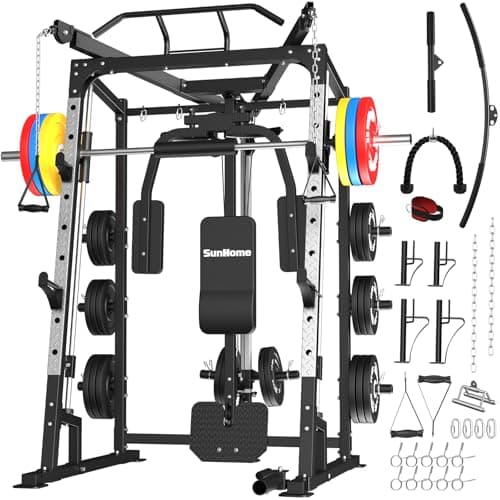
SunHome — SunHome S4 Smith Machine Power Cage
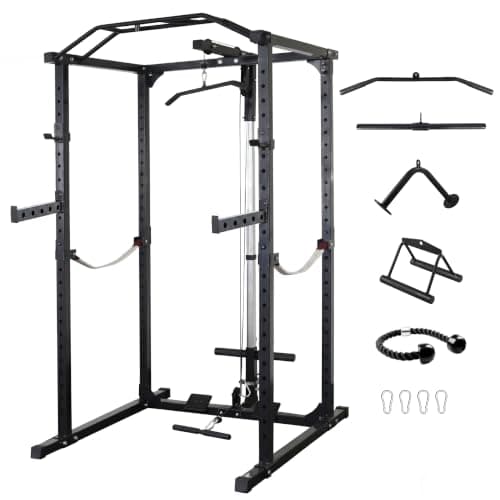
The verdict
Choose a power rack if your goal is real barbell strength and long-term versatility — it trains stabilizers, carries over to sport and life, and does everything a barbell can. Choose a Smith machine if you mostly train alone for hypertrophy, want a guided path with built-in catches, or are a nervous beginner learning to grind under load. Many serious home gyms end up with a rack first and add a Smith later; if you buy one, the rack is the more complete foundation.
Side-by-side
| Attribute | Smith Machine | Power Rack |
|---|---|---|
| Best for | Guided, solo-friendly hypertrophy and assistance work | Free-barbell strength, versatility, athletic carryover |
| Bar path | Fixed track — locked vertical or fixed angle | Free — you control the path in all planes |
| Stabilizer recruitment | Lower — the machine balances the bar for you | Higher — you balance and stabilize every rep |
| Safety when training alone | High — rotate hooks to rack anywhere in range | High with pins/straps set correctly each session |
| Learning curve | Gentle — easy to grasp and stay on the track | Steeper — free-bar technique takes practice |
| Versatility | Moderate — mostly presses, squats, guided rows | Wide — squats, presses, pulls, chins, accessories |
| Strength carryover | Good for hypertrophy; less to free-weight sport | Strong — transfers to real-world and athletic tasks |
| Footprint / cost | Similar footprint; varies by model and add-ons | Similar footprint; cage plus a barbell and plates |
Who should pick which
Pick Smith Machine
- Solo lifters who want built-in catch hooks and a guided path to push close to failure safely.
- Hypertrophy-focused trainees who like isolating muscles without fighting balance on a fixed track.
Pick Power Rack
- Anyone whose main goal is free-barbell strength, athletic carryover, and stabilizer recruitment.
- Lifters who want one versatile anchor for squats, presses, pulls, pull-ups, and accessories.
- People training for sport or general robustness where balance and coordination matter.
The fixed bar path is the core difference
Everything else flows from one fact: the Smith machine locks the bar to a track, and the power rack does not. On a Smith, the bar can only travel along its rails, so the machine does the balancing for you. That is why it feels stable and beginner-friendly, and why it is handy for chasing a pump without fighting coordination. But a fixed path also forces your joints into the machine's line rather than your natural groove, which some lifters find fine and others find cranky on the knees, shoulders, or wrists. A power rack leaves the barbell free, so you own the path in every plane — more demanding, more honest, and more transferable to how strength actually gets expressed outside the gym.
Stabilizers and carryover: the rack's advantage
Because you balance a free barbell yourself, the power rack recruits the stabilizing muscles and coordination that a guided bar takes out of the equation. That is the whole point of free-weight training for strength and sport: the ability to produce force while controlling the load carries over to picking things up, pushing, and athletic movement. Research and coaching consensus generally favor free-weight squats and presses over machine equivalents for maximal strength and functional carryover. The Smith still builds muscle and can drive real hypertrophy, but for raw, transferable strength the free barbell in a rack is the more complete tool.
Training alone: both can be safe, differently
This is the Smith machine's best argument. Its rotating hooks let you rack the bar almost anywhere in the range by flicking your wrists, so a failed press or squat is easy to bail without a spotter — genuinely reassuring for solo beginners grinding near their limit. A power rack matches that safety, but only if you use it correctly: set the safety pins or straps at the right height every single session so a missed rep lands on the catches instead of on you. Done right, a rack is just as safe to train alone in; the difference is that the Smith's safety is automatic while the rack's depends on you setting it up. For a distracted or new lifter, that automatic net has real value.
Versatility and what else you can do
A power rack is a platform, not a single exercise. Inside and around one cage you can back squat, front squat, overhead press, bench (with a bench), rack pull, do pull-ups on the top bar, and hang bands, dip attachments, or a landmine — it grows with you for years. A Smith machine is more specialized: it excels at guided squats, presses, and machine-style rows, and many have useful attachments, but it is fundamentally built around that one fixed bar. If you want a single anchor that covers the widest range of barbell and bodyweight work, the rack is far more versatile; if you want a dedicated guided station to complement free weights you already own, the Smith fills that niche well.
Which one should anchor your gym
If you are building around one big piece and your goal is strength, athletic carryover, and long-term flexibility, the power rack is the better foundation — it does everything a barbell can and lets you train hard alone with pins set properly. If you mostly train solo for size, prefer a guided path, or are a cautious beginner who wants an automatic safety net while learning to push, the Smith machine is a legitimate primary and a very good hypertrophy tool. The honest situational answer: most strength-minded home gyms should start with a rack and a barbell, then add a Smith later if guided work appeals — but a lifter whose priorities are solo safety and bodybuilding-style isolation can reasonably flip that order.
Frequently asked questions
For maximal, transferable strength the power rack wins because you lift a free barbell and train the stabilizers and coordination the Smith takes out. The Smith machine still builds real muscle and is excellent for solo hypertrophy work, but its fixed bar path limits carryover to free-weight and athletic strength. If strength and carryover are the goal, the rack is the better anchor.
Related reading
Sources
- Essentials of Strength Training and Conditioning: Free Weights vs Machines — National Strength and Conditioning Association (NSCA)
- Free Weights vs Machines for Strength Development — American Council on Exercise (ACE)
- Power Rack and Smith Machine Buying Guides — BarBend
- Best Power Racks and Smith Machines, Tested — Garage Gym Reviews
SunHome — SunHome S4 Smith Machine Power Cage
$599.99 · on Amazon