Free Weights vs Machines: Which Builds More Muscle?
Free weights and machines sit at the center of one of the oldest gym debates, and the research has quietly settled a lot of it: both build muscle and strength well when effort and progression are matched. A 2023 systematic review and meta-analysis comparing the two found no meaningful difference in muscle growth, and only a specificity effect for strength — you get better at the exact way you train, so free-weight training tests best on free weights and machine training tests best on machines. That reframes the choice. Free weights — barbells, dumbbells, kettlebells — demand more balance and stabilizer work, transfer well to sport and daily life, cost less per exercise, take up little space, and offer huge variety, but they have a steeper learning curve and need safeties or a spotter for heavy work. Machines — cable stacks, selectorized units, the Smith machine — put you on a guided path that is easier to learn, safer to push to failure alone, and excellent for isolation, beginners, and rehab settings, but they cost more, eat more floor space, and ask less of your stabilizers. It is not either/or. Most well-rounded home gyms end up using both, and that is the smart default.

Generic (Amazon) — High-Speed Adjustable Jump Rope (Self-Locking)
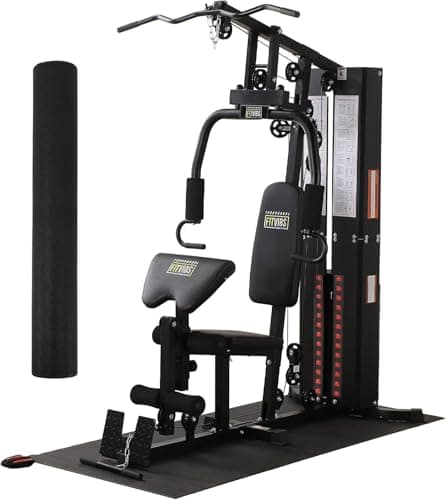
BalanceFrom — BalanceFrom High-Density Gym Equipment Mat (3ft x 6.5ft)
The verdict
Do not treat this as a war with a winner — treat it as a toolkit. If you can own only one category, free weights are the more complete and economical foundation: a barbell, an adjustable set of dumbbells, and a rack cover squats, presses, hinges, rows, and carries, transfer well beyond the gym, and fit a small space. Add machines when you want to isolate muscles cleanly, train hard to failure without a spotter, or you are a beginner or coming back from injury and want a guided, lower-skill path. The evidence says both grow muscle and build strength when you match effort and progressive overload, so the best program for most people mixes them: free weights for the big compound strength work and functional transfer, machines and cables for safe, high-intensity isolation and volume. Buy free weights first, layer in machines as budget and space allow, and stop worrying about which is objectively better.
Side-by-side
| Attribute | Free Weights | Machines |
|---|---|---|
| Muscle growth | Builds muscle well when effort matches | Builds muscle equally well in studies |
| Strength transfer | Higher — carries to sport and daily life | More specific to the machine's fixed path |
| Stabilizer demand | High — you balance and control the load | Low — the path is guided for you |
| Learning curve | Steeper — technique takes coaching | Gentler — easier to learn and set up |
| Training to failure alone | Riskier — needs safeties or a spotter | Safer — guided path, easy to bail |
| Cost | Cheaper per exercise | More expensive per station |
| Space | Compact and versatile | Bulkier — more floor space per machine |
| Best for | Compound strength, transfer, variety | Isolation, beginners, safe intensity |
Who should pick which
Pick Free Weights
- Athletes and anyone who wants strength that transfers to sport and daily life through real balance and stabilizer demand.
- Budget- and space-conscious lifters who want the most training options per dollar and square foot.
- Lifters who like compound barbell and dumbbell work — squats, presses, hinges, and carries — as the core of their program.
Pick Machines
- Beginners and returning lifters who want an easy-to-learn, guided path with a lower risk of losing position under load.
- Solo lifters who want to train hard to failure without a spotter, especially on presses and leg work.
- Anyone focused on isolation and bodybuilding-style volume, or training around an injury where a fixed path feels safer.
What the research actually shows
Start with the evidence, because it settles more than the internet arguments suggest. A 2023 systematic review and meta-analysis in BMC Sports Science, Medicine and Rehabilitation pooled the controlled studies comparing free-weight and machine training and found no significant difference in muscle hypertrophy between them — if size is the goal, neither modality is required. For strength the picture is nuanced but consistent: gains are largely specific to how you test them. Free-weight training produced bigger improvements on free-weight strength tests, and machine training produced bigger improvements on machine tests, but head-to-head there was no clear overall winner. Stronger by Science, reviewing the same body of work, lands in the same place: match volume, effort, and progression, and both tools grow muscle and build strength effectively. The practical takeaways are simple. First, you cannot go badly wrong choosing either for hypertrophy. Second, if you care about performing on a specific implement — a barbell squat, a competition lift, a sport skill — train that way, because specificity is real. Third, the old claim that machines are inferior for building muscle does not hold up. Effort and progressive overload matter far more than the equipment category.
Free weights: transfer, stabilizers, and variety
Free weights ask more of you, and that is their strength. Because a barbell or dumbbell moves through space with no fixed track, you have to balance and control the load, which recruits stabilizing muscles and trains coordination the way real life and sport demand. That tends to give free-weight strength better carryover to athletic movement and everyday tasks like lifting, carrying, and getting off the floor. They are also remarkably economical in both money and space: one barbell and a set of adjustable dumbbells unlock squats, deadlifts, presses, rows, lunges, cleans, carries, and dozens of accessory moves, all in a corner of a garage. That variety means a single modest purchase can run an entire program for years. The cost is a steeper learning curve — technique on the squat, hinge, and overhead press takes coaching and practice — and a genuine safety consideration. Training free weights hard, especially to or near failure, calls for safeties in a rack or a spotter, because there is no guided path to bail you out if a rep stalls. For lifters willing to learn the movements and set up safely, free weights are the most versatile, transferable, space-efficient tool there is.
Machines: safety, isolation, and an easy on-ramp
Machines trade some of that stabilizer demand for control, and in return they solve real problems. A cable stack, selectorized machine, or Smith machine moves the load along a fixed or guided path, so the exercise is easier to learn and harder to get badly wrong — a big deal for beginners and for anyone returning from injury who wants a predictable groove. That guided path also makes it much safer to train alone to true failure: you can push a leg press or a machine chest press to the point where a rep does not move and simply rack it, no spotter required, which is exactly the kind of hard effort that drives growth. Machines shine for isolation too, letting you target a muscle — lats on a pulldown, hamstrings on a leg curl, quads on an extension — without stabilizers or coordination becoming the limiting factor. The trade-offs are practical: machines cost more per movement, take up more floor space, and each unit usually does only a handful of exercises. They also ask less of your balance, so strength built on them transfers a little less to free-form movement. For safe intensity, clean isolation, and an easy on-ramp, they are excellent.
Cost, space, and building a home gym
For home-gym buyers, budget and square footage often decide more than theory. Free weights win decisively on value density: a quality barbell, a rack with safeties, and an adjustable dumbbell set cover the entire movement spectrum for a fraction of what comparable machine coverage costs, and they tuck into a compact footprint. That is why almost every home gym starts here. Machines are a bigger commitment. A good functional trainer or cable stack is versatile but expensive and space-hungry, and single-purpose selectorized machines each claim floor space while doing only a few things. The sensible path for most people is to build the free-weight base first — rack, barbell, plates, dumbbells — and then add machines as budget and room allow, prioritizing the most versatile piece, usually a cable or functional trainer, because it delivers the widest range of isolation and high-intensity work per square foot. If space is truly tight, adjustable dumbbells plus a rack and bench can run a complete program on their own. Machines are a powerful upgrade, not a required starting point, for a home setup.
The honest answer: use both
The framing of free weights versus machines is mostly a false choice. The research says both build muscle and strength well when effort and progression are matched, and each tool is simply better at certain jobs. Free weights are the better foundation for compound strength, athletic transfer, variety, and value, and they are what you should learn and prioritize if you want strength that shows up outside the gym. Machines are the better tool for safe, spotter-free intensity, clean isolation, and an easy learning curve, which makes them ideal for beginners, rehab-minded training, and bodybuilding-style volume. A smart program uses both: barbells and dumbbells for the big lifts that build a strong, coordinated body, and cables and machines to hammer individual muscles and push hard sets to failure without risk. Buy free weights first because they do the most for the least, then layer in machines as your goals, budget, and space grow. Whatever mix you land on, remember this is training equipment for healthy exercise; if you are managing pain or an injury, get guidance from a qualified professional before loading up.
Frequently asked questions
No — the research shows they build muscle about equally. A 2023 meta-analysis comparing free weights and machines found no significant difference in hypertrophy, meaning size comes down to effort, volume, and progressive overload rather than the equipment. What differs is strength specificity: you improve most at the exact way you train, so free-weight work tests best on free weights and machine work tests best on machines. Pick based on your goals, learning curve, and what you will actually train hard on, not on a belief that one category is secretly better for growth.
Related reading
Sources
- Effect of free-weight vs. machine-based strength training on maximal strength, hypertrophy and jump performance — a systematic review and meta-analysis (no difference in hypertrophy; strength gains are specific to the modality trained) — BMC Sports Science, Medicine and Rehabilitation — Haugen et al., 2023
- Are free weights better than machines for strength and size? (review of the evidence: both work when volume and effort are matched; specificity effect for strength) — Stronger by Science
- The 12 Best Dumbbells, Tested and Reviewed: what free-weight versatility and value look like in a home gym — BarBend
- Best Cable Machine for Home Gyms: cost, footprint, and the versatility of a guided cable station — Garage Gym Reviews
Generic (Amazon) — High-Speed Adjustable Jump Rope (Self-Locking)
$11.99 · on Amazon