Best Berberine Supplements, Scored on a Public Rubric
Berberine is a plant alkaloid — pulled from barberry, goldenseal, and Oregon grape — with a genuinely respectable evidence base and a marketing problem. The evidence first: a 2024 systematic review in Frontiers in Pharmacology pooled 50 randomized controlled trials covering 4,150 people and found berberine lowered fasting blood glucose by about 0.59 mmol/L and post-meal glucose by 1.57 mmol/L, alongside small drops in LDL, total cholesterol, and triglycerides. The US National Center for Complementary and Integrative Health sums it up the same careful way: "some evidence that berberine may have a modest effect on lowering blood glucose levels in people with type 2 diabetes and may reduce cholesterol levels." Modest and real is the honest verdict. Then the marketing arrives. Berberine went viral as "nature's Ozempic," which is a category error — Ozempic is a GLP-1 receptor agonist; berberine works mainly by activating an energy-sensing enzyme called AMPK, an entirely different pathway, and NCCIH is blunt that there is not enough rigorous evidence to say it drives weight loss at all. So this is not a fairy-dust supplement — it is a real metabolic tool over-sold as a shortcut. The thing that actually separates a good berberine bottle from a useless one is boring: absorption. Plain berberine has oral bioavailability under 1% — most of what you swallow is chewed up by first-pass metabolism before it does anything — so the form on the label matters more than the milligram count printed next to it. We scored these seven on the two numbers that decide whether the trial results have any chance of applying to you: the dose the studies actually used (0.9–1.5 g/day, split across meals), and whether the format gives that dose a fighting chance of being absorbed. If you train hard and eat a whole-food, lower-carb diet, berberine is a supplement to that — not a substitute for it.
Top pick
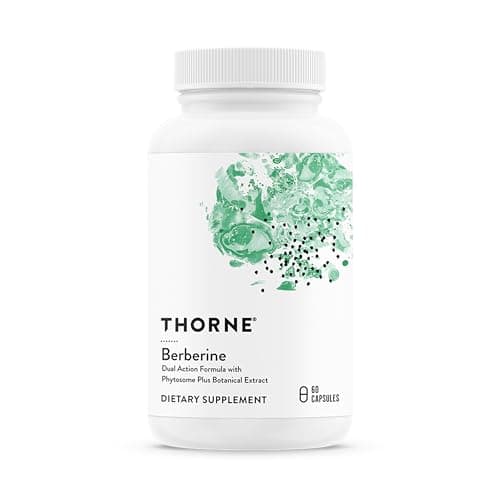
Thorne — Berberine — Dual Action Phytosome Formula (30 servings)
Berberine phytosome plus botanical extract, capsule, 30 servings, gluten-free
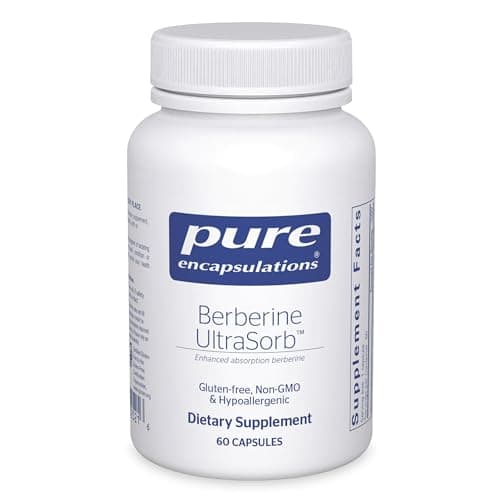
Pure Encapsulations — Berberine UltraSorb — Phytosome 550 mg (60 capsules)
At a glance
Tap a row to check price · tap a header to sort| # | Best for | Price | ||
|---|---|---|---|---|
| 1 | 1. Thorne — Berberine — Dual Action Phytosome Formula (30 servings)Best overall | Best overall | 8.4/10 | |
| 2 | 2. Pure Encapsulations — Berberine UltraSorb — Phytosome 550 mg (60 capsules)Best clean label | Best clean label | 8.2/10 | |
| 3 | 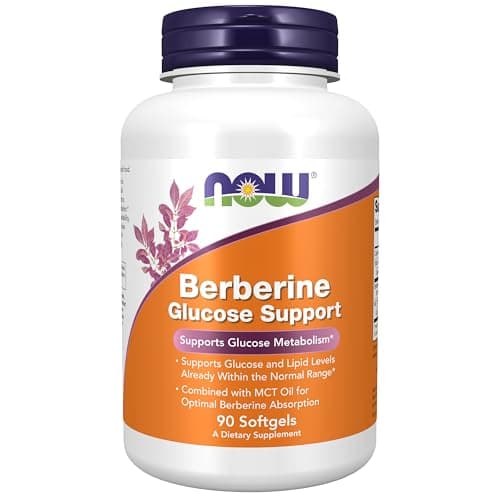 3. NOW Foods — Berberine Glucose Support with MCT Oil (90 softgels)Best value from a QC-serious brand | Best value from a QC-serious brand | 7.9/10 | $19.99$39.9950% offCheck Price for NOW Foods Berberine Glucose Support with MCT Oil (90 softgels) on AmazonIn Stock |
| 4 | 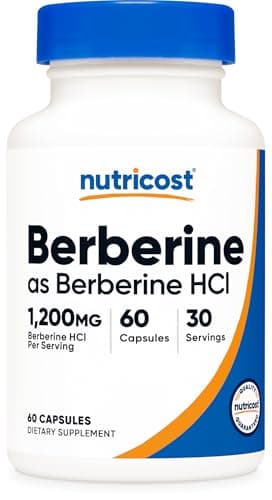 4. Nutricost — Berberine HCl 1200 mg (60 vegetarian capsules)Best single-ingredient value | Best single-ingredient value | 7.7/10 | |
| 5 | 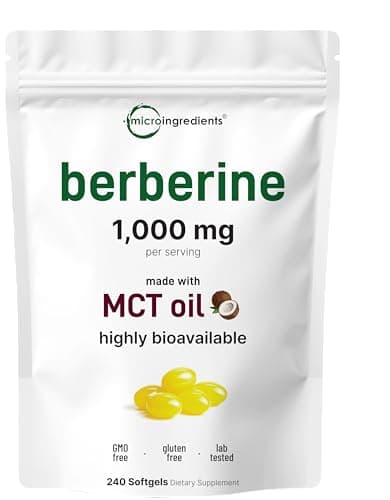 5. Micro Ingredients — Berberine 1000 mg with MCT Oil (240 softgels)Best bulk value | Best bulk value | 7.4/10 | $23.99$29.9920% offCheck Price for Micro Ingredients Berberine 1000 mg with MCT Oil (240 softgels) on AmazonIn Stock |
| 6 | 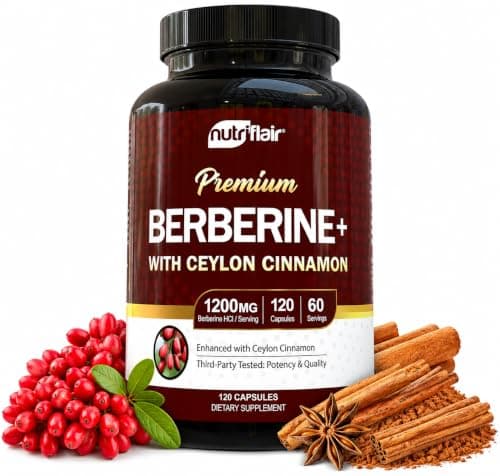 6. NutriFlair — Berberine HCl 1200 mg plus Ceylon Cinnamon (120 capsules)Popular bestseller | Popular bestseller | 6.4/10 | |
| 7 | 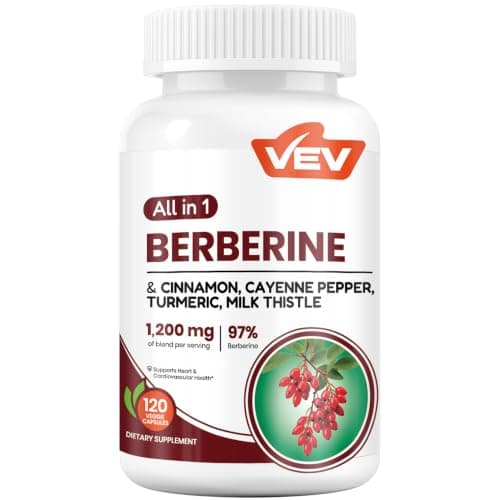 7. VEV — Berberine with Cinnamon, Cayenne, Turmeric & Milk Thistle (120 capsules)The kitchen-sink blend our rubric is designed to catch | The kitchen-sink blend our rubric is designed to catch | 4.6/10 | $9.49$12.9927% offCheck Price for VEV Berberine with Cinnamon, Cayenne, Turmeric & Milk Thistle (120 capsules) on AmazonIn Stock |
Prices pulled from Amazon as of October 18, 2026 and are subject to change. The price shown on Amazon at checkout applies.
How we scored
Every product below is scored on six metrics, 0-10 each, with the weighting described on how we review. The criteria specific to this category:
- Dose inside the evidence-supported range — the 2024 meta-analysis pins the effective range at 0.9–1.5 g/day, usually split as ~500 mg with meals, so we score for products that let you hit that without guesswork.
- Absorption-enhanced form scored above plain powder — plain berberine's oral bioavailability is under 1%, so phytosome, liposomal, or MCT/lipid delivery earns real points because it addresses the category's actual bottleneck.
- Single-ingredient labels over kitchen-sink blends — a bottle that buries berberine among cinnamon, turmeric, cayenne, and milk thistle is selling a story, not a measurable dose.
- Third-party testing stated by the brand — berberine is an unregulated botanical extract, so an independent identity-and-contents check is the only real accountability.
- Clean, honest labeling — no 'AMPK activator' hype stickers standing in for an actual amount, and no proprietary blends hiding how much berberine you're really getting.
- Cost per evidence-based daily dose rather than headline price per bottle — a cheap bottle you'd have to take six capsules of is not cheap.
What to know before buying
- Berberine is not 'nature's Ozempic,' and the mechanism is why. Semaglutide (Ozempic) is a GLP-1 receptor agonist; berberine works mainly by activating AMPK, a cellular energy sensor that nudges glucose out of the blood through an insulin-independent pathway. Those are different biological levers. The viral comparison oversells the effect and misdescribes how it works — NCCIH notes that while some preliminary studies suggest berberine may play a role in weight, "there isn't enough rigorous scientific evidence to determine whether it is effective." Buy it for its measured effect on blood sugar and lipids, not for a prescription-drug outcome it does not deliver.
- The effect on blood sugar is real but modest, and biggest as an add-on. In the 2024 meta-analysis of 50 trials, berberine on its own lowered fasting glucose by roughly 0.59 mmol/L and cut LDL, total cholesterol, and triglycerides by about 0.30–0.35 mmol/L each; its effect on HbA1c on its own did not reach significance. Paired with standard glucose-lowering medication, the numbers got larger — HbA1c fell by 0.69%. Read that honestly: it is a useful nudge on metabolic markers, not a replacement for medication or for the diet and training that move those numbers most.
- Absorption is the whole ballgame, so read the form before the milligrams. A review of berberine's pharmacokinetics puts its oral bioavailability under 1% — extensive first-pass metabolism in the gut and liver degrades most of a dose before it reaches circulation. That is why a 1,200 mg plain-HCl capsule and a 550 mg phytosome capsule are not the mismatch they look like: the phytosome (berberine bound to phosphatidylcholine), liposomal, and lipid/MCT-paired forms are engineered specifically to get more of the dose past that bottleneck. A big number on a poorly-absorbed powder is not the same as a delivered dose.
- Take it with meals, in divided doses — that is how the trials did it. Berberine has a short half-life, and the studied protocol is typically ~500 mg taken two to three times a day with food, which also blunts the post-meal glucose spike the supplement is best at flattening and tends to reduce stomach upset. A single once-a-day megadose is neither how the evidence was generated nor easy on your gut.
- GI side effects are common, especially early. NCCIH lists abdominal pain, constipation, diarrhea, nausea, and vomiting as reported side effects; they cluster at higher doses and in the first weeks. Starting at one 500 mg dose with a meal and building up is the standard way to stay ahead of them.
- This is a real drug-interaction risk, not a token disclaimer. Berberine inhibits the CYP3A4 and CYP2D6 liver enzymes that clear a long list of medications, so it can raise blood levels of drugs like certain statins, cyclosporine, and others, and it can stack with diabetes or blood-pressure medication to push glucose or pressure too low. If you take prescription medication — especially for blood sugar, cholesterol, or the heart — clear berberine with your doctor or pharmacist first.
- Some people should not take it at all. NCCIH states that people who are pregnant or breastfeeding should not use berberine, and that it should not be given to infants: berberine can cause or worsen jaundice in newborns and could lead to kernicterus, a rare but serious form of brain injury. This is a hard line, not a caution.
- It supplements a whole-food, lower-carb plate — it does not fix a processed-food diet. Berberine's best-documented job is flattening the glucose response to a meal. The most powerful lever on that same response is the meal itself: protein, fiber, and fewer refined carbs. Use berberine as a targeted add-on to that, the way our protein and keto-electrolyte roundups frame the base diet — not as permission to skip it.
Our picks
Thorne — Berberine — Dual Action Phytosome Formula (30 servings)
Key specs: Berberine phytosome plus botanical extract, capsule, 30 servings, gluten-free
Pros
- Phytosome delivery (berberine bound to phosphatidylcholine) targets the category's real problem — sub-1% bioavailability — instead of just printing a bigger milligram number
- Thorne is one of the most rigorously third-party-tested brands in supplements, which is the accountability berberine's unregulated-botanical status otherwise lacks
- Clean capsule from a brand known for minimal excipients and published testing
Cons
- The 'dual action' formula pairs the phytosome with a botanical extract, so it is not strictly single-ingredient
- Premium price per serving, and a 30-serving bottle is a short run at a twice-daily dose
Thorne — Berberine — Dual Action Phytosome Formula (30 servings)
- Third-party testing9/10
- Bioavailability9/10
- Clinical evidence7/10
- Value5/10
- Brand transparency8/10
- Form & absorption7/10
Pure Encapsulations — Berberine UltraSorb — Phytosome 550 mg (60 capsules)
Key specs: Berberine phytosome 550 mg, single ingredient, capsule, 60 capsules, hypoallergenic
Pros
- Single-active phytosome: enhanced absorption with nothing else riding along, which is exactly what the rubric rewards
- Pure Encapsulations is built around short, hypoallergenic ingredient lists and independent testing — the cleanest label of the group
- 550 mg of an absorption-enhanced form is a more meaningful dose than its number suggests next to plain-HCl bottles
Cons
- The most expensive option here by a clear margin
- 60 capsules means restocking often if you run a twice-daily protocol
Pure Encapsulations — Berberine UltraSorb — Phytosome 550 mg (60 capsules)
- Third-party testing8/10
- Bioavailability9/10
- Clinical evidence8/10
- Value4/10
- Brand transparency9/10
- Form & absorption9/10
NOW Foods — Berberine Glucose Support with MCT Oil (90 softgels)
Key specs: Berberine with MCT oil for absorption, softgel, 90 softgels
Pros
- MCT-oil delivery gives the dose a lipid vehicle to improve uptake, a sensible middle ground between plain powder and premium phytosome
- NOW is one of the few mass-market brands that runs its own analytical lab, so the label carries real in-house QC
- Strong price for 90 softgels — the value pick that doesn't cut the testing corner
Cons
- MCT pairing is less clinically established for absorption than a phytosome complex
- Softgels can't be split to fine-tune the dose the way a plain capsule can
NOW Foods — Berberine Glucose Support with MCT Oil (90 softgels)
- Third-party testing8/10
- Bioavailability7/10
- Clinical evidence8/10
- Value9/10
- Brand transparency8/10
- Form & absorption7/10
Nutricost — Berberine HCl 1200 mg (60 vegetarian capsules)
Key specs: Berberine HCl 1200 mg per serving, single ingredient, vegetarian capsule, gluten-free, non-GMO, 60 capsules
Pros
- 1,200 mg per serving lands squarely in the 0.9–1.5 g/day range the trials used, with nothing else in the capsule to dilute it
- Single-ingredient label from a brand that manufactures in a GMP facility and sells at a fair price
- Plain capsule you can split across meals to run the divided-dose protocol properly
Cons
- Plain berberine HCl with no absorption enhancement — the honest weak point of any straight-powder product in this category
- Third-party testing is less publicly documented than Thorne's or Pure Encapsulations'
Nutricost — Berberine HCl 1200 mg (60 vegetarian capsules)
- Third-party testing7/10
- Bioavailability6/10
- Clinical evidence9/10
- Value8/10
- Brand transparency8/10
- Form & absorption8/10
Micro Ingredients — Berberine 1000 mg with MCT Oil (240 softgels)
Key specs: Berberine 1000 mg with MCT oil, sourced from Berberis aristata, softgel, non-GMO, gluten-free, no soy, 240 softgels
Pros
- 240 softgels is by far the cheapest way to run a sustained daily dose without reordering constantly
- MCT-oil pairing gives the powder a lipid vehicle, and the source plant (Berberis aristata) is stated on the label
- 1,000 mg servings keep you inside the studied range
Cons
- House-brand supply chain with less published analytical detail than the premium picks
- MCT delivery is a modest absorption aid, not the phytosome-grade fix
Micro Ingredients — Berberine 1000 mg with MCT Oil (240 softgels)
- Third-party testing6/10
- Bioavailability7/10
- Clinical evidence8/10
- Value9/10
- Brand transparency7/10
- Form & absorption7/10
NutriFlair — Berberine HCl 1200 mg plus Ceylon Cinnamon (120 capsules)
Key specs: Berberine HCl 1200 mg with Ceylon cinnamon, capsule, made in USA, 120 capsules
Pros
- A 1,200 mg berberine dose that stays inside the evidence-supported range
- Large 120-count bottle at a mainstream price, which is why it sells well
Cons
- The Ceylon-cinnamon add-in is marketing more than mechanism — it dilutes the clean-single-ingredient case without a matching evidence base
- Plain berberine HCl with no absorption enhancement, and no independent testing highlighted on the listing
NutriFlair — Berberine HCl 1200 mg plus Ceylon Cinnamon (120 capsules)
- Third-party testing5/10
- Bioavailability6/10
- Clinical evidence7/10
- Value7/10
- Brand transparency6/10
- Form & absorption6/10
VEV — Berberine with Cinnamon, Cayenne, Turmeric & Milk Thistle (120 capsules)
Key specs: Berberine plus Ceylon cinnamon, cayenne pepper, turmeric, and milk thistle, capsule, 120 capsules
Pros
- The cheapest bottle in the roundup
- Fine if you specifically wanted a low-dose multi-botanical, rather than a measurable berberine dose
Cons
- Five actives in one capsule means the berberine amount is squeezed — you cannot run the 0.9–1.5 g/day protocol the evidence is built on without swallowing a handful
- The extra botanicals are exactly the over-marketed 'metabolism blend' framing to be skeptical of — story on the label, not a dose you can trust
- No absorption enhancement and no third-party testing surfaced — the weakest accountability here
VEV — Berberine with Cinnamon, Cayenne, Turmeric & Milk Thistle (120 capsules)
- Third-party testing4/10
- Bioavailability5/10
- Clinical evidence3/10
- Value7/10
- Brand transparency3/10
- Form & absorption4/10
Frequently asked questions
For blood sugar and cholesterol, modestly yes. A 2024 systematic review in Frontiers in Pharmacology pooled 50 randomized controlled trials and 4,150 participants and found berberine lowered fasting glucose by about 0.59 mmol/L and post-meal glucose by 1.57 mmol/L, with small reductions in LDL, total cholesterol, and triglycerides; paired with standard glucose-lowering medication, HbA1c fell by 0.69%. The US National Center for Complementary and Integrative Health describes it the same measured way — a modest effect on blood glucose and cholesterol in people with type 2 diabetes. It is a real but modest metabolic nudge, not a dramatic one.
Related reading
Sources
- In the News: Berberine — National Center for Complementary and Integrative Health (NIH), 2023
- Effects of administering berberine alone or in combination on type 2 diabetes mellitus: a systematic review and meta-analysis (50 RCTs, 4,150 participants) — Frontiers in Pharmacology, 2024
- Glucose-lowering effect of berberine on type 2 diabetes: A systematic review and meta-analysis — Frontiers in Pharmacology, 2022
- Research progress on berberine with a special focus on its oral bioavailability — Journal of Translational Medicine / Fitoterapia review, 2016
Last verified: July 15, 2026. See our editorial policy and how we review for details on scoring and update cadence. Canonical URL: https://trustedhealthgear.com/reviews/best-berberine.
Thorne — Berberine — Dual Action Phytosome Formula (30 servings)
$44.00 · on Amazon